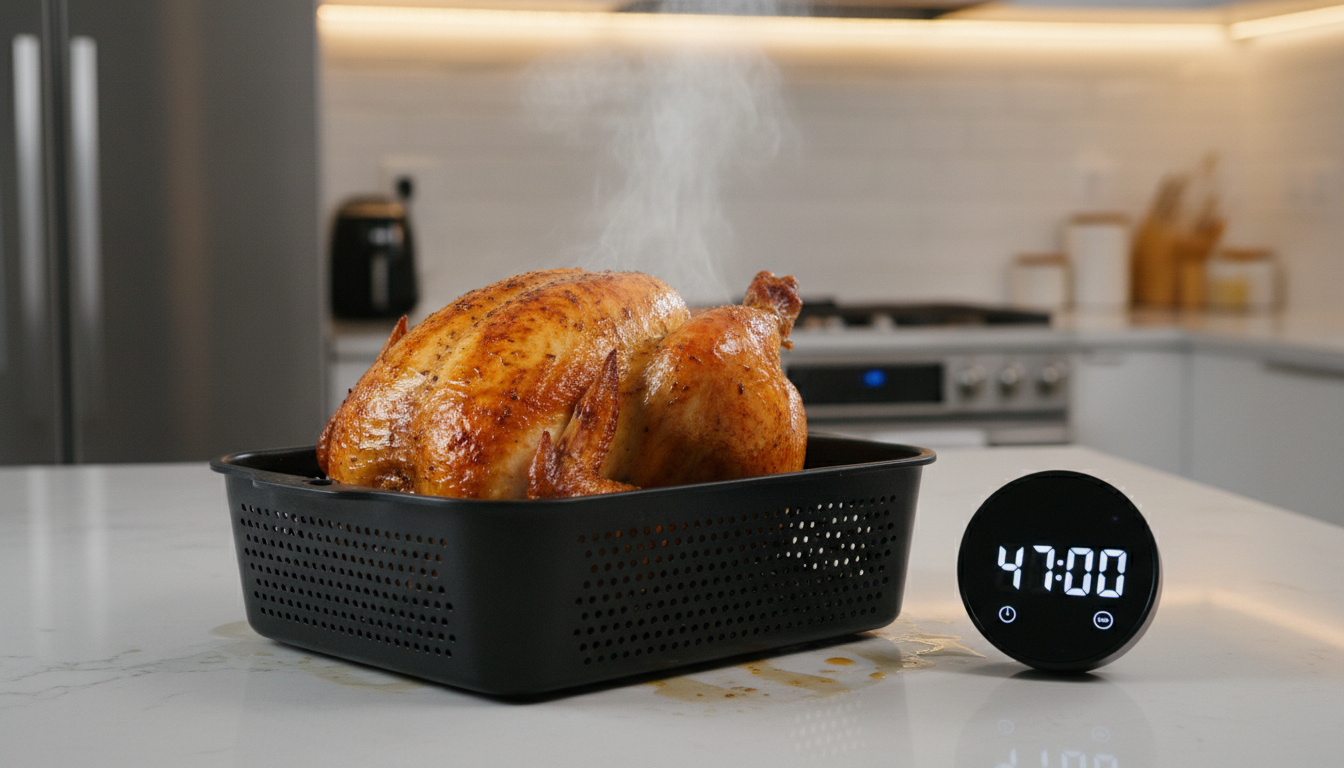

Roasting a 1.5 kg whole chicken in an air fryer transforms a traditionally hour-long oven process into a 50-minute weeknight solution. The rapid circulation of hot air renders subcutaneous fat while dehydrating the skin surface, creating a crackling exterior that rivals traditional roasting methods.
This specific weight—approximately 3.3 pounds—represents the practical upper limit for most consumer basket air fryers, feeding three to four adults comfortably. Success requires precise temperature management, strategic positioning, and verification through instant-read thermometry rather than visual estimation alone.
How Long and at What Temperature to Cook a 1.5 kg Chicken in an Air Fryer?
A 1.5 kg chicken requires 45 to 50 minutes total cooking time at 350°F to 360°F (175°C to 182°C), according to tested recipes from multiple culinary sources. Natasha’s Kitchen provides specific weight-based calculations showing this duration applies to birds between 3 and 3.5 pounds.
Key operational insights emerge from comparative testing across multiple appliance models:
- Air frying reduces total cooking duration by 30-40% compared to conventional oven roasting
- The 30-minute flip point remains constant regardless of minor weight variations
- Resting periods enable carryover cooking that raises internal temperature 5-10°F
- Appliance wattage variations create ±10 minute deviations from stated times
- Dry skin surfaces achieve crispiness through accelerated Maillard reactions
- 1.5kg represents the practical capacity limit for standard 5-6L baskets
| Parameter | Specification | Critical Notes |
|---|---|---|
| Chicken Weight | 1.5 kg (3.3 lbs) | Medium size; fits most 5L baskets |
| Total Duration | 45-50 minutes | Varies by model wattage |
| Cooking Temperature | 350-360°F (175-182°C) | Preheating essential |
| Flip Interval | 30 minutes | Breast-side down to up |
| Breast Target | 165°F (74°C) | USDA safety minimum |
| Thigh Target | 175°F (79°C) | Optimal tenderness |
| Rest Period | 5-20 minutes | Juice redistribution |
| Preheat Time | 5 minutes | Prevents sticking |
Do You Need to Preheat and Flip the Chicken?
Preheating and positioning protocols significantly impact final texture and safety. Nom Nom Paleo emphasizes that starting with a cold appliance increases sticking risk and extends cooking duration unpredictably.
The Preheating Protocol
Set the air fryer to 350-375°F (175-190°C) and run empty for five minutes. This creates an immediate sear when the chicken contacts the basket, preventing skin adhesion and initiating the Maillard reaction that produces golden crispness. Spray the hot basket lightly with oil immediately before adding the bird.
Strategic Flipping Technique
Position the chicken breast-side down for the initial 30 minutes. This protects the delicate white meat from direct heat exposure while allowing the back and thighs to crisp. After 30 minutes, use tongs to flip breast-side up, cooking an additional 15-20 minutes until the breast reaches 165°F and thighs hit 175°F.
Preheating your air fryer for exactly 5 minutes at the target temperature ensures the chicken skin begins crisping immediately upon contact, preventing adhesion to the basket and reducing total cooking time by approximately 3-5 minutes.
How to Check Doneness and Safe Internal Temperature
Visual cues alone prove insufficient for poultry safety. Downshiftology recommends instant-read thermometry as the only reliable verification method, particularly given the compact cooking chamber’s tendency to cook unevenly if the bird touches the basket sides.
USDA Temperature Standards
The USDA mandates a minimum internal temperature of 165°F (74°C) measured in the thickest part of the breast. Thigh meat requires 175°F (79°C) for optimal tenderness and safety. These temperatures eliminate Salmonella and Campylobacter pathogens. Carryover cooking during the resting phase typically raises internal temperatures an additional 5-10°F, so remove the chicken slightly before target if resting longer than 10 minutes.
Visual and Tactile Verification
Insert an instant-read thermometer into the breast thickest portion, avoiding bone contact which skews readings. Piercing the thigh near the joint provides secondary confirmation. Clear juices flowing from the thigh joint indicate doneness, though thermometry remains essential. The meat should feel firm with slight springback when pressed.
The Resting Phase
Transfer the cooked chicken to a cutting board immediately. Tent loosely with foil and rest 5-20 minutes. This pause allows muscle fibers to relax and reabsorb juices that would otherwise flood the cutting board. The internal temperature continues rising during this period, completing the cooking process without additional heat.
Preparation Tips, Seasoning, and Common Mistakes
Proper preparation determines the textural difference between rubbery and crisp skin. Spend with Pennies identifies inadequate drying as the primary cause of soggy results, while Little Spoon Farm recommends overnight uncovered refrigeration for maximum skin dehydration.
Essential Preparation Steps
Remove the chicken from packaging and pat every surface dry with paper towels. Moisture inhibits crisping and promotes steaming. Rub the skin with high-smoke-point oil such as avocado or light olive oil. Apply salt, garlic powder, and onion powder at minimum. For advanced preparation, leave the seasoned bird uncovered in the refrigerator for 24 hours to desiccate the skin surface. Tuck wing tips behind the back to prevent burning.
Frequent Errors to Avoid
Cooking from frozen state guarantees uneven cooking and food safety risks; always thaw completely in the refrigerator. Overcrowding the basket or allowing the chicken to touch the heating element in toaster oven models creates hot spots and burning. Skipping the flip results in a soggy back and overcooked breast. Neglecting the resting phase causes immediate juice loss upon slicing.
Never rely exclusively on stated cooking times. Air fryer wattage varies significantly between 1500W and 1800W models, potentially altering cooking duration by 10 minutes or more. Always verify internal temperature reaches 165°F (74°C) in the breast and 175°F (79°C) in the thigh using an instant-read thermometer.
Most basket air fryers accommodate whole chickens up to 4-5 lbs (1.8-2.3kg). Toaster oven variants may require selecting smaller birds or adjusting rack height to prevent contact with upper heating elements. Verify your specific model’s maximum capacity before purchasing poultry.
Step-by-Step Cooking Timeline
Executing the cook in distinct phases ensures consistent results. Jennifer Banz notes that higher temperature settings around 375°F (190°C) can reduce total time to 45 minutes, though monitoring becomes more critical.
- Preparation (10 minutes): Remove giblets, pat skin completely dry, apply oil and seasonings, tuck wing tips behind back.
- Preheating (5 minutes): Set air fryer to 350-360°F (175-182°C). Spray basket with high-heat oil.
- Initial Cook (30 minutes): Place chicken breast-side down. This protects white meat while crisping the back.
- Flip (1 minute): Using tongs and a spatula for stability, turn breast-side up.
- Final Cook (15-20 minutes): Continue until breast reaches 165°F (74°C) and thighs reach 175°F (79°C).
- Resting (10-20 minutes): Transfer to cutting board, tent loosely with foil, allow carryover cooking to complete.
Established Facts vs. Model Variables
Distinguishing between immutable safety standards and appliance-specific variations prevents both foodborne illness and disappointing texture.
Confirmed Standards
- USDA mandates 165°F (74°C) minimum internal temperature in breast tissue
- Thigh meat requires 175°F (79°C) for optimal tenderness
- Flipping at 30 minutes prevents breast meat desiccation
- Resting 5-20 minutes allows juice redistribution and carryover cooking
- Dry skin surfaces are prerequisite for crisping
Appliance Variables
- Wattage differences (1500W vs 1800W) alter cooking speed ±10 minutes
- Basket depth and airflow patterns affect browning uniformity
- Initial chicken temperature (refrigerated vs room temp) impacts start time
- Ambient kitchen humidity and altitude modify heat transfer
- Toaster oven vs basket style requires different positioning
The Science Behind Air Fryer Roasting
Air fryer technology relies on rapid air circulation rather than radiant heat transfer. A high-powered fan forces air through a heating element and around the food at velocities sufficient to create convective heat transfer rates significantly higher than conventional ovens. This accelerated energy transfer rapidly dehydrates the chicken skin surface, initiating the Maillard reaction at lower effective temperatures than traditional roasting requires.
The compact cooking chamber presents both advantages and constraints. Reduced volume means faster preheating and less energy waste, but requires strategic positioning to prevent airflow obstruction. Understanding these thermal dynamics proves as critical as knowing How Long Does It Take To Die From Sepsis – Early Action in medical contexts—both require precise timing and recognition of critical thresholds.
Expert Guidance and Citations
Culinary professionals and food safety experts emphasize instrument-based verification over visual cues.
Never rely on time alone. Always use a meat thermometer to check that the breast has reached 165°F and the thighs have hit 175°F. The difference between juicy and dry meat is often just 5 degrees.
— Nom Nom Paleo
Most basket air fryers can fit a whole chicken up to 4-5 pounds. If your chicken is touching the heating element or sides, you need a smaller bird or need to use a different cooking method.
— Natasha’s Kitchen
Summary
Cooking a 1.5 kg chicken in an air fryer requires 45 to 50 minutes at 350-360°F (175-182°C), with a mandatory flip at the 30-minute mark. Always verify internal temperatures reach 165°F (74°C) in the breast and 175°F (79°C) in the thighs using a meat thermometer, followed by a 10-20 minute rest. For additional health-related visual identification guidance, see How to Identify a Wart – Quick, Clear Expert Guide.
Frequently Asked Questions
Can I cook a stuffed chicken in an air fryer?
No. Stuffing blocks airflow and prevents the cavity from heating sufficiently to kill bacteria within the recommended timeframe. Cook stuffing separately in an oven-safe dish.
What if my air fryer basket is smaller than 5 liters?
Select a smaller chicken (1.2kg maximum) or use a toaster oven air fryer with adjustable racks. Never force a large bird against the heating element or walls.
Can I cook frozen chicken directly in the air fryer?
No. Always thaw completely in the refrigerator first. Frozen centers prevent even cooking and create food safety risks as exterior surfaces overcook while interiors remain raw.
Why is my chicken skin not crispy?
Excess moisture prevents crisping. Pat the chicken completely dry before oiling. Avoid overcrowding and ensure adequate airflow around all surfaces. Marinating uncovered overnight helps desiccate the skin.
How does altitude affect air fryer cooking time?
Higher altitudes may require slight time adjustments due to reduced air density affecting convection efficiency. Increase checking frequency by 5 minutes earlier per 1,000 feet above 3,000 feet elevation.
Can I cook two small chickens simultaneously?
Only if they fit without touching each other or the basket sides. Overcrowding blocks airflow and prevents crisping. If stacking is necessary, rotate positions midway through cooking.

Arthur Oliver Howard Fletcher is a staff writer for NationalReport.uk, covering UK national news, politics, the economy and public services. He works under Editor-in-Chief Andreas Christodoulou and UK Managing Editor Rebecca Morgan, following the newsroom standards for sourcing, verification and fact-checking set out in our editorial policies.