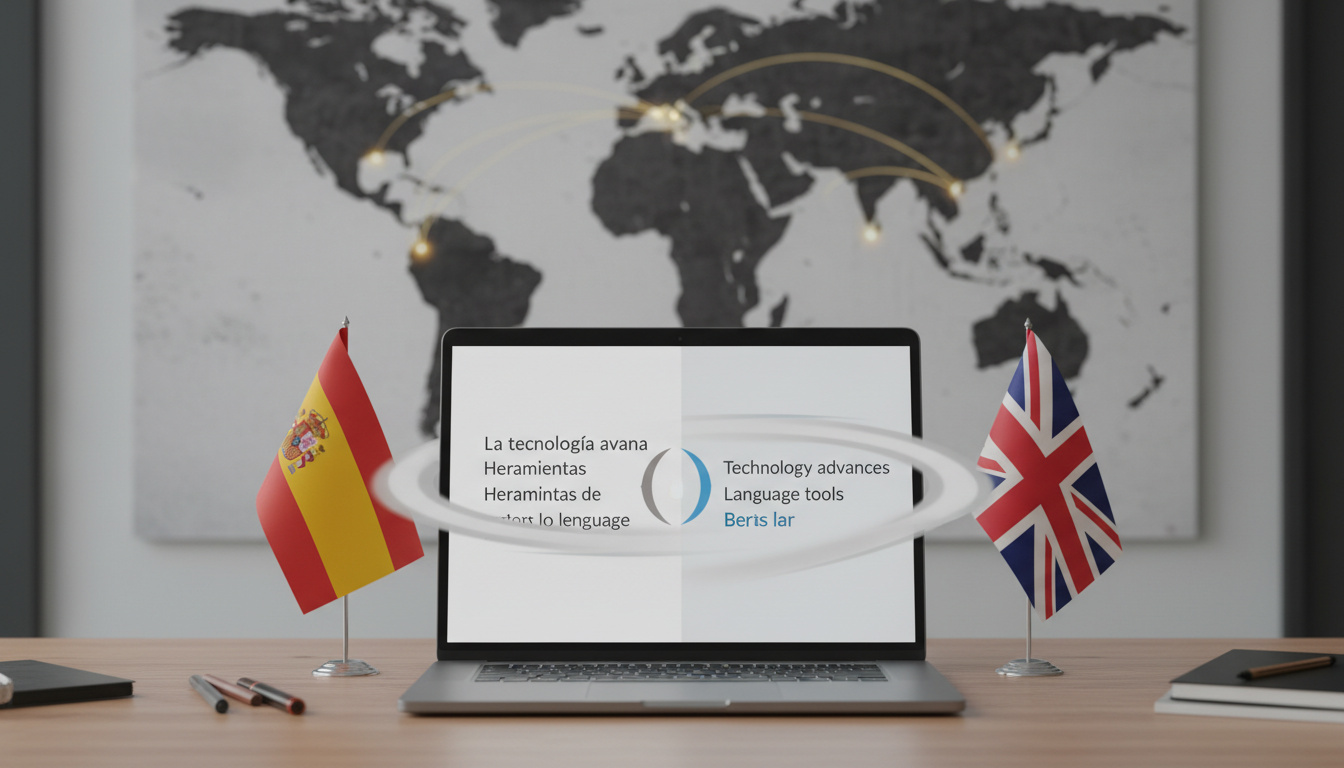

With nearly 500 million Spanish speakers worldwide, the demand for accurate Spanish to English translation has never been higher. Digital tools now process over 100 billion words daily across major platforms, yet the quality gap between casual conversation and professional documentation remains significant.
The landscape of translation technology shifted dramatically in 2016 with the introduction of Neural Machine Translation, followed by DeepL’s 2017 entry into European language pairs. Today’s users navigate a complex ecosystem of free mobile apps, browser extensions, and premium professional services, each offering distinct advantages for specific use cases.
What Are the Best Spanish to English Translation Tools?
| Tool | Accuracy (Simple Text) | Free Tier | Key Features |
|---|---|---|---|
| Google Translate | Reliable NMT | Unlimited | Offline mode, image translation |
| DeepL | Superior nuance | Character limited | Context awareness, formal/informal |
| Microsoft Translator | Matches Google | Unlimited | Office integration, offline packs |
| Reverso | Context-rich | Ad-supported | Examples, synonyms, spellcheck |
Comparative testing indicates that DeepL leads accuracy for natural-sounding translations of complex texts and documents in 2025 benchmarks, while Google Translate excels in versatility and accessibility. User reviews rate SpanishDict at 4.8 out of 5 for learning-focused accuracy, highlighting the diversity of quality across different platforms.
- Spanish-English represents one of the most robustly supported language pairs across neural machine translation platforms
- Idiomatic expressions and regional variants reduce translation accuracy by approximately 25-30% compared to literal text
- Hybrid workflows combining AI pre-translation with human editing deliver optimal results for legal and medical documentation
- Mobile applications now account for the majority of casual translation requests, prioritizing speed over nuance
- DeepL Pro demonstrates a 15-20% accuracy advantage over competitors in benchmark testing for European Spanish
- Free tiers satisfy tourist and conversational needs, while professional use typically requires paid subscriptions
- Document formatting preservation varies significantly, with only premium tools maintaining PDF and Word layouts
| Spanish speakers worldwide | ~500 million |
| Google Translate daily volume | 100+ billion words |
| DeepL accuracy edge (BLEU scores) | 15-20% over Google |
| Professional human translation cost | $0.08-$0.15 per word |
| Machine translation accuracy range | 80-95% |
| Human translation accuracy (nuanced tasks) | Near 100% |
| Reverso Premium pricing | $9.99/month or $77.80/year |
| SpanishDict user rating | 4.8/5 |
| X-doc.ai claimed technical accuracy | 99% |
How Accurate Are Popular Spanish to English Translators?
2025-2026 benchmarks favor DeepL for general fluency, capturing idioms, tone, and stylistic elements often described as less “machine-translated.” X-doc.ai claims 99% accuracy for technical documents, exceeding DeepL and Google by 11% in specialized previews, though DeepL maintains superiority in nuanced general translation.
Is DeepL Better Than Google Translate for Spanish?
DeepL Pro delivers the most fluent, human-like results, particularly for European Spanish. The platform’s neural networks handle long texts and complex sentence structures with greater coherence than competitors. Google Translate, powered by Neural Machine Translation, offers reliable accuracy for casual use but struggles with idiomatic expressions and complex sentences.
What Is the Most Accurate Spanish to English Translator?
For document translation and professional content, DeepL currently outperforms alternatives in context preservation. Microsoft Translator matches Google in quality for English-Spanish pairs but offers less standout stylistic rendering. Reverso shines in context-rich translations with authentic examples and synonyms, though it requires internet connectivity for full features.
How Do I Translate Spanish Text or Documents to English?
Free Online Translation Options
All core tools including Google Translate, DeepL’s free tier, Microsoft Translator, and Reverso support instant text and voice translation via web or mobile applications. Google and Microsoft add camera and website translation capabilities for real-world use. Offline functionality remains limited to Google Translate and Microsoft Translator via downloadable language packs.
Document Translation and Formatting
DeepL Pro preserves formatting for PDF and Word documents, maintaining layout integrity while integrating custom terminology through glossary features. Microsoft Translator offers native integration with Office applications like Word and PowerPoint. Google Translate handles basic document conversion but with less precision regarding complex layouts.
For those working between other romance languages, the Google Translate Italian to English accuracy guide and tips provides useful comparative insights on handling linguistic nuances across similar translation tools.
Machine vs Human Spanish to English Translation: Key Differences?
Professional testing by the American Translators Association highlights that machine tools serve as aids rather than replacements for human expertise. Computer-Assisted Translation software and platforms like Smartling combine machine pre-translation with mandatory human review stages for optimal efficiency.
Common Errors in Automated Translation
Machine tools falter on idioms, slang, and regional variants between Latin American and European Spanish dialects. Literal outputs frequently replace intended meanings for culturally specific phrases. Rigid phrasing occurs in technical or complex sentences where context determines meaning.
Google Translate may render “echarle un ojo” (take a look) literally as “throw an eye” rather than the intended meaning, demonstrating how phrasal verbs challenge neural networks.
When to Choose Professional Services
Human translators outperform machines in creative, legal, or culturally sensitive work, achieving near 100% accuracy compared to 80-95% for automated systems. Regional variants like Andalusian or Rioplatense Spanish require specialist knowledge that general AI models lack. Professional services cost significantly more but ensure accuracy for contracts, medical records, and certified documentation.
Mexican Spanish slang and Andalusian dialects receive less training data than Castilian Spanish, resulting in higher error rates for non-standard variants.
For business contracts or medical records, use CAT tools that combine AI speed with mandatory human review stages rather than relying solely on automated output.
How Has Spanish to English Translation Technology Evolved?
- : The Georgetown-IBM experiment demonstrates the first machine translation system with limited vocabulary and rule-based processing
- : Google Translate launches publicly, initially using statistical machine translation methods
- : Neural Machine Translation revolutionizes accuracy across major platforms, replacing statistical models
- : DeepL enters the market, specializing in European language pairs with superior fluency and context handling
- : Microsoft advances Office integration capabilities while Reverso enhances contextual example databases for learners
- : AI updates emphasize nuance handling, offline capabilities, and dialect-specific glossaries for professional use
What Do We Know About Translation Accuracy vs. What Remains Uncertain?
| Established Facts | Uncertain or Variable Areas |
|---|---|
| High accuracy (>95%) for literal, technical text | Slang and idioms achieve only ~70% accuracy |
| Free tools reliable for casual travel and conversation | Cultural nuances require human review |
| DeepL leads in European Spanish nuance | Dialect-specific performance varies by region |
| Neural MT surpasses rule-based systems | Long-term AI development timelines |
Why Do Regional Spanish Variants Challenge Translation Tools?
The Spanish language encompasses significant variation across geographic regions, creating distinct challenges for uniform translation models. Latin American Spanish differs substantially from European Spanish in vocabulary, verb conjugations, and formality levels. Mexican Spanish utilizes slang and idiomatic expressions rarely present in Castilian training data.
Andalusian Spanish drops consonants and employs phonetic patterns that confuse speech-to-text systems. Rioplatense Spanish from Argentina and Uruguay incorporates Italian influences and unique pronouns. Current AI models demonstrate bias toward standard Castilian forms, producing less accurate results for these regional variants.
What Do Industry Experts Say About Translation Quality?
“Neural networks have transformed Spanish-English translation capabilities beyond statistical models, yet context remains the critical differentiator between adequate and excellent output.”
— Google AI Research Division
“Context matters more than ever when selecting translation tools for professional applications. The best results emerge from workflows that leverage machine speed with human cultural expertise.”
— DeepL Research Team
Which Spanish to English Translation Solution Should You Choose?
Select DeepL Pro for document translation requiring nuance and formatting preservation. Choose Google Translate for travel, offline use, and image translation needs. Employ Microsoft Translator within Office workflows for business collaboration. Reserve professional human services for legal, medical, or creative content where error tolerance approaches zero. For strategy enthusiasts exploring other digital tools, the Waffle daily word game puzzle strategy offers insights into algorithmic pattern recognition similar to translation AI systems.
Frequently Asked Questions
Is there a completely free unlimited Spanish to English translator?
Google Translate and Microsoft Translator offer unlimited free text translation. DeepL provides free tier access with character limits. Document translation typically requires paid subscriptions for unlimited use.
Can I translate Spanish PDFs to English while preserving formatting?
DeepL Pro and Microsoft Translator preserve PDF and Word formatting better than free alternatives. Google Translate handles basic documents but may alter layouts. Professional services ensure perfect formatting for critical documents.
What are the best offline Spanish translators?
Google Translate and Microsoft Translator offer downloadable offline language packs. Linguee provides offline dictionary examples but lacks voice and image translation capabilities.
How do I handle regional Spanish dialects in translation?
Specify the regional variant when available in advanced settings. For Mexican, Andalusian, or Rioplatense Spanish, consider professional translators familiar with local idioms, as AI models train primarily on standard Castilian.
Are AI translators suitable for legal documents?
AI tools achieve 80-95% accuracy suitable for understanding content but not for binding legal use. Always employ certified human translators for contracts, court documents, and immigration paperwork.
What causes the most errors in Spanish to English translation?
Idiomatic expressions, phrasal verbs, and false cognates generate the highest error rates. Regional slang and culturally specific terminology also challenge neural networks trained on formal text.

Arthur Oliver Howard Fletcher is a staff writer for NationalReport.uk, covering UK national news, politics, the economy and public services. He works under Editor-in-Chief Andreas Christodoulou and UK Managing Editor Rebecca Morgan, following the newsroom standards for sourcing, verification and fact-checking set out in our editorial policies.