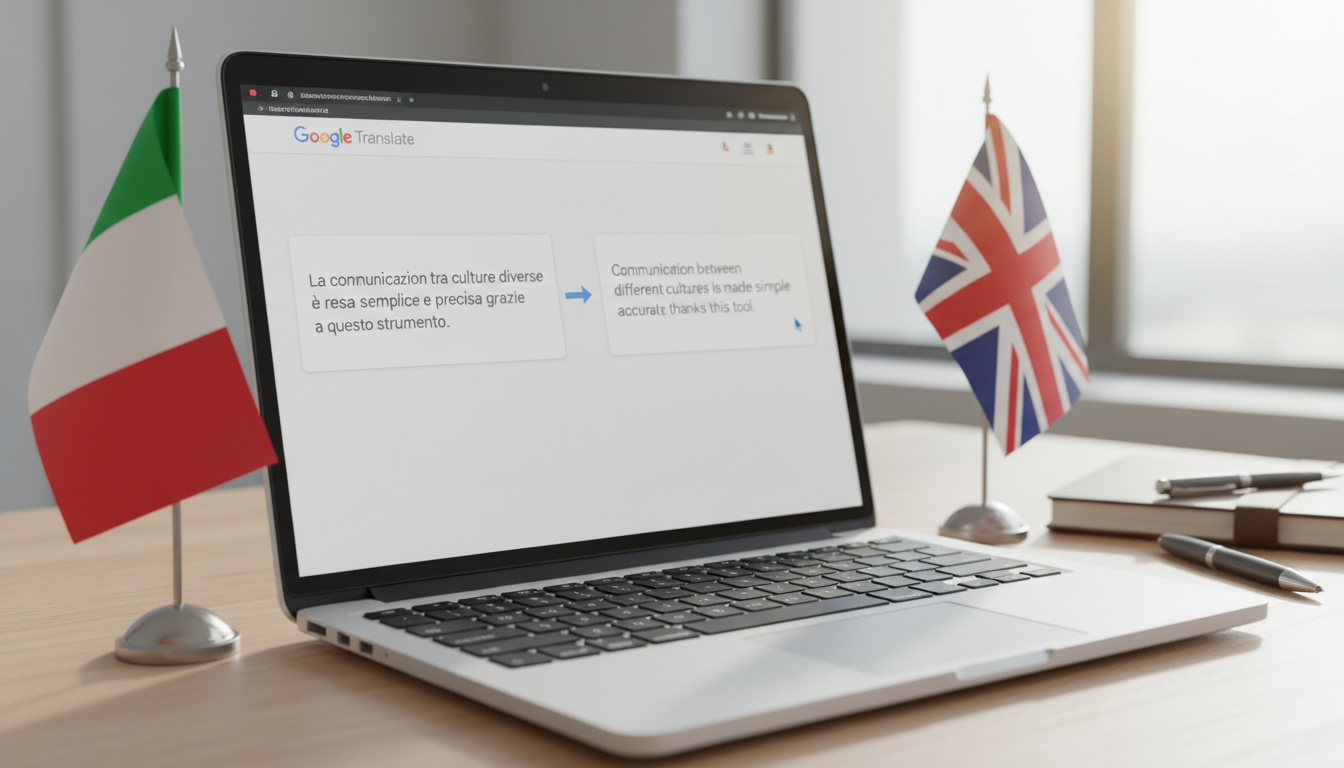

Google Translate processes billions of words daily between Italian and English, serving tourists navigating Roman menus, businesses drafting Milanese contracts, and students deciphering Dante. The service offers instant conversion across web browsers, mobile applications, and integrated browser extensions, positioning itself as the most accessible translation tool for this language pair.
Yet accessibility does not guarantee precision. Independent testing reveals significant variance in output quality depending on text complexity, regional dialect, and intended use case. While neural machine translation has narrowed the gap between artificial and human interpretation since 2016, Italian’s linguistic diversity—from standard Tuscan to Sicilian vernaculars—continues to challenge algorithmic consistency.
This examination assesses practical application methods, quantified accuracy benchmarks, and technological limitations based on current performance data and comparative studies against specialized alternatives.
How to Use Google Translate for Italian to English
Free tool available via browser or iOS/Android applications without registration.
NMT engine analyzes full-sentence context rather than word-by-word conversion.
Voice dictation, camera scanning, handwriting recognition, and document upload support.
Downloadable Italian language packs enable basic translation without internet connectivity.
- Instant translation available for text segments under 5,000 characters
- Camera mode overlays English text onto live Italian images in real time
- Conversation mode facilitates bilingual dialogue with automatic language detection
- Document preservation maintains basic formatting for .docx and .pdf conversions
- Chrome browser extension translates entire webpages while preserving layout
- Transcribe function converts live Italian speech to English text continuously
- Starred translations save frequently used phrases for offline reference
| Feature | Specification |
|---|---|
| Launch Year | 2006 |
| Neural Update | 2016 |
| Languages Supported | 130+ |
| Italian-English Accuracy Range | 80-95% (context-dependent) |
| Character Limit | 5,000 per translation |
| Document File Size Limit | 10 MB maximum |
| Offline Availability | Yes (limited features) |
| Mobile App Rating | 4.4/5 (iOS), 4.3/5 (Android) |
Is Google Translate Accurate for Italian to English?
Quantified Accuracy Benchmarks
Independent testing by Kylian AI reports Italian-to-English translation accuracy at 94.12%, equating to 0.59 mistakes per ten words. This positions Italian below Spanish (96.58%) and German (94.56%) in translation fidelity, though ahead of lower-resource languages. However, Smartling and Timekettle place the broader accuracy range between 80-90% for major European languages, while UCLA Medical Center studies indicate 82.5% meaning preservation across diverse language pairs.
Discrepancies between 80% and 94% accuracy figures reflect different testing methodologies. Higher percentages typically measure technical word-for-word correctness, while lower figures account for contextual nuance and natural phrasing essential for professional communication.
Readability vs. Technical Correctness
Despite high technical accuracy scores, Google Translate achieved the lowest readability rating (4.50/10) among tested languages in Kylian AI evaluations. The system produces grammatically correct English that often retains awkward Italian sentence structures, creating unnatural flow that native speakers immediately identify as machine-generated. Literary translations scored 96.35% accuracy while conversational phrases dropped to 72.29%, revealing significant performance gaps based on register.
Italian-to-English translations frequently generate technically accurate but stylistically stilted output. Business documents requiring professional tone or marketing materials relying on persuasive language require human post-editing to achieve publishable standards.
Context-Dependent Performance
iFLYTEK research confirms accuracy drops precipitously for complex compound structures and culturally specific references. The system handles straightforward declarative sentences reliably but struggles with subjunctive mood variations unique to Italian grammar. Regional expressions involving food culture, historical references, or family relationships often literalize incorrectly, stripping intended emotional resonance.
Reserve Google Translate for hotel bookings, restaurant inquiries, transportation logistics, and simple e-commerce transactions. Avoid using unedited output for legal contracts, medical instructions, literary publication, or high-stakes business negotiations.
Google Translate Features for Italian-English Translation
Offline Functionality Constraints
The mobile application supports downloadable Italian language packs enabling basic translation without cellular or Wi-Fi connectivity. Testing indicates offline mode performs adequately for simple noun phrases and present-tense statements but fails on complex verb conjugations, idioms, and context-dependent pronouns. Users must download packs before losing connectivity, with each language requiring approximately 35-50 MB storage space.
Voice and Image Recognition
Conversation mode facilitates real-time bilingual dialogue by automatically detecting language switches between speakers. Camera translation uses optical character recognition to overlay English text onto live Italian video feeds, effective for printed menus, signage, and documents with standard typography. Handwriting input accommodates non-keyboard characters or cursive script, though accuracy decreases with unconventional penmanship.
Document Processing Protocols
The document upload feature preserves basic formatting while translating .docx, .pdf, .pptx, and .xlsx files up to 10 MB. Users receive downloadable translated documents maintaining original layout structures, though complex tables and embedded images may require manual adjustment. This function processes standard Italian efficiently but struggles with scanned PDFs containing regional dialects or antiquated typography.
How Has Google Translate Improved for Italian English?
- : Initial launch utilizing statistical machine translation based on bilingual text corpora, producing rigid word-for-word conversions with frequent grammatical errors.
- : Neural Machine Translation (NMT) rollout reduces errors 55-85% for common language pairs by analyzing full-sentence context rather than phrase fragments.
- : Introduction of Transcribe mode enabling real-time continuous speech translation for live conversations and media content.
- : PaLM 2 integration begins enhancing contextual understanding for ambiguous terms and polysemous words common in Italian.
- : Gemini model capabilities expand multimodal translation features, improving image context recognition and cross-referencing visual elements with text.
What Google Translate Handles Well—and Where It Fails
| Established Reliability | Remaining Uncertainties |
|---|---|
| Simple present-tense statements | Regional dialects (Sicilian, Neapolitan, Venetian) |
| Technical business terminology | Legal contract language and liability clauses |
| Restaurant menus and ingredient lists | Idiomatic expressions and colloquialisms |
| Tourist accommodation and transportation | Poetic metaphor and literary devices |
| E-commerce product descriptions | Medical prescriptions and dosage instructions |
| Standard email correspondence | Historical texts with archaic vocabulary |
Why Italian Poses Unique Challenges for Machine Translation
Italy’s linguistic landscape extends far beyond standard Tuscan Italian. Regional dialects function as distinct languages with separate grammatical rules, vocabulary, and phonetic systems. Research demonstrates that Google’s training data heavily favors standard written Italian, leaving low-resource dialects severely underrepresented. Sicilian, Neapolitan, and Venetian inputs frequently produce gibberish or standard Italian approximations rather than accurate English equivalents.
Historical influences compound these challenges. Italian incorporates significant Arabic, Greek, Spanish, and French loanwords depending on geographic region. The language’s complex verb conjugation system—including remote past tenses and multiple subjunctive moods—lacks direct English equivalents, forcing algorithmic approximations that flatten temporal nuance. Cultural concepts embedded in food terminology, familial relationships, and artistic criticism resist literal translation, requiring contextual knowledge unavailable to current neural networks.
The What Is Good Friday – Significance And Global Traditions illustrates how cultural context shapes linguistic meaning across regions, a complexity machine systems struggle to replicate when handling Italy’s diverse cultural expressions.
Expert Assessments and User Experiences
Gets meaning across most times, but sometimes completely wrong.
— Rick Steves Travel Forum community feedback
Italian-to-English yields 94.12% accuracy, lower than English (97.18%), Spanish (96.58%), or German (94.56%), with readability challenges from awkward structure.
— Kylian AI Translation Accuracy Study
Not sufficient for professional/business use without human review.
Key Takeaways for Italian-English Translation
Google Translate serves effectively for travel logistics, casual communication, and preliminary document review, delivering 80-94% accuracy depending on text complexity. Users should verify critical translations with native speakers or professional services, particularly for legal, medical, or business content where nuance errors carry significant consequences. For recreational linguistic challenges similar to crossword puzzles, enthusiasts might enjoy the Waffle Daily Word Game – Clever Puzzle Strategy, though machine translation remains distinct from wordplay logic. DeepL presents a viable alternative for European language pairs requiring superior fluency, despite lacking Google’s offline capabilities.
Frequently Asked Questions
Is there a Google Translate app for Italian to English?
Yes, free applications for iOS and Android support comprehensive Italian-English translation. The apps include camera, voice, and offline modes, though offline functionality requires advance download of language packs.
How to translate a document from Italian to English with Google Translate?
Upload .docx, .pdf, .pptx, or .xlsx files up to 10 MB through the web interface or mobile app. The system preserves basic formatting while converting text, though complex layouts may require manual adjustment post-translation.
Can I use Google Translate offline for Italian-English?
Offline translation works for basic phrases and simple sentences after downloading the Italian language pack. Accuracy decreases significantly for complex grammar, idioms, and context-dependent meanings without server connectivity.
Does Google Translate handle Italian dialects?
No, the system performs poorly on regional dialects including Sicilian, Neapolitan, and Venetian. Training data focuses on standard Tuscan Italian, causing frequent errors or nonsensical outputs when processing regional speech patterns.
What are the best alternatives to Google Translate for Italian?
DeepL frequently outperforms Google Translate on Italian-English pairs regarding natural phrasing and nuance. Smartling AI Hub offers business solutions with human validation, while Timekettle devices provide specialized conversation hardware.
How accurate is Google Translate from Italian to English?
Accuracy ranges from 72% for conversational slang to 96% for literary text, with most technical assessments placing average performance between 80-94%. Readability scores remain lower than accuracy figures suggest due to unnatural sentence structures.

Arthur Oliver Howard Fletcher is a staff writer for NationalReport.uk, covering UK national news, politics, the economy and public services. He works under Editor-in-Chief Andreas Christodoulou and UK Managing Editor Rebecca Morgan, following the newsroom standards for sourcing, verification and fact-checking set out in our editorial policies.