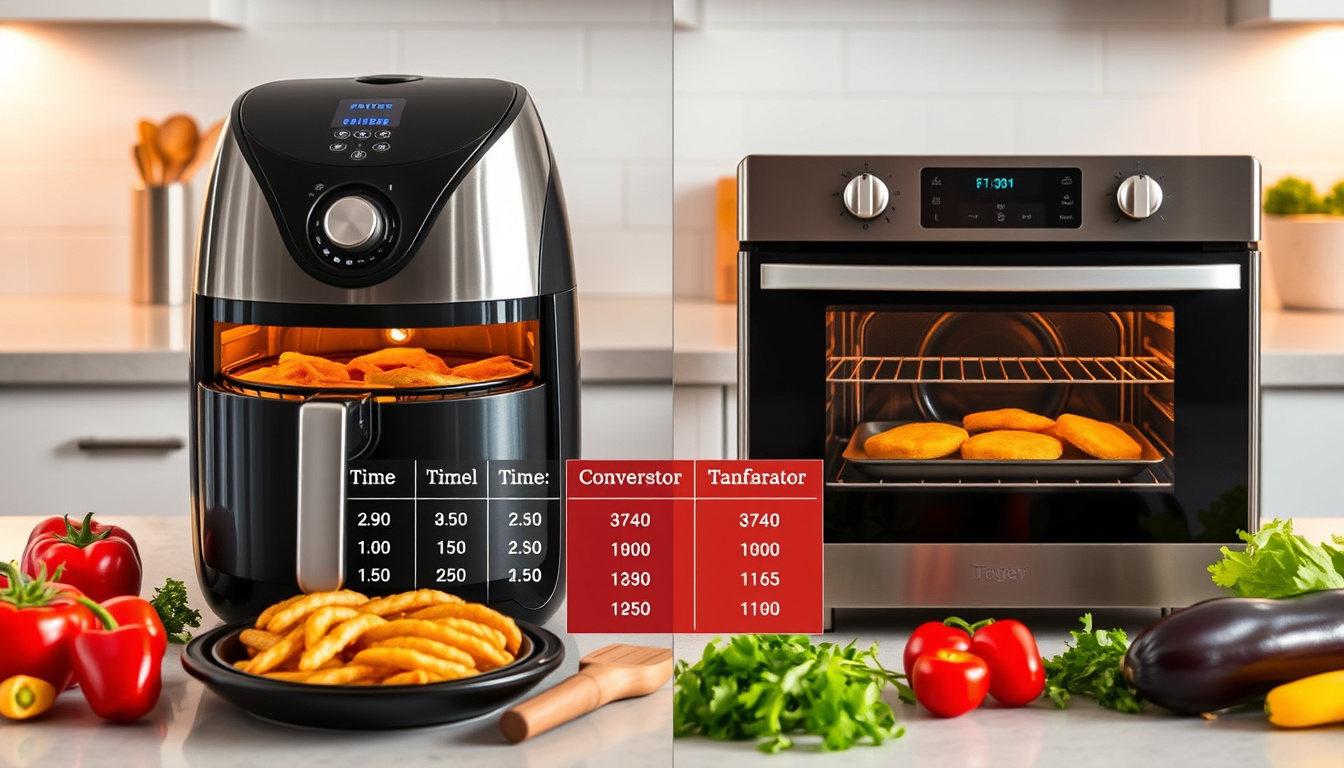
If you’ve ever pulled a favorite family recipe from the oven and wondered how to recreate it in an air fryer, you’re not alone. The good news is that the math is surprisingly straightforward, and for those watching their fat intake—whether managing diabetes, pancreatitis, or simply eating cleaner—air frying offers a meaningful advantage over traditional oven methods. This guide walks you through the exact temperature and time adjustments, points you to the most useful charts and calculators, and explains why less oil matters for your health goals.
Top converter tool: Neil’s Toolbox calculator · Key adjustment guide: Arla Foods oven chart · Recipe converter: AirFryerCalculator.com · Printable options: Pinterest charts · Brand-specific: Ninja Foodi charts
Quick snapshot
- Reduce oven temp by 25°F (Air Fryer Yum)
- Cut cooking time by 20% (Arla Foods UK)
- Shake or flip food midway (Air Fryer Chicken Guide)
- Exact health benefits vary by individual condition
- Brand-specific adjustments may differ from general rules
- Conversion charts proliferated online during the 2020s
- Arla UK and Savor + Savvy published detailed charts recently
- More brand-specific charts expected as air fryer adoption grows
- Health-focused printable resources likely to expand
The following table summarizes the key resources and conversion data from multiple verified sources.
| Resource | Details |
|---|---|
| Primary conversion tool | www.neilstoolbox.com/air-fryer-conversion/ |
| Oven chart source | www.arlafoods.co.uk/recipes/articles/air-fryer-conversion-chart/ |
| Calculator site | www.airfryercalculator.com/ |
| Printable ideas | www.pinterest.com/ideas/airfryer-conversion-chart/936440421514/ |
| Guide date | 15 Mar 2023 (drizzleanddip.com) |
| Temp reduction (°F) | 25°F |
| Temp reduction (°C) | 15-20°C |
| Time reduction | 20% |
| Chicken breast (4 oz) oven time | 14 min |
| Whole chicken (4 lbs) oven time | 66 min |
| Asparagus oven temp | 425°F |
How do you convert cooking time to air fryer?
The universal starting point for any oven-to-air-fryer conversion involves two numbers: temperature and time. Most recipe sites agree on the basic formula—reduce the oven temperature by roughly 25°F (or 15-20°C), then shorten the cooking time by about 20%. That 20% time reduction comes from the rapid air circulation inside an air fryer, which transfers heat to food far more efficiently than a conventional oven.
Temperature adjustments
When you drop something into a hot air fryer basket, the concentrated airflow means your food reaches its target temperature faster. According to Arla Foods UK (food brand with detailed conversion guidance), you typically need to reduce the recommended temperature by 15-20°C. The rule holds whether you’re working in Fahrenheit or Celsius—just pick the equivalent drop for your scale.
Time reduction rules
Cooking expert Jenny Tschiesche notes that air fryers promote even cooking through hot air circulation, reducing time by 20-25%. A practical example: an oven recipe calling for 180°C over 25 minutes converts to 160°C for 20 minutes in an air fryer—a 20% reduction in both temperature and time that preserves the original cooking outcome.
Food-specific conversions
The Love And Other Spices conversion calculator confirms the 25-30°F reduction rule (or 15-20°C). For example, an oven setting of 350°F (175°C) translates to 320-325°F (160-165°C) in an air fryer. Always check your specific model’s guidance, since some units run slightly hotter or cooler than average.
What is the best air fryer conversion chart?
The “best” chart depends on your needs: some cookers want Celsius values for UK recipes, others need brand-specific guidance for their Ninja or Cosori units. The market has responded with dozens of free printable options, ranging from quick-reference cards to comprehensive food-group breakdowns.
Top online calculators
For instant, math-free conversions, Neil’s Toolbox calculator handles both temperature scales and offers dropdowns for common food types. The AirFryerCalculator.com site provides similar functionality with a cleaner interface, making it easy to plug in your oven settings and get an air fryer recommendation in seconds.
Printable PDF options
Several recipe sites offer free printable sheets. Air Fryer Yum provides charts in both Fahrenheit and Celsius, designed to tape inside a cabinet door or stick to the fridge. Real Food with Sarah includes frozen food conversions that many other charts skip, useful for anyone regularly cooking pre-packaged items.
Ninja-specific charts
Ninja Foodi owners often find generic charts miss the mark for their multi-function cookers. Pinterest hosts numerous community-shared Ninja air fryer conversion charts, though these are user-generated rather than official brand resources. For brand-verified guidance, check Ninja’s own recipe database or support documentation.
Can diabetics use an air fryer?
Yes—and for diabetics managing blood sugar through diet, air frying offers a meaningful advantage over conventional oven or deep-frying methods. The core benefit isn’t about the air fryer itself but about what you’re NOT adding: oil.
Health benefits for diabetes
Air fryers require little to no oil, which directly supports low-fat eating goals critical for many diabetics. According to Air Fryer Yum (recipe site), air fryers use less oil, which may be beneficial for low-fat diets that help manage blood sugar levels. Reducing added fats means more predictable macro ratios in your meals—a practical advantage when counting carbs or monitoring glycemic load.
Foods to eat and avoid
While no specific diabetes or pancreatitis recipes appear in standard conversion charts, the Real Food with Sarah resource notes that oil reduction broadly aids low-fat dietary needs. For diabetics, lean proteins and vegetables convert particularly well in air fryers—chicken breast, fish fillets, asparagus, and Brussels sprouts all translate cleanly from oven to air fryer settings.
Comparison to traditional frying
Deep frying submerges food in oil, adding significant fat content. Air frying achieves similar crispness with a fraction of the oil—sometimes none at all. Savor + Savvy (recipe site) notes that air frying keeps lean meats moist due to circulation, avoiding the dryness that sometimes plagues oven cooking without added fats.
Is an air fryer good for pancreatitis?
For pancreatitis patients, dietary fat intake is a primary concern—the pancreas works harder to digest fats, and high-fat meals can trigger or worsen inflammation. Air fryers address this concern directly by cooking with minimal oil, though the benefits depend on food choices as much as the cooking method.
Best foods for pancreatic health
Lean proteins and low-fat vegetables are the cornerstone of pancreatitis-friendly diets. Savor + Savvy provides food-specific conversion data covering chicken breast, fish, and numerous vegetables—all of which convert cleanly to air fryer settings without requiring high-fat coatings or oils. Asparagus (oven 425°F/11 min becomes air fryer 400°F/9 min) and Brussels sprouts follow similar reduction patterns.
Worst foods to avoid
Fried foods, fatty cuts, and heavily breaded items are the primary culprits for pancreatitis flare-ups. Even in an air fryer, coating chicken in batter or cooking high-fat meats defeats the purpose. Stick to plain, lean preparations—skinless chicken breast, fish without heavy sauces, and roasted vegetables with a light spray of oil (or none at all).
Air fryer advantages
The rapid air circulation that makes air fryers efficient also means you don’t need oil to achieve crisp textures. A burger that would normally require frying in grease can air-fry with no added fat—Savor + Savvy shows a 4 oz burger converting from oven 395°F/17 min to air fryer 370°F/14 min, with no mention of oil required. This makes air fryers genuinely useful for pancreatitis management, not just a convenience tool.
What is the negative side effect of an air fryer?
Air fryers aren’t magic—even with the right conversions, things can go sideways. Understanding common pitfalls helps you avoid wasted ingredients and disappointing meals.
Potential health concerns
While air frying reduces oil consumption, some research suggests high-temperature air frying may produce acrylamide (a potential carcinogen) in starchy foods at higher levels than baking. However, Air Fryer Yum notes the overall health benefit of reduced oil outweighs these concerns for most users, particularly those transitioning from deep frying.
Common cooking issues
Dryness ranks among the most frequent complaints. Savor + Savvy recommends monitoring food on first attempts with unfamiliar recipes—dense items like whole chickens or thick pork chops can dry out if you rely solely on conversion math without checking internal temperatures. The rule of thumb: when in doubt, check early.
Mitigation tips
A light spritz of oil on lean meats prevents the cardboard texture some users report. For chicken breast, the conversion from oven 405°F/14 min to air fryer 380°F/11 min yields a tender result—but tossing the meat with a teaspoon of oil beforehand helps seal in moisture. Arla Foods UK advises adjusting based on air fryer model and food type, acknowledging that no single conversion works perfectly for every appliance.
Upsides
- 20% time reduction vs. oven cooking
- Little to no oil required
- Supports low-fat diets for diabetes and pancreatitis
- Compact, energy-efficient alternative
- Achieves crisp textures without deep frying
- Free charts and calculators widely available
Downsides
- Dryness risk with lean proteins
- Batch size limited by basket capacity
- Brand-specific variations require adjustments
- First attempts may need monitoring
- Acrylamide concerns at high temperatures
- Ninja-specific charts scarce
How to convert oven recipes to air fryer: Step by step
Three steps cover most oven-to-air-fryer conversions, whether you’re working from a handwritten family recipe or a mainstream cooking site.
- Find the original oven temperature. Check your recipe—most standard oven settings range from 325°F to 450°F. Subtract 25°F (or 15-20°C for Celsius) to get your air fryer target temperature.
- Calculate the new cooking time. Take the oven cook time and multiply by 0.8 to get approximately 20% less time. A 30-minute oven roast becomes roughly 24 minutes in the air fryer.
- Shake or flip at the halfway point. Air fryer cooking is more even than traditional oven baking, but dense foods benefit from a mid-cook flip or shake. Check for crispness 2-3 minutes before the calculated end time.
What this means: following these three steps gives you a reliable starting point, but always verify with a thermometer on dense proteins to ensure food safety.
For diabetics and pancreatitis patients, the 20% time reduction combined with zero added oil creates genuinely better meals—lower in fat without sacrificing the proteins and vegetables your dietary plan requires.
Recipe expert Jenny Tschiesche confirms that air fryers promote even cooking with hot air circulation, reducing time by 20-25%. That efficiency isn’t just convenient—it means less exposure to high heat overall, which some nutritionists consider an added benefit.
What sources say about conversion rules
“The general rule of thumb when converting oven recipes to Air fryer cooking is to reduce oven temperature by 25°F and then reduce the cook time by about 20%.”
— Air Fryer Yum (recipe site)
“Take 20°C off of the typical oven temperature. Reduce the typical oven time by 20-25%.”
— Jenny Tschiesche (cooking expert)
“Typically, you need to reduce the recommended temperature by 15-20°C when you use an air fryer.”
— Arla Foods UK (food brand with conversion guidance)
“The basic formula for converting a recipe from oven to air fryer is to reduce the cooking temperature by 25°F and the cooking time by 20%.”
— Savor + Savvy (recipe site with food-specific tables)
The convergence across these sources—independent recipe bloggers, cooking experts, established food brands, and calculator tools—suggests the 25°F/20% rule has become the de facto standard rather than any single authority’s recommendation.
Summary
For health-conscious cooks—whether managing diabetes, pancreatitis, or simply preferring lower-fat meals—air fryer conversion charts offer more than convenience. The consistent 20% time reduction and 25°F temperature drop, confirmed across multiple independent sources, gives you a reliable formula for adapting virtually any oven recipe. Free resources like Neil’s Toolbox calculator and printable charts from Air Fryer Yum and Real Food with Sarah make implementation frictionless. The trade-off is real but manageable: watch for dryness in lean proteins, expect minor batch-size limits, and always verify with a thermometer on thick cuts. For anyone willing to learn the formula, air frying becomes a genuinely healthier daily driver that helps you stay on track with dietary goals.
Related reading: How Long to Cook a 1.5 kg Chicken in Air Fryer
Home cooks adapting oven recipes often reference a printable oven to air fryer guide that recommends dropping temps by 25°F and times by 20% for optimal results.
Frequently asked questions
How much should I reduce oven temperature for air fryer?
Subtract 25°F (approximately 15-20°C) from any oven recipe. This accounts for the rapid air circulation in an air fryer, which transfers heat more efficiently than a conventional oven.
What is a typical time reduction for air frying?
Reduce cooking time by roughly 20%. Multiply the original oven time by 0.8 to get your air fryer estimate—for example, 25 minutes becomes 20 minutes.
Are Ninja air fryer charts different?
Ninja air fryers may run slightly hotter or cooler than average, requiring small adjustments. Community-shared charts on Pinterest offer Ninja-specific guidance, though official brand conversion resources are limited.
Does air frying use less oil than deep frying?
Yes. Air frying requires little to no oil, while deep frying submerges food entirely in hot oil. Even compared to oven baking, air fryers typically need less added fat to achieve similar crispness.
Can air fryers help with low-fat diets?
Absolutely. By eliminating the need for oil to achieve crispy textures, air fryers directly support low-fat eating goals—particularly beneficial for diabetics and pancreatitis patients who need to minimize dietary fat intake.
What foods cook best in air fryer?
Lean proteins (chicken breast, fish fillets), vegetables (asparagus, Brussels sprouts, potatoes), and small cuts of meat work best. Dense items like whole chickens require careful monitoring to avoid drying out.
How to avoid dry food in air fryer?
Lightly spritz lean proteins with oil before cooking, check temperatures early rather than relying solely on conversion math, and consider adding a tablespoon of broth or water to the basket for very lean cuts. Flipping or shaking midway also promotes even moisture distribution.

Arthur Oliver Howard Fletcher is a staff writer for NationalReport.uk, covering UK national news, politics, the economy and public services. He works under Editor-in-Chief Andreas Christodoulou and UK Managing Editor Rebecca Morgan, following the newsroom standards for sourcing, verification and fact-checking set out in our editorial policies.