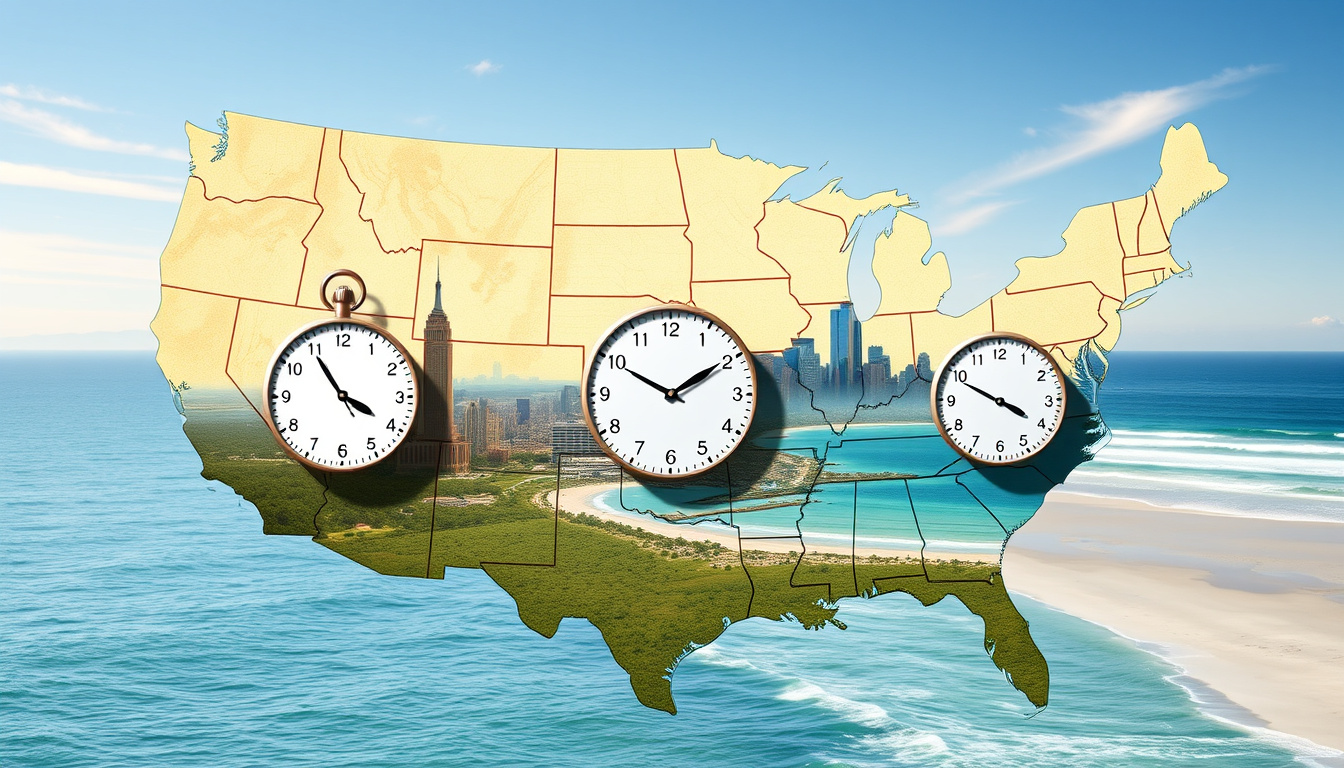

America stretches across so many time zones that even Americans sometimes lose track. This guide cuts through the confusion — giving you a state-by-state clock, the official reference point, and how US time stacks up against Ireland and Australia.
Main US Time Zones: 4 (Eastern, Central, Mountain, Pacific) · Current Reference (NY): Always same as New York (time.is) · Official Source: time.gov · North America Coverage: World Clock continent=namerica (timeanddate.com) · DST Impact: Clocks change (timeanddate.com)
Quick snapshot
- United States spans 9 standard time zones (Wikipedia)
- 4 main contiguous zones: Eastern UTC-05:00, Central UTC-06:00, Mountain UTC-07:00, Pacific UTC-08:00 (Time Zones Map)
- time.gov is the official US government time service (Time.gov)
- Exact local time requires live lookup — static articles go stale
- County-level zone splits within states like Kansas and Nebraska
- Post-2024 boundary changes on DOT official map
- DST starts for Eastern Time on March 8, 2026 (24TimeZones)
- Most US states shift clocks in spring and fall (24TimeZones)
- Use official time.gov for live US clocks
- Check state-specific zones for accuracy
- Account for DST transitions when planning calls
| Time Zone | Standard UTC Offset | DST Offset | Key States & Territories |
|---|---|---|---|
| Eastern | UTC-05:00 | UTC-04:00 | New York, Florida, Georgia, Massachusetts, Ohio, Pennsylvania |
| Central | UTC-06:00 | UTC-05:00 | Texas, Illinois, Missouri, Louisiana, Wisconsin |
| Mountain | UTC-07:00 | UTC-06:00 | Colorado, Utah, New Mexico, Wyoming (Arizona: no DST) |
| Pacific | UTC-08:00 | UTC-07:00 | California, Washington, Nevada, Oregon |
| Alaska | UTC-09:00 | UTC-08:00 | Most of Alaska |
| Hawaii-Aleutian | UTC-10:00 | No DST | Hawaii, parts of Aleutian Islands |
| Atlantic | UTC-04:00 | No DST | Puerto Rico, US Virgin Islands |
| Samoa | UTC-11:00 | No DST | American Samoa |
| Chamorro | UTC+10:00 | No DST | Guam, Northern Mariana Islands |
What time is it in America now, AM or PM?
America uses the 12-hour AM/PM clock format — morning runs from 12:00 AM to 11:59 AM, and afternoon starts at 12:00 PM and continues through 11:59 PM. The United States spans 9 standard time zones, which means when it’s morning on the East Coast, it can still be the middle of the night on the West Coast.
Current time across major zones
The main contiguous zones run from UTC-05:00 in the East to UTC-08:00 on the West Coast. New York (Eastern Time) is typically the reference point for international callers — Time.is shows the official New York time continuously. Meanwhile, Time.gov displays live clocks across all US zones, including UTC reference time.
When someone in the US says “call me at 9,” always confirm AM or PM — unlike much of Europe and Asia that use 24-hour format, Americans always specify morning or afternoon.
AM PM format explained
The 12-hour clock system splits the day into two identical 12-hour periods. At midnight, the day flips to 12:00 AM (ante meridiem, “before midday”), and noon marks 12:00 PM (post meridiem, “after midday”). This creates the common confusion: 12:00 AM is not morning — it’s the start of a new day, while 12:00 PM is midday.
For anyone scheduling international calls with the US, clarifying 9 AM Eastern vs 9 PM Pacific avoids a 12-hour error that could mean calling at midnight your time.
What time is it in key US states like Florida, California, New York, Texas?
Major US states don’t all share one clock. Each falls into one or more time zones, and a few have surprising exceptions that catch even Americans off guard.
Florida time
Most of Florida runs on Eastern Time (UTC-05:00 standard, UTC-04:00 during DST). However, the Florida Panhandle — including Pensacola and the westernmost counties — follows Central Time, creating a sharp three-hour difference within the same state (TimeTrex).
California time
California uses Pacific Time (UTC-08:00 standard, UTC-07:00 with DST). Los Angeles, San Francisco, and San Diego all share this zone, making California 3 hours behind Eastern Time during standard months.
New York time
New York runs on Eastern Time throughout the state, matching Connecticut, Pennsylvania, and the majority of the East Coast. The Wikipedia entry on US time zones lists 17 states plus DC under Eastern Time.
Texas time
Most of Texas operates on Central Time, covering Houston, Dallas, and San Antonio. But El Paso and the westernmost tip of Texas follow Mountain Time, meaning Texas actually straddles two zones (TimeTrex).
Is America 5 hours behind?
The short answer depends on which part of America you mean and which European reference point you use. Eastern Time sits at UTC-05:00 during standard months, which is 5 hours behind GMT. But this only holds when comparing Eastern Time to UK/Ireland time — Pacific Time is 8 hours behind GMT.
Behind UK/Europe context
The United Kingdom and Ireland use GMT (UTC+00:00) in winter and BST (UTC+01:00) in summer. From late October through late March, New York is exactly 5 hours behind London. During British Summer Time, the gap narrows to 4 hours because the UK shifts forward while the US remains on standard time.
Zone-specific offsets
If you’re comparing against UK time, here’s the breakdown: Eastern Time lags 5 hours behind GMT, Central Time lags 6 hours, Mountain Time lags 7 hours, and Pacific Time lags 8 hours. The US Naval Observatory confirms these are regulated by the Department of Transportation, ensuring consistent zone boundaries across all states.
“America is 5 hours behind” only applies to New York — not to Los Angeles, which is a full 8 hours behind GMT, or Chicago, which sits 6 hours behind.
International schedulers who assume a single US-to-UK offset risk calling the wrong hour for West Coast contacts.
Time difference with Ireland?
Ireland operates on WET/GMT in winter and IST (Irish Standard Time, UTC+01:00) in summer. The time difference between Ireland and the United States swings between 5 hours and 8 hours depending on the season and which US state you’re comparing.
Ireland vs New York
During winter months (late October through late March), Ireland is 5 hours ahead of New York. When Ireland switches to IST in late March, and the US shifts to DST on the second Sunday in March, the gap widens temporarily to 4 hours for about three weeks before the US catches up.
EST to Dublin conversion
New York Eastern Time (EST = UTC-05:00) means Dublin (GMT/UTC+00:00 in winter) is exactly 5 hours ahead. For summer calls during EDT (UTC-04:00), Ireland at IST (UTC+01:00) sits just 5 hours ahead as well — but because Ireland shifts earlier than the US, there’s a brief period when the gap is only 4 hours.
The third Sunday in March is the DST switchover date for the US — Ireland typically converts to summer time a week later. That one-week window is when the 4-hour gap appears, catching schedulers off guard.
Business callers who pre-check DST transition dates sidestep the one-week window when Ireland and New York sit just 4 hours apart.
What time is it in America and Australia?
Australia spans three time zones itself (AEST, ACST, AWST), so the US-Australia time difference varies dramatically depending on which cities you’re comparing. Sydney runs 15-16 hours ahead of Eastern Time, while Perth sits a full 12 hours ahead of Pacific Time — or behind, depending on your perspective.
Offsets explained
During Australian summer (December through February), Eastern Australia (Sydney, Melbourne, Brisbane) operates at AEDT (UTC+11:00), making it 16 hours ahead of New York EST. During US winter months, this shrinks to 15 hours because Australia doesn’t shift back as far. Perth operates at AWST (UTC+08:00) year-round, sitting 8 hours ahead of UTC.
Current comparison tool
For live comparisons, Timeanddate.com’s World Clock lets you enter any US city alongside Sydney, Melbourne, or Perth to see exact offsets at any moment. The Time.gov official clock provides the baseline US reference for all conversions.
Sydney is 15-16 hours ahead of New York, meaning your 9 AM call in New York is 10 PM or midnight in Sydney. Perth sits 12 hours ahead of Eastern Time — or, from the West Coast perspective, your Pacific Time call subtracts 8 hours to reach Perth.
Workers scheduling calls between New York and Sydney who forget the 15-16 hour gap risk reaching colleagues in the middle of their night.
US Time Zones Comparison Table
These comparisons show the practical spread across major regions — the gap between New York and Honolulu differs from the gap between New York and Los Angeles, and Arizona’s unique DST stance creates a further wrinkle.
| Comparison | Time Zone | UTC Offset | DST Active? | Example Cities |
|---|---|---|---|---|
| New York vs Los Angeles | Eastern vs Pacific | 3-hour difference | Yes (both shift) | New York, Los Angeles |
| New York vs Hawaii | Eastern vs Hawaii-Aleutian | 5-hour difference | Hawaii: No DST | New York, Honolulu |
| New York vs Alaska | Eastern vs Alaska | 4-hour difference | Yes (Alaska shifts) | New York, Anchorage |
| Arizona vs Navajo Nation | Mountain (both) | Same zone | Arizona: No DST / Navajo: Yes | Phoenix, Window Rock |
The pattern is clear: the US doesn’t run on one clock. From coast to coast, a single call must account for a 3-hour window minimum — and that’s before accounting for Arizona’s year-round Mountain Time or Hawaii’s refusal to shift for DST.
How to check the current time in America
Checking US time is straightforward when you know where to look. The key is using official or specialist sources that update in real time, not static references that go stale.
- Visit Time.gov for the official US government clock showing UTC and major zone times
- Check Time.is for a specific city like New York or Los Angeles with live updates
- Use Timeanddate.com’s World Clock to compare your local time against multiple US zones simultaneously
- For state-by-state specifics, consult the Wikipedia time zones article to verify which zone applies to your target city
- Account for DST if calling between early March and early November — most states shift forward one hour during this period
Relying on a single time zone (like always checking New York) works for East Coast references, but will consistently miscalculate calls to the West Coast by 3 hours if not adjusted manually.
Callers who bookmark time.gov get the authoritative baseline for any US zone conversion — no guessing required.
Confirmed facts vs common myths
Confirmed facts
- United States officially observes 9 time zones per Wikipedia
- 4 main contiguous zones are Eastern (UTC-05:00), Central (UTC-06:00), Mountain (UTC-07:00), Pacific (UTC-08:00)
- Arizona and Hawaii do not observe DST, confirmed by TimeTrex
- Time zone boundaries and DST rules are regulated by the Department of Transportation
- time.gov is the official US government time service
Common myths
- “The entire US is one time zone” — false, spans at least 4 major zones
- “California is always 3 hours behind New York” — true during standard months, but DST affects both equally
- “Arizona observes DST” — false for most of Arizona, true only for Navajo Nation
- “12:00 AM is afternoon” — false, 12:00 AM is midnight (start of day)
Readers who accept the 9-zone reality skip the confusion that trips up travelers assuming state borders align with time zone lines.
What experts and officials say
The United States spans 9 time zones, with 4 main time zones — Pacific, Mountain, Central, Eastern. In addition to Alaska, Hawaii, and 3 US dependencies.
— Daylight-Savings.com (Time Zone Reference Site)
Time zone boundaries and DST observance are regulated by the Department of Transportation. Hawaii and most of Arizona do not follow daylight saving time.
— Wikipedia (Encyclopedia Reference)
NIST provides the official US time zone map and live clocks through the US Naval Observatory, serving as the authoritative reference for all zone boundaries.
— US Naval Observatory (Official Government Time Service)
The implication: time zone accuracy in the US comes down to knowing which zone your specific city falls in — not assuming state boundaries match zone boundaries. The Department of Transportation sets the rules, but individual cities and counties follow their zone based on historical and practical decisions that don’t always follow the map you’d expect.
Related reading: US to UK sizes · What is half and half
In contrast to DST shifts in New York, Florida, California or Texas, Arizona follows a year-round MST policy that simplifies coordination across the Southwest.
Frequently asked questions
Is AM morning or night in America?
AM stands for “ante meridiem” (before midday), meaning it covers the hours from 12:00 AM (midnight) to 11:59 AM (late morning). PM stands for “post meridiem” (after midday), covering 12:00 PM (noon) to 11:59 PM (late night). So AM is the morning/night half depending on whether you count midnight as night or morning.
What time is it in the USA just now?
Check the official clock at Time.gov for live US time across all zones. For a specific city like New York, Time.is provides continuously updated local time.
North America time now?
North America spans 5 main time zones: Eastern (UTC-05:00), Central (UTC-06:00), Mountain (UTC-07:00), Pacific (UTC-08:00), and Alaska (UTC-09:00). The Timeanddate.com World Clock covers all North American zones with live updates.
When is 12:00 AM Tuesday?
12:00 AM Tuesday is exactly midnight at the transition from Monday to Tuesday. It’s the start of Tuesday and is written as 00:00 on the 24-hour clock. For US scheduling purposes, 12:00 AM is the earliest moment of any given day.
Does all of Arizona observe daylight saving time?
No — most of Arizona does not observe DST, staying on Mountain Standard Time (UTC-07:00) year-round. The exception is the Navajo Nation, which does observe DST and shifts to Mountain Daylight Time (UTC-06:00) during summer months.
Why does the US have so many time zones?
The US has 9 time zones because of its geographic size — spanning roughly 3,000 miles from coast to coast. Time zones follow roughly 15-degree increments of longitude, but zone boundaries are adjusted to follow state and county lines where practical, as regulated by the Department of Transportation.
When does DST start and end in the US?
In 2026, DST starts on March 8 (second Sunday in March) and ends on November 1 (first Sunday in November). Most states shift clocks forward one hour in spring and back one hour in fall, except Arizona, Hawaii, and US territories that don’t observe DST.

Arthur Oliver Howard Fletcher is a staff writer for NationalReport.uk, covering UK national news, politics, the economy and public services. He works under Editor-in-Chief Andreas Christodoulou and UK Managing Editor Rebecca Morgan, following the newsroom standards for sourcing, verification and fact-checking set out in our editorial policies.