
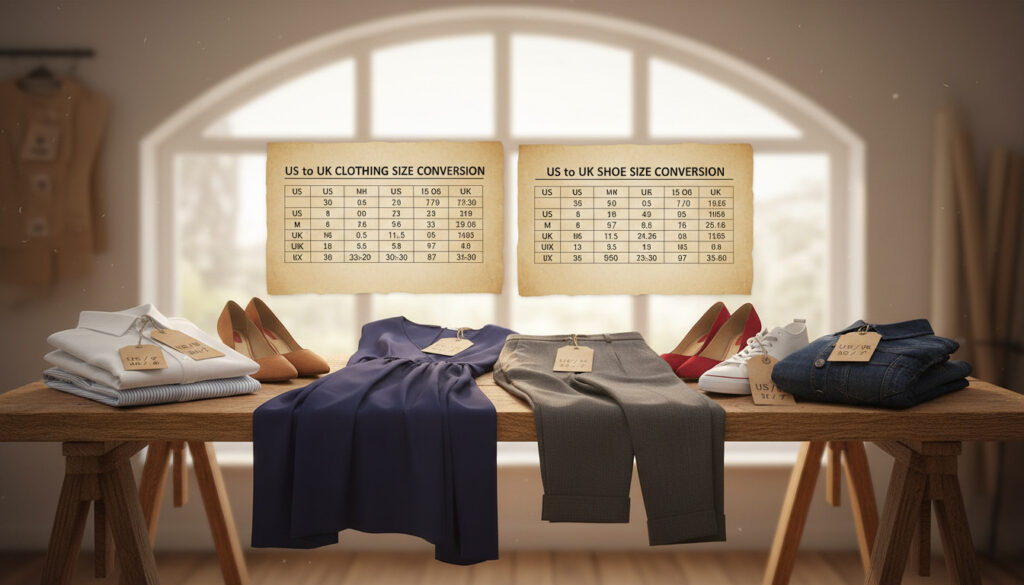
Converting US to UK sizes requires more than a simple number swap. Whether ordering from British retailers or packing for London, understanding the sizing gap prevents costly returns. Women’s clothing typically shifts by four digits—what reads as a US 8 translates to a UK 12—while men’s measurements align more closely across the Atlantic.
The divergence stems from distinct standardization histories and modern vanity sizing practices. UK sizes historically tracked closer to actual body measurements in inches, while US labels have inflated over decades to flatter customers. Shoes follow separate arithmetic entirely: women’s footwear requires adding two sizes to reach the US equivalent, while men’s adds only one.
Globalization has not harmonized these systems. Post-Brexit Britain retains EU-aligned numeric charts, while American brands continue varying their fits. This guide provides the precise conversions for clothing, shoes, and children’s wear, alongside the context explaining why identical measurements yield different labels.
US Clothing Sizes to UK: Complete Conversion Chart
Quick US-UK Clothing Converter
Women add 4 to reach UK size; men check chest measurements directly.
Shoe Size Snapshot
Women: UK size + 2 = US. Men: UK size + 1 = US.
Top Size Myths
Alpha sizes (XS-XXL) are not universal—measurements vary 1-2 inches between markets.
Brand Variance Alert
Fast fashion runs larger; luxury EU brands often fit smaller than labeled.
- Women’s numeric conversion: UK sizes run approximately four digits smaller than US (US 8 ≈ UK 12).
- Men’s chest alignment: UK and US sizes typically match or differ by only 0-1 size for upper body garments.
- Vanity sizing impact: US women’s labels often indicate smaller sizes than actual measurements to flatter customers.
- Alpha size discrepancies: While labels like XS or Medium appear consistent, underlying measurements differ by up to two inches.
- Children’s parallel tracking: Toddler and children’s sizes align closely between US and UK, using age and height references.
- Trouser complications: Waist and hip measurements vary significantly by brand, requiring specific chart consultation.
- Post-Brexit consistency: UK retained EU-aligned sizing charts with no mandated changes to conversion formulas as of 2025.
| Category | US Size | UK Equivalent | Key Measurements |
|---|---|---|---|
| Women’s Dress | 2 | 6 | Bust 31.5-33″, Waist 24-25.5″ |
| Women’s Dress | 4 | 8 | Bust 33-34.5″, Waist 25.5-27″ |
| Women’s Dress | 6 | 10 | Bust 34.5-36″, Waist 27-28.5″ |
| Women’s Dress | 8 | 12 | Bust 36-38″, Waist 28.5-30″ |
| Women’s Dress | 10 | 14 | Bust 38-40″, Waist 30-32″ |
| Women’s Dress | 12 | 16 | Bust 40-42″, Waist 32-34″ |
| Women’s Alpha | XS | 6-8 | Corresponds to US 2-4 range |
| Men’s Chest | 38-40″ | 38-40 | Direct alignment for Medium |
US Shoe Sizes to UK for Men and Women
Footwear conversion follows stricter arithmetic than apparel, yet precision remains essential. Women’s shoes require adding two full sizes to reach the US equivalent—a UK 5 becomes a US 7. Men’s conversion narrows to a single size difference, making a UK 9 correspond to a US 10.
Women’s Footwear Conversion
The two-size gap holds consistently across standard women’s footwear. A UK size 3 translates to a US 5, while a UK 8 reaches US 10. Foot length measurements provide the most reliable verification: a UK 5 typically accommodates a 9.25-inch foot, whereas the equivalent US 7 fits identical proportions. Retailer data confirms this pattern applies to heels, flats, and athletic shoes, though width variations persist by brand.
Men’s Footwear Conversion
Men’s sizing follows a simple incremental rule: add one to the UK size for the US equivalent. This creates a direct 38-40 UK to 39-41 EU correlation for medium builds, with chest measurements serving as the primary reference point. International sizing databases note that formal shoes often fit more narrowly than athletic trainers, requiring brand-specific consultation despite the numeric consistency.
Men’s US to UK Clothing Sizes
Men’s apparel presents fewer conversion challenges than women’s, primarily because both markets historically relied on objective chest and waist measurements rather than arbitrary numeric scales. A 40-inch chest typically reads as size 40 in both the US and UK, though trouser waistbands may vary by one to two inches depending on the manufacturer.
Upper Body Measurements
Chest circumference defines men’s sizing across both markets. Conversion specialists document that a 38-40 inch chest corresponds to Medium in both regions, while 42-44 inches marks the Large threshold. Alpha sizing—XXS through XXL—aligns closely, though European luxury brands often cut slimmer through the torso than their American counterparts.
Trousers and Lower Body
Waist measurements introduce uncertainty. While the numeric labeling often matches (a 32-inch waist reads as 32 in both markets), the actual fit varies by brand origin. UK trousers sometimes sit higher on the waist than US cuts, affecting the perceived size equivalence. Retail calculators recommend verifying hip measurements alongside waistbands, as the seat-to-waist ratio differs between British and American pattern-making traditions.
Are US and UK Sizes the Same? Key Differences Explained
The short answer is no—particularly for women’s clothing. The divergence extends beyond simple numeric shifts to fundamental philosophical differences in how garments are labeled and marketed. While UK sizes have remained relatively tethered to actual body dimensions, US sizing has drifted toward vanity labeling.
Contemporary US women’s labels often indicate sizes significantly smaller than the garment’s actual measurements. A modern “US 8” may fit like a historical US 12, whereas UK sizing adheres closer to literal inch measurements. This inflation stems from 1990s American retail trends designed to boost sales through flatter sizing.
Standardization Gaps
Neither market enforces binding sizing laws. The American Society for Testing and Materials (ASTM) and British Standards Institution (BSI) provide guidelines, but manufacturers retain flexibility. This creates the paradox where a customer might wear UK 12 in one brand and UK 14 in another despite identical body measurements. International label guides confirm that alpha sizes (XS-XXL) demonstrate the widest variance, sometimes differing by two full inches in chest or hip width.
ASOS, Nike, and luxury European houses each maintain proprietary fit standards. A Medium at a fast-fashion retailer may correspond to a Large at a luxury label. Always consult individual brand charts before purchasing—generic conversions provide starting points, not guarantees.
Record your current bust, waist, hip, and foot length in inches. Compare these against brand-specific charts rather than relying solely on size number conversions. This approach bypasses vanity sizing inconsistencies.
How US-UK Sizing Standards Evolved Over Time
- Pre-2000: UK and US sizing systems remained closely aligned, with both markets using similar inch-based measurements for women’s apparel.
- Post-WWII Standardization: Modern numeric charts emerged from reconstruction-era efforts to standardize garment production, establishing the UK numeric (4-26) and US numeric (0-24) scales.
- 1990s Vanity Sizing: American retailers began introducing smaller size labels for identical measurements to enhance customer satisfaction, widening the gap with UK standards.
- 2010s Globalization: Brand harmonization attempts failed due to divergent market preferences; EU cm-based sizing gained traction as a neutral reference.
- 2016-2025 Post-Brexit: Despite political separation from the EU, UK clothing and shoe sizing retained EU-aligned charts with no mandated conversion changes.
What is US Size to UK? Established Facts vs. Uncertainties
| Established Information | Information That Remains Unclear |
|---|---|
| Women’s clothing: UK size = US size minus 4 (e.g., US 8 = UK 12) | Exact trouser waist conversions vary by brand (0-2 size variance) |
| Men’s chest measurements align directly between US and UK | Future UK regulatory changes regarding sizing standards post-Brexit |
| Women’s shoes: UK + 2 = US size | Specific extent of vanity sizing across individual US retailers |
| Men’s shoes: UK + 1 = US size | Whether international standardization will occur in coming decades |
| Children’s sizes align by age/height across US and UK | Precise measurement differences for alpha sizes (XS-XXL) between markets |
Why Do US and UK Sizes Differ?
The divergence originates in measurement philosophy rather than mathematics. British sizing evolved from literal inch-based garment construction—if a garment measured 32 inches at the bust, it became a size 32. American standards shifted toward marketing psychology, where smaller numbers on labels correlated with higher purchase rates regardless of actual dimensions.
This split intensified during the 1990s when US retailers discovered that customers preferred buying garments labeled two sizes smaller than their objective measurements. UK and EU markets resisted this trend, maintaining truer dimensional standards. The resulting confusion means that converting US dress size 8 to UK 12 provides the mathematical equivalent, but not necessarily identical fit, given the inflationary pressure on American labels. Footwear specialists note similar discrepancies in shoe width markings.
Regional body demographics compound these differences. Average builds vary between markets, causing brands to grade their patterns differently for American versus British distribution. When combined with currency fluctuations affecting cross-border shopping, the sizing complexity adds friction to international retail. The sizing complexity is further compounded by regional body demographics, which can influence purchasing decisions, such as when looking for Набори чайників та тостерів в Ірландії.
Sizing Standards and Regulatory Background
No international body mandates clothing size uniformity. The ASTM International (formerly American Society for Testing and Materials) publishes voluntary standards for the US market, while the British Standards Institution (BSI) performs similar functions in the UK. Neither organization possesses enforcement power over private manufacturers.
Standards bodies like ASTM (US) and BS (UK) influence, but non-binding—leading to inconsistencies.
— International Textile Standards Review
The European Union’s centimeter-based sizing (EN 13402) offered potential harmonization, but post-Brexit analysis reveals the UK maintained these EU-aligned charts without adopting independent British standards. Children’s apparel faces slightly stricter scrutiny under UK trading standards regarding choking hazards and labeling, but size conversions remain unregulated.
Converting US to UK Sizes: Essential Takeaways
Successful conversion requires treating charts as starting points, not certainties. Women should subtract four from their US size to approximate UK equivalents, while men can transfer chest measurements directly with minimal adjustment. Footwear demands separate calculations: add two sizes for women’s shoes, one for men’s. Given persistent vanity sizing in American women’s wear and brand-specific variations in both markets, measuring your body in inches and comparing against retailer-specific charts remains the only reliable method. Major retailers provide detailed guides that supersede generic conversion tables.
Common Questions About US to UK Sizing
How do I accurately measure for US to UK conversion?
Measure bust, waist, and hips in inches using a fabric tape. Compare these numbers against the brand’s specific size chart rather than relying on generic conversions. Record foot length for shoes, as this provides more consistent results than size numbers.
Are UK sizes always smaller than US sizes?
For women’s clothing, yes—UK sizes run approximately four digits smaller. Men’s sizes are nearly identical or differ by only one size. However, vanity sizing in US women’s clothing means the actual garment may be larger than the number suggests.
What is US dress size 8 in UK?
US dress size 8 converts to UK size 12. This corresponds to a 36-38 inch bust and 28.5-30 inch waist according to standard measurement charts.
Do shoes convert using the same formula as clothing?
No. Women’s shoes require adding two sizes to the UK number to reach US sizing (UK 5 = US 7). Men’s shoes require adding only one size (UK 9 = US 10). These conversions differ from clothing formulas.
Why do I fit different sizes in different brands?
Brands use proprietary fit models and target different demographics. Fast fashion often runs larger, while luxury brands cut slimmer. Always check individual size charts, as alpha labels (XS-XXL) can vary by up to two inches between manufacturers.
Is EU sizing more reliable than US-UK conversion?
EU centimeter-based sizing often provides more consistent measurements because it references actual body dimensions rather than arbitrary numbers. Using EU sizes as an intermediary reference can help bridge US-UK conversions for international shoppers.
How do children’s sizes compare between US and UK?
Children’s sizes align closely by age and height. A UK 2-3 years typically corresponds to US 2T, while UK 7-8 years matches US 7-8. EU height measurements in centimeters provide the most consistent reference for children’s clothing.

Arthur Oliver Howard Fletcher is a staff writer for NationalReport.uk, covering UK national news, politics, the economy and public services. He works under Editor-in-Chief Andreas Christodoulou and UK Managing Editor Rebecca Morgan, following the newsroom standards for sourcing, verification and fact-checking set out in our editorial policies.