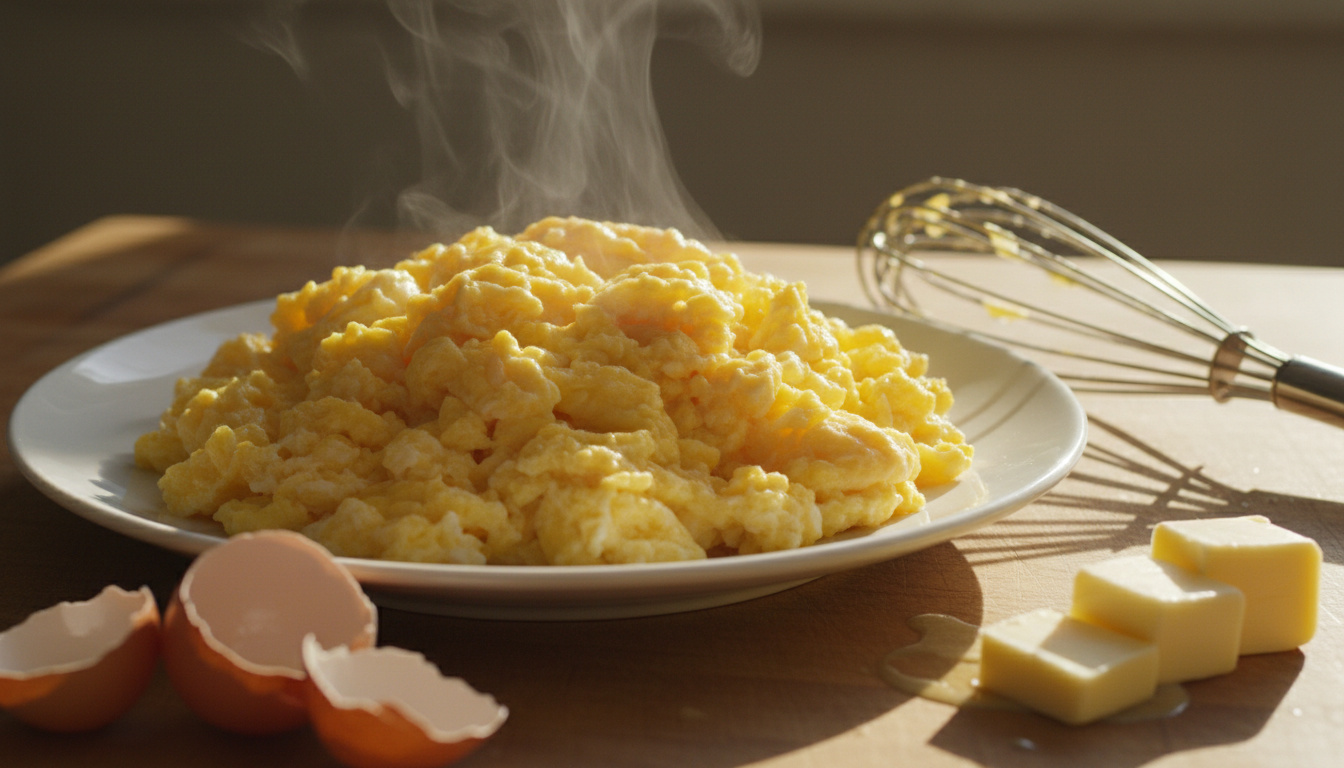
Scrambled eggs represent the ultimate test of kitchen timing. Mastering the technique yields clouds of custard-like curds that barely hold their shape, while rushed or overheated attempts produce rubbery disappointment.
The pursuit of perfection has driven chefs to develop specific protocols. Among the most celebrated methodologies, approaches eliminating common shortcuts—no pre-whisking, no milk dilution—focus on temperature control and constant movement.
This analysis examines evidence-based techniques for achieving fluffy, creamy results, including precise heat management, equipment selection, and critical timing windows.
How Do You Make Scrambled Eggs? Basic Recipe
Classic Stovetop
Cold eggs cracked directly into a buttered nonstick pan, stirred constantly over medium-high heat with intermittent cooling cycles.
Microwave Quick
Beaten eggs microwaved in 15-second bursts with butter, suitable for speed but lacking the silkiness of stovetop methods.
With Cheese
Grated cheddar or goat cheese folded in during the final 30 seconds for melty richness without added liquid.
Creamy Finish
Sour cream or crème fraîche stirred off-heat at the end creates luxurious texture without diluting during cooking.
- Start with cold eggs straight from refrigeration to prevent premature wateriness.
- Use butter rather than oil for proper emulsification and silkiness.
- Maintain medium-high heat rather than low temperature to build structure quickly.
- Stir constantly with a silicone spatula, scraping the bottom to prevent sticking.
- Remove the pan from heat periodically to prevent overcooking and rubberiness.
- Avoid adding salt until the final minute to prevent moisture loss.
- Skip milk or cream during cooking; add dairy only at the end if desired.
| Attribute | Specification |
|---|---|
| Serves | 3 persons (6 eggs) |
| Prep Time | 1 minute |
| Cook Time | 3 minutes |
| Total Time | 4-6 minutes |
| Calories | ~500-600 (per 6-egg serving) |
| Protein | ~36g |
| Key Ingredients | Cold fresh eggs, unsalted butter |
| Best Pan | Deep nonstick saucepan |
| Finish Options | Sour cream, chopped chives |
How Do You Make Scrambled Eggs Fluffy and Perfect?
What is the best way to make scrambled eggs?
Evidence points to the alternating heat method. Rather than maintaining constant low heat, which produces dense, sulfurous results, the optimal technique employs bursts of medium-high heat followed by brief off-heat stirring according to detailed culinary testing.
What’s the secret to good scrambled eggs?
Temperature modulation stands paramount. The eggs require enough heat to set protein structures rapidly into soft curds, yet residual cooking must finish gently off the burner to avoid toughness.
How does Gordon Ramsay make scrambled eggs?
Gordon Ramsay’s Scrambled Eggs technique specifically prohibits pre-whisking. Cold eggs crack directly into the pan with butter. The mixture cooks over medium-high heat while stirring continuously. After approximately 30 seconds, visible curds emerge. At this stage, the pan leaves the burner for 10 seconds while stirring continues, then returns for 30 seconds. This cycle repeats three to four times over roughly three minutes until the eggs appear slightly underdone and glossy.
Cold eggs and cold butter in the pan prevent the whites from cooking too quickly before the yolks emulsify. This combination creates the foundation for silky texture.
Using a rubber or silicone spatula to scrape the bottom constantly prevents sticking and encourages the formation of large, fluffy curds rather than fine, dense fragments.
Do You Add Milk to Scrambled Eggs? Variations and Options
Do you add milk to scrambled eggs?
Adding milk during cooking introduces water content that dilutes flavor and creates weeping liquid in the final dish. The proteins in milk can also toughen when heated alongside egg proteins, resulting in a less desirable texture.
How to make scrambled eggs without milk?
Creaminess emerges from fat and technique rather than liquid. Butter emulsifies with egg yolks during the stirring process. For enhanced richness, stir in one teaspoon to one tablespoon of sour cream, crème fraîche, or plain yogurt during the final minute off-heat as demonstrated in professional kitchen variations.
Scrambled eggs with cheese?
Grated cheddar, goat cheese, or cream cheese—approximately one to two ounces per six eggs—incorporates during the last 30 seconds of cooking. The residual heat melts the cheese into streaks without making the eggs watery.
Adding salt at the beginning draws moisture from the eggs through osmosis, resulting in watery eggs. Season only in the final minute of cooking or immediately before serving.
How Long to Cook Scrambled Eggs? Tips and Common Mistakes
How long to cook scrambled eggs?
The total active cooking period spans approximately three minutes for a six-egg batch. Smaller quantities of two to three eggs require roughly 2.5 minutes, while larger batches may extend slightly. The eggs should appear slightly wet when removed from heat; they continue cooking from residual warmth according to restaurant kitchen standards.
Best pan for scrambled eggs?
A deep nonstick saucepan or skillet between eight and ten inches accommodates six eggs without overcrowding. Cast iron works but requires vigilant scraping. Avoid thin pans that create hot spots leading to scorching.
Common mistakes when making scrambled eggs?
Overcooking produces rubbery textures, while insufficient stirring creates stuck-on patches and uneven curds. Starting with room-temperature eggs rather than cold ones accelerates cooking too quickly, reducing control. Pre-whisking in a bowl breaks down the proteins prematurely, resulting in flatter, denser curds rather than fluffy clouds.
What Is the Timeline for Making Scrambled Eggs?
- Preparation (0:00-0:30): Crack cold eggs directly into a cold nonstick pan with butter.
- Initial Heat (0:30-1:00): Place over medium-high heat; begin constant stirring with silicone spatula.
- First Curds (1:00-1:30): Remove from heat while continuing to stir for 10 seconds; return for 30 seconds.
- Cycling (1:30-2:30): Repeat the 10-second off/30-second on heat cycle three to four times.
- Finishing (2:30-3:00): Add salt, pepper, optional sour cream, and chives; stir off-heat.
- Serving (3:00-3:30): Plate immediately while slightly wet; garnish and serve.
What Do We Know for Certain About Scrambled Eggs?
| Established Facts | Uncertainties/Limitations |
|---|---|
| Ramsay’s stovetop method uses cold eggs and butter with on/off heat cycling for approximately 3 minutes. | Microwave-specific timings for achieving comparable creaminess lack authoritative source documentation. |
| Adding milk or cream during cooking creates wateriness; dairy should only be added at the end. | Vegan adaptations using tofu follow similar principles but lack specific citation in available research. |
| Constant stirring with silicone spatula prevents sticking and promotes large curds. | Exact calorie counts vary significantly based on butter quantity and optional additions. |
| Seasoning at the end prevents moisture loss during cooking. | Altitude adjustments for boiling points receive limited coverage in standard culinary sources. |
Where Did Scrambled Eggs Originate?
The preparation of beaten eggs cooked in butter traces back to Roman antiquity, appearing in Apicius’s fourth-century cookbook. The modern emphasis on ultra-creamy, custard-like textures gained prominence through contemporary chef methodologies, particularly techniques emphasizing emulsification and precise heat control.
What Do Sources Say About Perfect Scrambled Eggs?
The technique produces the fluffiest, creamiest scrambled eggs without milk or cream by cracking cold eggs directly into a nonstick pan with butter, stirring constantly on medium-high heat while alternating on and off the burner for about 3 minutes.
— Two Kooks in the Kitchen
Additional documentation from FDA guidelines emphasizes cooking eggs until both whites and yolks are firm to eliminate Salmonella risk, though the creamy method achieves this while maintaining moisture.
Nutritional analysis from Egg Info confirms eggs provide high-quality protein and choline, with preparation methods affecting final caloric density primarily through added fats. USDA food safety standards recommend immediate consumption after cooking to prevent bacterial growth.
What’s the Bottom Line on Making Scrambled Eggs?
Perfect scrambled eggs require no special ingredients beyond fresh eggs and butter. The critical factors include starting with cold eggs, using medium-high heat with intermittent cooling, stirring constantly with a silicone spatula, and seasoning at the end. Gordon Ramsay Scrambled Eggs (Foolproof) methodology demonstrates that technique outweighs complexity, producing restaurant-quality results in under five minutes.
Frequently Asked Questions
How to make scrambled eggs creamy?
Stir in sour cream, crème fraîche, or plain yogurt during the final minute off-heat. Avoid adding liquid during cooking.
Why do scrambled eggs turn rubbery?
Overcooking or excessive heat toughens proteins. Remove eggs from heat while slightly wet; residual heat completes cooking without rubberiness.
Can you make scrambled eggs in the microwave?
Yes, though results differ from stovetop methods. Beat eggs with butter in a microwave-safe bowl, cook on high in 15-second bursts, stirring between intervals, for 1-2 minutes total.
Do you need to whisk eggs before scrambling?
No. Cracking cold eggs directly into the pan preserves protein structure, creating larger, fluffier curds than pre-whisked eggs.
What is the best pan material for scrambled eggs?
Deep nonstick coatings provide the best results, though cast iron works with diligent scraping. Avoid thin metal pans that scorch.

Arthur Oliver Howard Fletcher is a staff writer for NationalReport.uk, covering UK national news, politics, the economy and public services. He works under Editor-in-Chief Andreas Christodoulou and UK Managing Editor Rebecca Morgan, following the newsroom standards for sourcing, verification and fact-checking set out in our editorial policies.