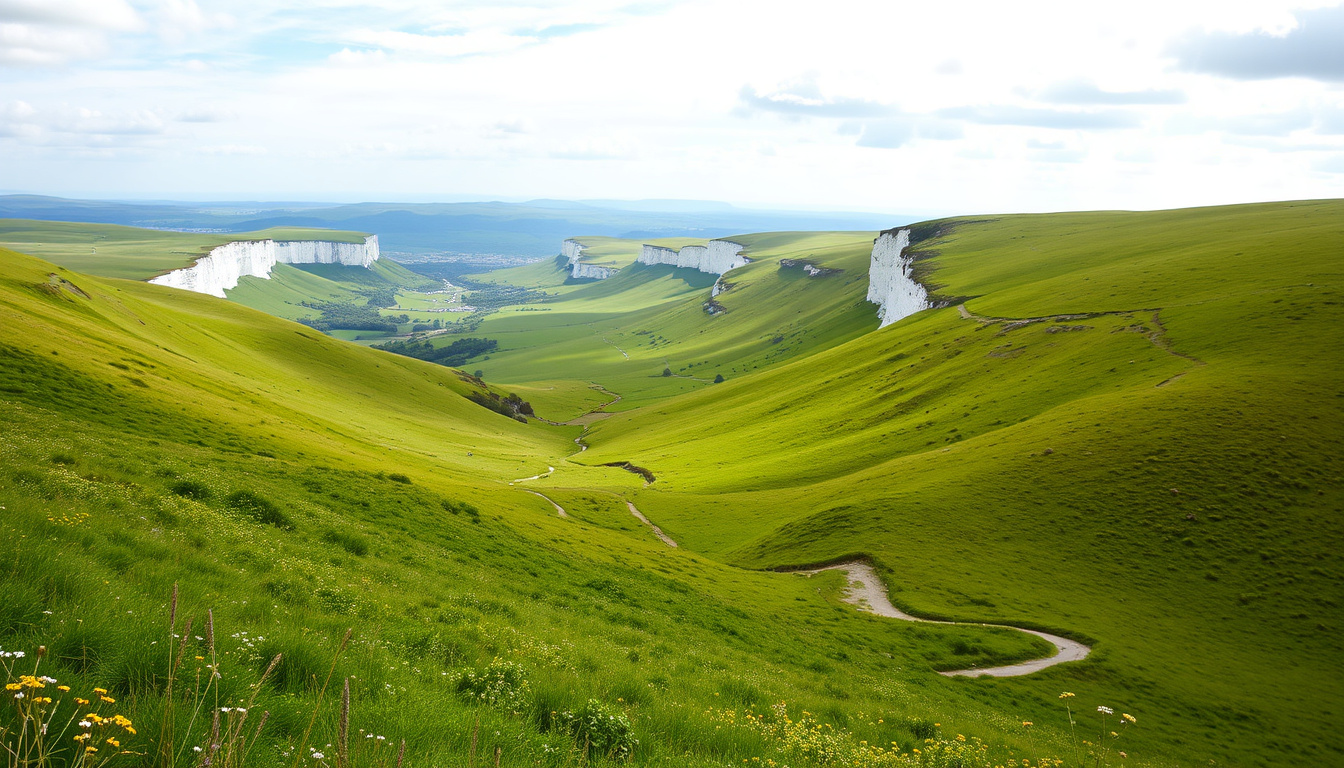
There’s a reason people keep returning to the South Downs – it’s England’s newest national park, and it packs a surprising amount into 1,627 square kilometres. From the iconic white cliffs of the Seven Sisters to its certified dark-sky reserves and flourishing vineyard scene, this protected landscape offers far more than just a good walk.
Designated: 31 March 2010 ·
Area: 1,627 sq km (628 sq mi) ·
Location: South East England (East Sussex, West Sussex, Hampshire) ·
Key feature: White cliffs of Seven Sisters ·
Status: England’s newest national park
Quick snapshot
- Designated 31 March 2010 – England’s newest national park (South Downs National Park Official)
- Home to the Seven Sisters white cliffs and Beachy Head (VisitBritain (UK tourism authority))
- International Dark Sky Reserve status (We Are Global Travellers (travel publication))
- Exact annual visitor numbers (estimated 39 million but not officially confirmed)
- Whether any proposed expansion will include new areas (speculation from local forums)
- Designated 31 March 2010 as England’s newest national park (Experience Sussex (regional tourism site))
- South Downs Way fully established as a National Trail by 2010 (Experience Sussex (regional tourism site))
- Continued conservation of rare chalk grassland habitat (South Downs National Park Official)
- Growing popularity of vineyard and brewery trails (South Downs National Park Official)
The key facts table below reveals a consistent pattern: the park is young, large, and defined by its dramatic coastline and chalk downland.
| Fact | Value |
|---|---|
| Designation year | 2010 |
| Area | 1,627 sq km |
| Length of South Downs Way | 100 miles (160 km) |
| Highest point | Blackdown (280 m) |
| White cliffs location | Seven Sisters, near Seaford and Eastbourne |
Is South Downs National Park worth visiting?
Reasons to visit: chalk grassland, dark skies, vineyards
The park’s claim to fame is its globally rare chalk grassland – a habitat that supports species like the Adonis blue butterfly and skylark (South Downs National Park Official (park authority)). It also holds an International Dark Sky Reserve, making it one of the best places in southern England for stargazing (We Are Global Travellers (travel publication)). And increasingly, the park’s vineyards and breweries – such as the Nyetimber estate – draw food-focused travellers.
Pros and cons: crowded trails vs. quiet areas
Popular sections like the Seven Sisters cliffs can feel busy on summer weekends, but the park is large enough that you can find solitude in the western woodlands or on the Devil’s Dyke ridge (TripAdvisor (user reviews)). Car parks at key viewpoints often fill by 10 a.m.
Who should visit and who might skip
If you want dramatic coastal walks, historic market towns, and a pint after a long day’s hike, the South Downs delivers. If you’re after remote wilderness or high-altitude scenery, it won’t match the Lake District or Snowdonia. The park’s charm is its gentle accessibility – Brighton and London are less than two hours away.
What is special about the South Downs National Park?
Globally important chalk grassland and rare species
- The chalk grassland is a rare habitat globally – 80% of it has been lost since the 1940s (South Downs National Park Official).
- Rare species include the Adonis blue butterfly and skylark (Experience Sussex (regional tourism site)).
The implication: visitors get a rare chance to experience a habitat that nearly vanished.
Dark sky reserves – minimal light pollution
The South Downs was designated an International Dark Sky Reserve in 2016 (We Are Global Travellers (travel publication)). It’s one of only 20 such reserves worldwide, and the easiest to reach from London.
Cultural heritage: ancient woodland, downland farming
Traditional downland farming – sheep grazing on open chalk hills – shaped the landscape for centuries. Ancient woodlands like the Mens survive in the western Weald (VisitBritain (UK tourism authority)).
Visitors get a rare chance to experience a habitat that nearly vanished. For conservationists, the park is a testing ground for restoration; for casual walkers, it means flower-filled hillsides that few other English landscapes can match.
Where are the White cliffs in South Downs National Park?
Location of the Seven Sisters Cliffs
The iconic white cliffs – the Seven Sisters – sit on the Sussex coast between Seaford and Eastbourne, within Seven Sisters Country Park (An Adventurous World (travel blog)). They are part of the Sussex Heritage Coast.
Viewpoints and walking routes to the cliffs
- Best viewed from the South Downs Way or from the beach at Cuckmere Haven (South Downs National Park Official).
- The cliffs rise to 162 metres at their tallest point.
Access from Brighton and Eastbourne
Brighton is about 20 minutes by train to Seaford, then a one-hour walk to the cliffs. Eastbourne has regular bus services to Beachy Head, the easternmost point of the park and the highest chalk sea cliff in Britain (VisitBritain (UK tourism authority)).
On sunny weekends, the Seven Sisters car park overflows by 9 a.m. and the cliff path gets busy. Go early, or take public transport – the views are still worth it, but solitude is unlikely.
Where to go in South Downs National Park?
Top attractions: Devil’s Dyke, Ditchling Beacon, Seven Sisters
- Devil’s Dyke – a dramatic dry valley with a famous panoramic view (Experience Sussex (regional tourism site)).
- Ditchling Beacon – the highest point of the South Downs Way (248 m) with views of the Weald (TripAdvisor (user reviews)).
- Seven Sisters Country Park – the classic cliff walk.
Best small towns: Arundel, Lewes, Midhurst
Lewes offers a Norman castle and independent shops (VisitBritain (UK tourism authority)). Arundel has Arundel Castle and a Gothic cathedral. Midhurst, the park’s unofficial gateway, sits at the foot of the downs (South Downs National Park Official).
Map and highlights for first-time visitors
A standard approach: follow the South Downs Way from West to East – or pick the eastern section (Amberley to Eastbourne) for the most dramatic scenery. The western section (Winchester to Amberley) is quieter and more pastoral.
What is the prettiest part of the South Downs Way?
The section between Amberley and Washington
This stretch offers panoramic views of the Weald and the South Downs rolling hills. At Amberley, you can visit the Wildfowl and Wetlands Trust centre before climbing onto the escarpment (An Adventurous World (travel blog)).
Views of the Weald and the sea from Beachy Head
Beachy Head, at 162 metres, is the highest chalk sea cliff in Britain (South Downs National Park Official). The view spans from the Seven Sisters to the English Channel.
The Seven Sisters to Eastbourne stretch
The route across the Seven Sisters is especially photogenic – undulating white cliffs that drop into the sea. It’s part of the South Downs Way and takes about three hours from Exceat to Eastbourne (VisitBritain (UK tourism authority)).
For pure wow factor, the Seven Sisters to Eastbourne stretch wins. For a quieter, classic downland ramble with sweeping inland views, take the Amberley–Washington section. Both are short enough for a day trip from London.
Upsides and downsides of visiting South Downs National Park
Upsides
- Free entry – no park tickets required (South Downs National Park Official)
- Excellent hiking on the South Downs Way (100 miles, multi-use trail) (South Downs National Park Official)
- Dark skies for stargazing (We Are Global Travellers)
- Vineyard and brewery tours add a foodie angle (Experience Sussex)
Downsides
- Popular trails can be crowded on weekends (TripAdvisor)
- Car parks fill early – limited public transport in rural areas
- No dramatic mountains – gentle hills only (VisitBritain)
- Accommodation inside the park is limited and often pricey
What’s confirmed vs unclear
Confirmed facts
- The park was designated on 31 March 2010 (South Downs National Park Official)
- Seven Sisters Cliffs are within the park boundary (VisitBritain)
- The South Downs Way is 100 miles long and multi-user (South Downs National Park Official)
What’s unclear
- Exact annual visitor count (estimated 39 million per year but not officially verified)
- Whether any proposed expansion will include new areas
- Whether the park will introduce parking charges for all visitors in the future
What visitors say about South Downs National Park
“A place of breathtaking beauty, where rolling chalk hills meet the sea.”
– South Downs National Park Authority (South Downs National Park Official)
“The gateway to England – the South Downs offers everything from ancient woodland to glorious coastline.”
– National Parks UK (VisitBritain)
“One of the best places I’ve ever walked – the views from the Seven Sisters are absolutely stunning.”
– TripAdvisor reviewer (TripAdvisor)
A common thread in visitor reviews is that the park’s beauty exceeds expectations, though crowding at peak times is a frequent note. Visit on a weekday or off-season for the best experience.
The South Downs National Park is not a remote wilderness – it’s a working landscape shaped by centuries of farming, now repurposed for recreation, conservation, and gastronomy. For the London-based traveller seeking a weekend escape that combines coastal drama, dark skies, and a decent glass of sparkling wine, the choice is clear: pack your boots and a reservation at a vineyard. The trade-off between convenience and scenery means that here, convenience nearly wins.
Related reading: Olympic Lagoon Resort Paphos · Mirabello Bay Luxury Resort and Villas
For a deeper look at the best walks and stargazing spots, check out this comprehensive guide to the park.
Frequently asked questions
Do I need a ticket to enter South Downs National Park?
No. The park is free to enter. You only pay for parking at designated car parks. (South Downs National Park Official)
Can I see the Seven Sisters Cliffs without a long hike?
Yes. You can walk from the Seven Sisters Country Park car park to the cliffs in about 20 minutes. The full cliff walk from Seaford to Eastbourne takes 3–4 hours.
Are there guided tours in the South Downs?
Yes. Several operators offer guided walking tours, stargazing nights, and vineyard visits. Check the official park website for a list of providers.
What is the best time of year to visit South Downs National Park?
Late spring (April–June) for wildflowers and mild weather. Autumn (September–October) for clear skies and fewer crowds. Summer weekends are very busy.
Is the South Downs National Park dog-friendly?
Yes, but keep dogs on a lead during lambing season (March–May) and near livestock. Many trails are accessible with dogs.
Can I camp anywhere in the South Downs National Park?
Wild camping is not permitted without landowner permission. There are several official campsites and bothies available. Plan ahead.
How do I get to South Downs National Park from London?
Train from London Victoria to Brighton (1 hour) or to Lewes (1 hour 15 minutes). From Brighton, take bus 12X or 13X to the park. Car: A23/M23 to Brighton, then A27 to Seaford or Eastbourne.

Arthur Oliver Howard Fletcher is a staff writer for NationalReport.uk, covering UK national news, politics, the economy and public services. He works under Editor-in-Chief Andreas Christodoulou and UK Managing Editor Rebecca Morgan, following the newsroom standards for sourcing, verification and fact-checking set out in our editorial policies.