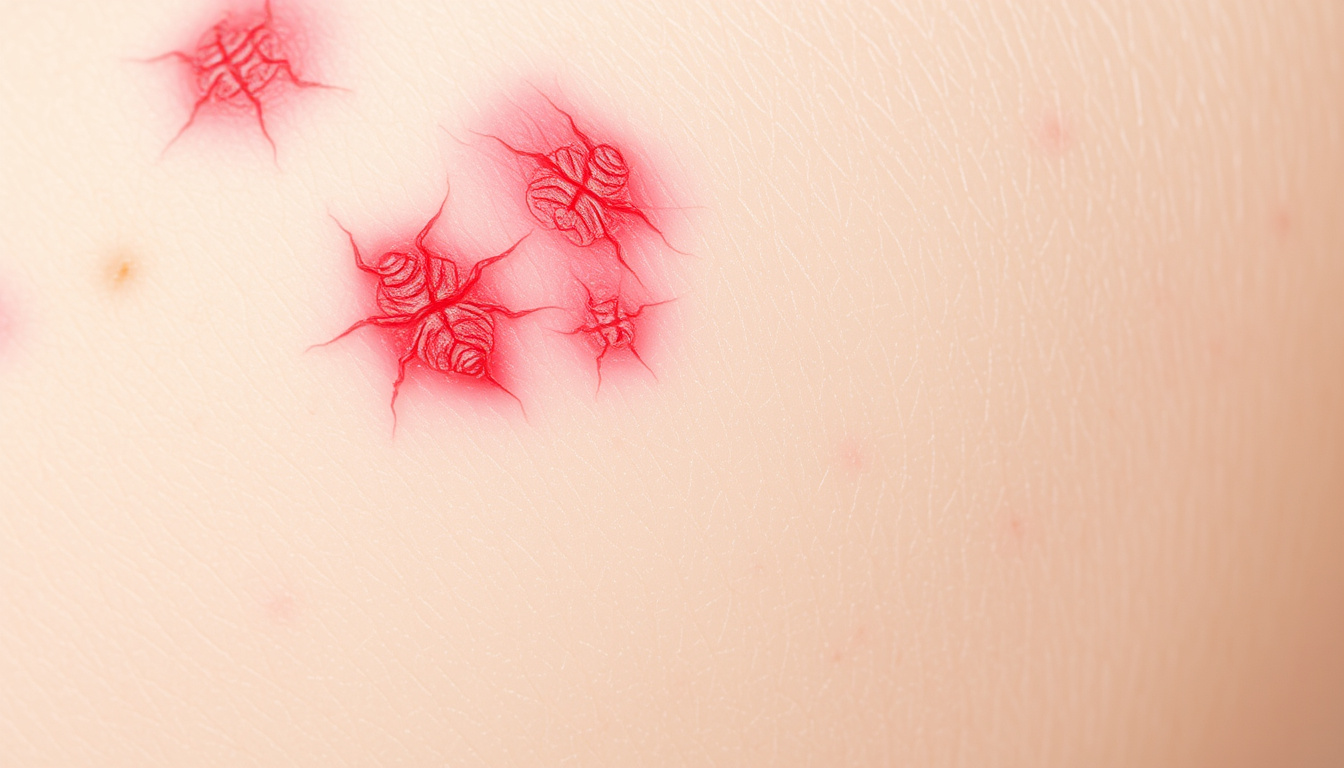
Scabies is a contagious skin infestation caused by the Sarcoptes scabiei mite. Identifying scabies early relies on recognizing specific visual patterns, though the signs can be subtle and easily confused with other conditions. This guide provides a detailed visual reference based on authoritative medical sources to help distinguish scabies from other rashes.
The mites burrow into the upper layer of skin where they lay eggs, triggering an allergic reaction that produces the characteristic symptoms. Understanding what scabies looks like is essential for timely diagnosis and treatment, particularly given its contagious nature through direct skin-to-skin contact.
What Does Scabies Look Like?
The visual appearance of scabies combines several distinct features that, together, help differentiate it from other skin conditions. The primary signs include a rash with small red spots, visible burrow tracks, and intense itching that worsens at night.
Key Insights on Visual Appearance
- Burrows appear as tiny raised, crooked lines that may be grayish-white or skin-colored
- The rash often resembles pimple-like bumps, hives, tiny knots, or scaly skin patches
- Bumps frequently form short straight or wavy lines, with water blisters marking mite entry points
- Only 10-15 mites are typically present on an infested person, making burrows difficult to spot
- Scratching from intense itching can cause sores that may become crusted or infected
| Characteristic | Details |
|---|---|
| Cause | Sarcoptes scabiei mite infestation |
| Primary symptom | Intense nocturnal itching |
| Rash appearance | Pimple-like bumps, tiny red spots, or scaly patches |
| Burrow characteristics | Grayish-white or skin-colored raised lines |
| Typical mite count | 10-15 mites on an infested person |
| Transmission | Prolonged skin-to-skin contact |
What Does Scabies Look Like When It First Starts?
Early-stage scabies produces symptoms that can easily be mistaken for other skin irritations. Initial signs typically develop gradually, making early recognition challenging without knowing what to look for.
First Signs and Initial Rash Development
When scabies first starts, the earliest and most common symptom is intense itching, especially at night. This itching results from the body’s allergic reaction to the mite, its eggs, and fecal matter deposited under the skin. Many people also develop a pimple-like (papular) itchy rash that may resemble hives, tiny bumps, knots, or patches of scaly skin.
The female mite burrows under the skin and begins laying eggs within hours—typically 2 to 3 eggs daily. These eggs hatch into adult mites within approximately 10 days, continuing the infestation cycle. The burrows themselves appear as tiny raised, crooked lines on the skin surface, though they may be difficult to identify because of the relatively small number of mites present.
In people who have never had scabies before, symptoms can take 2 to 6 weeks to appear after initial exposure. During this asymptomatic period, individuals can still spread scabies to others, making early detection difficult.
Where Early Scabies Typically Appears
Scabies typically appears first in skin folds and areas where clothing or jewelry covers the skin. The most commonly affected sites include between fingers and around nails, wrists, elbows, and armpits, as well as the groin, buttocks, and penis. Additional frequent locations include the waist, nipples, navel, and ankles, and the shoulder blades.
In infants and very young children, the rash often appears on the face, head, neck, scalp, palms, and soles of feet. Importantly, the face and neck are usually spared in older children and adults, which can help distinguish scabies from other conditions affecting facial skin.
What Is Crusted Scabies and How Does It Look?
Crusted scabies, also known as Norwegian scabies, represents a severe manifestation of the infestation distinguished by thick crusted areas on the skin. This condition occurs when an extremely large number of mites burrow in the skin, causing severe rash and intense itching that far exceeds what is experienced with typical scabies.
Visual Characteristics of Crusted Scabies
The hallmark of crusted scabies is the presence of thick crusts covering affected skin areas. These crusts form as a result of the massive mite burden—potentially millions of mites—combined with damage from constant scratching. The crusts may appear as thick, scaly patches that can cover large areas of the body.
Constant scratching from the severe itch can lead to open sores that may become secondarily infected. In severe cases, these secondary infections can progress to sepsis, a potentially life-threatening condition when infection enters the bloodstream.
Crusted scabies requires prompt medical treatment. The severe itching and skin damage can lead to secondary bacterial infections that, in rare cases, may progress to sepsis. Individuals with crusted scabies should seek immediate medical care.
Who Is at Risk for Crusted Scabies
Crusted scabies most commonly affects individuals with weakened immune systems, the elderly, and those with neurological conditions that impair sensation or the ability to scratch. These groups may not respond to the itching sensation normally, allowing the mite population to proliferate unchecked.
How Long Does Scabies Last?
The duration of scabies depends on several factors, including whether it is being treated and the individual’s immune response. Without treatment, scabies can persist indefinitely as the mites continue their lifecycle under the skin.
Timeline for Symptom Development
For first-time infestations, symptoms typically appear within 2 to 6 weeks after exposure. This incubation period allows the mite population to establish itself before the allergic reaction produces visible symptoms. Importantly, individuals can spread scabies during this asymptomatic period.
For those who have had scabies previously, symptoms typically develop within 1 to 4 days after re-exposure. This faster reaction occurs because the immune system has already developed sensitivity to the mites, eggs, and fecal matter.
Following effective treatment with appropriate topical medication, symptoms usually clear within 1 to 2 weeks. Itching may persist for several weeks even after successful treatment as the skin heals from mite damage and allergic reactions.
Will Scabies Go Away on Its Own?
Scabies does not resolve without treatment. The mites continue to reproduce under the skin, perpetuating the infestation. Without intervention, scabies will persist and may spread to others through skin contact. Proper medical treatment is necessary to eliminate the mites and resolve symptoms.
How Does Scabies Start?
Understanding the progression of scabies from initial exposure helps contextualize the visual signs that appear over time. The timeline below outlines the typical development of symptoms from first exposure through treatment.
- Initial exposure: Scabies mites transfer through prolonged skin-to-skin contact with an infested person
- Mite burrowing: Female mites excavate tunnels in the upper skin layer within hours of contact
- Egg deposition: Mites lay 2-3 eggs daily in the burrows they create
- Itch onset: First noticeable itching typically begins within days to weeks, depending on prior exposure history
- Rash appearance: Visible bumps and burrows develop as the allergic reaction intensifies
- Spread: Without treatment, infestation spreads to other body areas and to close contacts
- Treatment: Appropriate topical treatment kills mites and eggs, with symptoms resolving over 1-2 weeks
Scabies Rash: What Is Certain and What Remains Unclear
While the general features of scabies are well-established, certain aspects of its visual presentation can vary among individuals. Below is a comparison of established facts versus areas where individual variation exists.
| Established Information | Aspects with Individual Variation |
|---|---|
| Red spots and bumps appear | Exact shade and intensity of red varies by skin tone |
| Burrows are raised, crooked lines | Visibility depends on individual skin characteristics |
| Intense nocturnal itching | Severity of itching varies significantly between people |
| Common locations include fingers, wrists, groin | Specific distribution may differ slightly |
| Scratching causes sores and crusting | Degree of secondary skin damage varies |
| Crusted scabies has thick crusts | Crust thickness and extent varies by immune status |
Understanding Scabies in Context
Scabies affects millions of people worldwide each year, occurring in all populations regardless of hygiene standards. The World Health Organization recognizes scabies as a significant public health concern due to its contagious nature and impact on affected communities.
Diagnosis relies on the distinctive appearance and distribution of the rash along with the presence of burrows. Healthcare providers may confirm diagnosis by examining skin samples under a microscope to identify mites, eggs, or fecal matter.
The condition spreads primarily through extended skin-to-skin contact, making household members and close contacts particularly vulnerable. Outbreaks in nursing homes, childcare facilities, and other institutional settings require coordinated treatment efforts to prevent reinfestation.
Diagnosis is based on the distinctive appearance and distribution of the rash and the presence of burrows.
— UCLA Health, Scabies: Burrow Into Skin Cause Extreme Itch
The bumps often form short straight or wavy lines, with the bump or water blister marking where the mite entered the skin.
Summary
Recognizing scabies involves identifying its characteristic visual features: tiny red spots, raised burrow lines, and an intensely itchy rash concentrated in skin folds and covered areas. Early signs may be subtle, with itching preceding visible rash development. Crusted scabies represents a severe variant requiring urgent medical care. If you suspect scabies, consult a healthcare provider for proper diagnosis and treatment. Understanding how scabies appears is the first step toward effective management and preventing spread to others. For comparison purposes, learn How to Identify a Wart to better distinguish between common skin conditions.
Frequently Asked Questions
What do scabies look like to the human eye?
Scabies typically appears as tiny red spots, pimple-like bumps, or raised crooked lines (burrows) on the skin. The rash is often intensely itchy, especially at night, and commonly affects areas like between fingers, wrists, and the groin.
Can scabies look like other skin conditions?
Yes, the scabies rash can resemble hives, eczema, insect bites, or other allergic reactions. The distinctive burrow lines and nighttime itching help differentiate scabies from these conditions.
How soon can you see scabies after exposure?
For first-time exposure, symptoms typically appear within 2 to 6 weeks. For people previously exposed to scabies, symptoms usually develop within 1 to 4 days due to the immune system’s faster response.
What do burrows look like on the skin?
Burrows appear as tiny raised, crooked lines on the skin surface. They may be grayish-white or skin-colored and often have a bump or small blister at one end where the mite entered. However, burrows can be difficult to identify since only 10-15 mites are typically present.
Where does scabies rash first appear?
Scabies typically first appears in skin folds and areas covered by clothing or jewelry, including between fingers, around nails, on wrists, elbows, armpits, groin, buttocks, and waistline. In infants, the face, scalp, palms, and soles are often affected.
What is the difference between regular and crusted scabies?
Regular scabies involves 10-15 mites with moderate itching, while crusted scabies involves millions of mites and causes thick crusts to form on the skin with severe itching. Crusted scabies primarily affects people with weakened immune systems and requires more aggressive treatment.
Does scabies self-resolve without treatment?
No, scabies does not go away on its own. Without appropriate medical treatment, the infestation persists as mites continue to reproduce under the skin. Treatment with prescription scabicidal medications is necessary to eliminate the mites.

Arthur Oliver Howard Fletcher is a staff writer for NationalReport.uk, covering UK national news, politics, the economy and public services. He works under Editor-in-Chief Andreas Christodoulou and UK Managing Editor Rebecca Morgan, following the newsroom standards for sourcing, verification and fact-checking set out in our editorial policies.