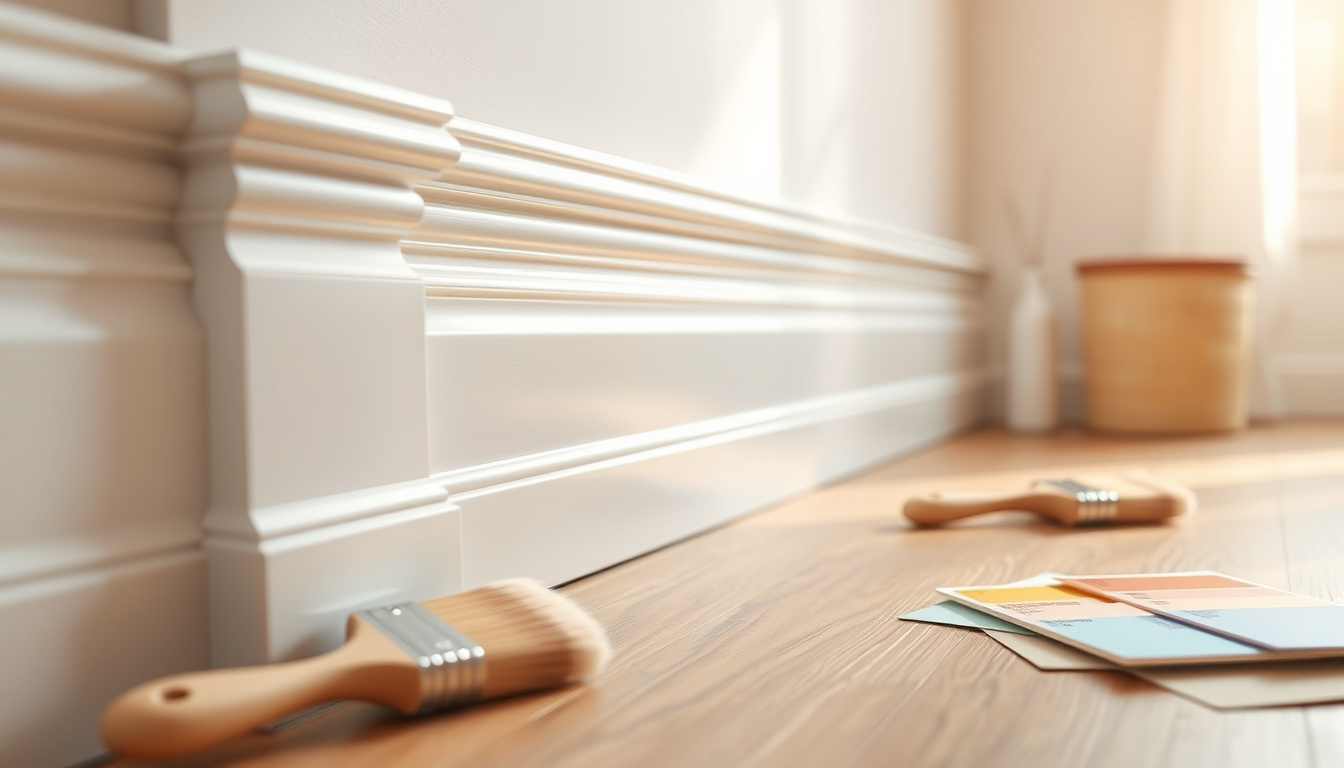
Few details say as much about a room as the trim where the wall meets the floor. Skirting boards quietly absorb scuffs, hide the gap between plaster and flooring, and set the room’s visual line, so the practical questions — what thickness, gloss or matt, what order to paint — come back to that junction.
Common materials: MDF, pine, oak, tulipwood ·
Typical thickness: 15–18 mm in most retail ranges ·
Paint coat count: Primer/undercoat plus 2–3 topcoats ·
Paint sheen options: Gloss, satin, eggshell, matt ·
2026 color direction: White and wall-matched tones
Quick snapshot
- Skirting boards are the trim fitted at the base of internal walls to cover the joint between wall and floor (adhesives maker Loctite).
- MDF is dimensionally stable, inexpensive, and accepts paint well (DIY repair guide The Garden Patch).
- Board thickness affects perceived robustness and resistance to knocks and scuffs (UK retailer B&Q).
- The best thickness has no single value — it depends on wall flatness, floor gap, and the profile.
- Gloss vs matt depends on the room’s light, durability needs, and how often you want to wipe the boards down.
- The exact 2026 trend direction is not confirmed by the available product data.
- B&Q’s current range pairs slim 14.5 mm and 15 mm boards with minimalist interiors and describes 18 mm and 25 mm boards as producing a more robust finish (UK retailer B&Q).
- White and wall-matched tones are the stated 2026 color direction. (UK retailer B&Q)
- Square and low-profile styles are visible across current product ranges. (UK retailer B&Q)
- Prime new MDF — including cut ends — before any finish coats.
- Paint skirting before walls for a cleaner cut-in line.
- Allow enough drying time between coats before adding the next one.
Six specs, one pattern: the decisions cluster around the board itself and the paint system that protects it.
| Spec | Typical value |
|---|---|
| Common materials | MDF, pine, oak, tulipwood |
| Typical thickness | 15–18 mm for residential MDF |
| Primer | 1 coat before finish coats; 2 coats on MDF cut ends |
| Number of topcoats | 2–3 after primer/undercoat |
| Common sheens | Gloss, satin, eggshell, matt |
| Profile direction | Square and minimalist styles in current ranges |
What is skirting in construction?
Skirting is the trim fitted at the base of internal walls to cover the joint between wall and floor — the visible cover for the junction that most rooms treat as an afterthought until it starts looking scuffed.
What does a skirting board do?
- Protects the lower wall from scuffs, kicks, and impact — the zone where vacuum cleaners, shoes, and furniture all make contact.
- Covers the gap where the floor finish meets the plaster, so an imperfect cut line does not become a permanent eyesore.
- Conceals cables and eases the transition between different floor finishes at doorways and thresholds.
- Sets the visual line of the room: a slim, low board reads minimal; a taller, profiled board reads traditional.
Where skirting sits matters as much as what it does. The board runs along the base of every internal wall, directly above the finished floor, which is why the same component is called a baseboard in North American installation guides. If you are refreshing the whole room, the same material logic applies to the hardware that shares the wall line — our door knobs buying guide covers those choices.
Where does skirting sit relative to the floor and wall?
- At the base of internal walls, sitting directly above the finished floor covering.
- It covers the wall-floor joint and provides a neat transition between plaster and flooring.
- In North American usage, the same component is called a baseboard, and installation guides treat it as wall-floor trim.
What this means: skirting is the room’s bottom edge in the literal sense. It takes the abuse that would otherwise land on the wall, and it gives the eye a clean line to follow around the room.
Can you replace skirting boards?
Yes — damaged, rotten, or simply dated boards can be removed and replaced without replacing the plaster behind them. The real question is whether the old boards need to go or can be brought back.
When should skirting boards be replaced?
- Structurally failed timber — boards that are split, rotting, or no longer hold fixings — is the clearest case for replacement.
- Sound boards can often be filled, refixed, or locally spliced rather than replaced; replacement is more appropriate when the timber has structurally failed or the original profile cannot reasonably be restored, according to restoration firm Solshine (restoration firm Solshine).
- If the existing profile is simply outdated, replacement is a chance to update the look of the whole room without re-plastering.
How is a skirting board removed and fitted?
- The sequence in Loctite’s baseboard guide starts by cutting through the paint or caulk at the wall-to-board seam, fixes boards with adhesive (adding nails when extra hold is needed), and seals the top and bottom edges with caulk (adhesives maker Loctite).
- New boards can also be fixed with screws, with mitre joints at internal and external corners.
- Measure each wall at least twice before cutting new boards (home improvement retailer The Home Depot).
- Let the boards acclimate indoors for several days before fitting so they can settle to the room’s conditions (The Home Depot).
Replacement is simpler than it sounds: once the old board is off, the wall behind usually needs only a little filler before the new board covers the damage. The plaster work stays intact, which is why this is a weekend job rather than a re-plastering job.
Replacement versus restoration comes down to a simple audit: what is the board doing, and can it be made to do it again?
Upsides
- Replacement fixes the root cause when timber has split or rotted.
- New boards can be primed and painted before fitting, making decorative profiles easier to reach.
- It is the practical moment to switch to a slim or square profile.
Downsides
- Replacement means mitring corners, fitting, caulking, and painting a full board — more work than a refresh.
- Sound period boards can lose their original profile if replaced instead of restored.
- New boards must be matched to the existing floor line and room height.
What is the best thickness for skirting boards?
There is no single best thickness, but the market splits into two clear directions: slim boards that recede, and thicker boards that assert themselves.
What thickness is available?
- Stock MDF boards commonly fall in the 15–18 mm range for residential rooms.
- B&Q’s range guidance splits the options: slim 14.5 mm and 15 mm boards for modern minimalist interiors, and 18 mm and 25 mm boards described as producing a more robust finish (UK retailer B&Q).
- Height is chosen separately from thickness: the height sets the visual weight, and the thickness sets the physical robustness.
Three specs, one pattern: material determines stability, thickness determines presence, and the paint system determines how often you will be touching it up.
| Spec | Typical value | Why it matters |
|---|---|---|
| Common materials | MDF, pine, oak, tulipwood | MDF is the common painted choice; solid wood suits natural finishes and heavy wear. |
| Slim board thickness | 14.5–15 mm | Listed for modern minimalist interiors. |
| Robust board thickness | 18–25 mm | Described as producing a more robust finish. |
| Typical residential MDF thickness | 15–18 mm | The common mid-range for painted boards. |
| Primer | 1 coat; 2 on MDF cut ends | Cut ends soak up more primer and need the extra coat. |
| Finish coats | 2–3 topcoats | Two coats of gloss or satin after priming is the typical described system. |
| Sheen options | Gloss, satin, eggshell, matt | Each sheen changes the reflection and cleaning trade-off. |
| Restoration sanding | 80 to 120 to 220/240 grit | Progressive sanding before priming, per restoration firm Solshine. |
Does thickness affect the look or durability?
- Yes — thickness changes how substantial the board reads and how well it resists knocks and scuffs.
- Thicker boards are often used where walls are uneven, because they are more forgiving of the wall line.
- The floor gap matters: a thicker board gives more room to cover an uneven floor edge.
Slim boards look current but demand reasonably flat walls; thicker boards forgive the wall but dominate the room’s edge. Pick the thickness for the wall you have, then the profile for the look you want.
Why this matters: thickness is the difference between skirting that disappears and skirting that anchors the room. A 14.5 mm board and an 18 mm board can look nearly identical in a photograph and completely different in a hallway.
Should you paint skirting boards gloss or matt?
Sheen is the most visible decision you will make on skirting, because the board sits low and catches raking light from windows and floors. Gloss and matt are the two extremes, and most rooms end up somewhere in between.
What is the difference between gloss, satin, eggshell, and matt?
- The spectrum runs gloss to satin to eggshell to matt, from highest reflection to none.
- Durability and wipeability track reflection: gloss leads the way, matt trails.
Four sheens, one pattern: the harder and more wipeable the finish, the more it reflects light and shows surface imperfections.
| Sheen | Reflection | Practical trade-off |
|---|---|---|
| Gloss | High, sharp highlights | Hard-wearing and wipeable but shows every surface imperfection. |
| Satin | Soft sheen | Common middle ground for woodwork; wipes clean without the glare. |
| Eggshell | Low sheen, slight texture | Low reflection; a frequent compromise when gloss feels too shiny. |
| Matt | Flat, no reflection | Hides marks and imperfections but is harder to clean and less durable. |
The practical difference shows up at the kick zone, where shoes, vacuum cleaners, and children all make contact. A glossy board wipes clean in one pass; a matt board hides the scuff but needs more effort to actually remove it.
Which sheen is easiest to keep clean?
- Gloss is the easiest to wipe clean, which is why it is a traditional pick for high-traffic areas.
- Matt is the hardest to clean but the best at hiding scuffs between washes.
- Satin and eggshell split the difference: they wipe down reasonably well without turning the skirting into a mirror.
Gloss rewards smooth walls and frequent wiping; on an imperfect surface it will advertise every ripple. Matt forgives the wall but asks you to clean more carefully — a real trade-off at the kick zone where scuffs actually happen.
Why this matters: the sheen decision is a maintenance decision. If the boards will take kicks, abrasion, and cleaning, gloss gives you the easiest recovery. If the walls are imperfect and you want a calm, light-absorbing room, a lower sheen is the honest choice.
What is the quickest way to paint skirting boards?
Speed on skirting boards is less about brushing faster and more about sequencing: rollers for the flats, brushes for the edges, and primer before anything else.
Should you paint skirting boards with a roller or brush?
- Use a mini roller on the flat faces — it covers ground quickly and leaves a smoother film.
- Use a brush to cut in the edges where the board meets the wall and floor.
- For decorative profiles, keep a brush handy for the grooves the roller cannot reach.
The combination matters more than the tool: a roller alone cannot reach the groove under the lip of a profiled board, and a brush alone will leave streaks across a long flat run.
How many coats of paint should you put on skirting boards?
- New boards need primer before any finish coat, and MDF cut ends are especially absorbent — they may need two primer coats (DIY repair guide The Garden Patch).
- After priming, the typical system is two coats of gloss or satin paint, with light sanding between coats to remove dust nibs and smooth the surface (The Garden Patch).
- In total, budget for a primer/undercoat plus two to three topcoats.
Can you cut in one day and paint the next?
Cut in one day, topcoat the next: the sequence matters less than the drying time. If the primer is not dry, the topcoat lifts, and you lose more time fixing it than you saved.
Yes — cutting in can be done one day and topcoats applied the next, as long as you respect the recommended drying time between coats. The boards do not know what day it is; the paint does.
What do I paint first, skirting or walls?
- Paint skirting before walls — it makes the wall cut-in line easier to get clean later.
- For new boards, painting before installation improves access to decorative profiles; painting after installation allows joints to be caulked against the wall for a neater seam. Both sequences are valid.
The quickest path, step by step
Quickest path: Cut in first · primer on cut ends · mini roller on flats · brush the edges · two to three topcoats
- Cut in the skirting before you paint walls — the wall line comes easier afterward.
- Prime first — and give MDF cut ends two primer coats.
- Roll the flat faces with a mini roller; brush the edges and grooves.
- Apply two to three topcoats, sanding lightly between coats.
- Respect the drying time before the next coat.
The catch: speed comes from the right tool order and dry-time discipline. The roller does the flats, the brush owns the edges, and skipping the primer is what creates the extra sanding later.
What are the trends for skirting boards in 2026?
The 2026 trend conversation is quieter than it sounds: white is still the default, and the louder shift is toward boards that match the wall and recede from view.
What is the most popular color for skirting boards?
- White remains the traditional favorite and the safest match for most rooms.
- Wall-matched skirting — painting the boards the same color as the wall — is the minimalist idea picking up momentum.
- Warm whites and off-whites sit in the same conversation, since pure white can read stark against soft wall colors.
Should skirting boards be painted lighter or darker than the wall color?
- Lighter than the wall: the board reads as a crisp line and defines the room’s edge.
- Same as the wall: the junction disappears and the room feels calmer and larger.
- Darker than the wall: a deliberate contrast that grounds the room, but a harder commitment to live with.
What are modern skirting board ideas?
- Square and low-profile styles are visible across current product ranges.
- Slim 14.5–15 mm boards are positioned for minimalist interiors, per B&Q’s range guidance.
- In period homes, the counter-trend is keeping original profiles: restoration rather than replacement preserves the existing line of the room, according to restoration firm Solshine (restoration firm Solshine).
The 2026 question is not white versus color — it is whether you want the skirting to disappear into the wall or hold the room’s edge as a crisp painted line. The product ranges are already split down that line.
What’s confirmed, what’s still unclear
After separating the product data from the opinions, five facts hold up and five questions stay open.
Confirmed facts
- Skirting boards are the trim fitted at the base of internal walls to cover the joint between wall and floor (Loctite).
- MDF is dimensionally stable, inexpensive, and accepts paint well (The Garden Patch).
- B&Q’s range splits slim 14.5–15 mm boards from robust 18–25 mm boards (B&Q).
- Measure each wall at least twice before installing new boards (The Home Depot).
- Sound boards can often be restored rather than replaced; structurally failed boards are the case for replacement, according to restoration firm Solshine.
What’s still unclear
- The best thickness has no universal value — it depends on wall flatness, floor gap, and the chosen profile.
- Whether gloss or matt suits a room depends on light, durability needs, and cleaning tolerance.
- Whether to restore or replace a period board depends on the timber’s condition and whether the profile can be matched.
- Whether painting before or after installation is better depends on whether you want easier access to profiles or neater caulked joints.
- The 2026 color direction is split between white and wall-matched tones; neither is confirmed as dominant by the available product data.
The honest take: the confirmed facts are enough to make a sensible decision, and the open questions are preferences, not mysteries. The data will not tell you which sheen you like; it will only tell you what each sheen costs.
What the trade says
Three voices frame the practical debate: the repair guide’s finish system, the adhesives maker’s installation sequence, and the restorer’s caution against unnecessary replacement.
New skirting board should be primed before applying finish coats, and MDF cut ends are especially absorbent — they may require two primer coats.
Replacement installation begins by cutting through paint or caulk at the wall-to-board seam; adhesive may be supplemented with nails when additional hold is needed.
adhesives maker Loctite’s install guide
Sound timber or plaster skirting can often be filled, refixed, or locally spliced rather than replaced — replacement is more appropriate where the original profile cannot reasonably be restored.
restoration firm Solshine
The pattern: the repair guide sells preparation, the adhesives maker sells the install sequence, and the restorer sells the second look. Between the three, the message is consistent: prepare properly, replace only what has failed, and restore what is still sound.
The takeaway: Skirting boards are the quiet workhorse of a room: they take the kicks, hide the junction, and set the eye line. What is confirmed is simple — MDF is the stable, paint-friendly default; slim boards look modern and thick boards read robust; primer earns its keep on every cut end. The judgment calls are yours: gloss rewards wiping but punishes imperfect walls, matt forgives the wall but asks more of you, and the best thickness follows the walls you actually have. For the UK DIYer painting a room this year, the decision is clear: paint the skirting before the walls, prime the cut ends properly, and pick a sheen you can live with, or you will be back with a brush fixing a paint line that never needed to fight you.
Related reading: Kitchen Cupboards: Types, Sizes, Costs & Trends
Frequently asked questions
Do new MDF skirting boards need a primer before painting?
Yes. New boards should be primed before finish coats, and MDF cut ends are especially absorbent — they may need two primer coats (The Garden Patch).
What is the best height for a skirting board?
There is no single best height. Height sets the visual weight of the board and is chosen separately from thickness, which handles physical robustness. Match the height to the room’s proportions and the profile you want, then choose thickness based on wall flatness and the floor gap.
How do I cut an external skirting board corner?
External corners are normally cut at 45 degrees with a mitre saw, and protective eyewear is recommended for the cut (adhesives maker Loctite).
Can I fit skirting boards over tile flooring?
Yes. The standard sequence — adhesive, nails for extra hold, then caulk along the top and bottom edges — works over tile as long as the bottom of the board is cut to follow the floor line.
How do I fill gaps between skirting boards and the wall?
Caulk is used along the top and bottom edges of baseboards to seal gaps (Loctite). For damage in the board itself, restoration guidance describes filling, progressive sanding, priming, and at least two topcoats — moving from 80 grit to 120 grit and finishing around 220 or 240 grit (restoration firm Solshine).
Should I remove skirting boards before painting a room?
Not usually. Painting skirting before walls makes the wall cut-in easier later. For new boards, painting before installation improves access to decorative profiles, while painting after installation allows joints to be caulked against the wall for a neater seam.

Arthur Oliver Howard Fletcher is a staff writer for NationalReport.uk, covering UK national news, politics, the economy and public services. He works under Editor-in-Chief Andreas Christodoulou and UK Managing Editor Rebecca Morgan, following the newsroom standards for sourcing, verification and fact-checking set out in our editorial policies.