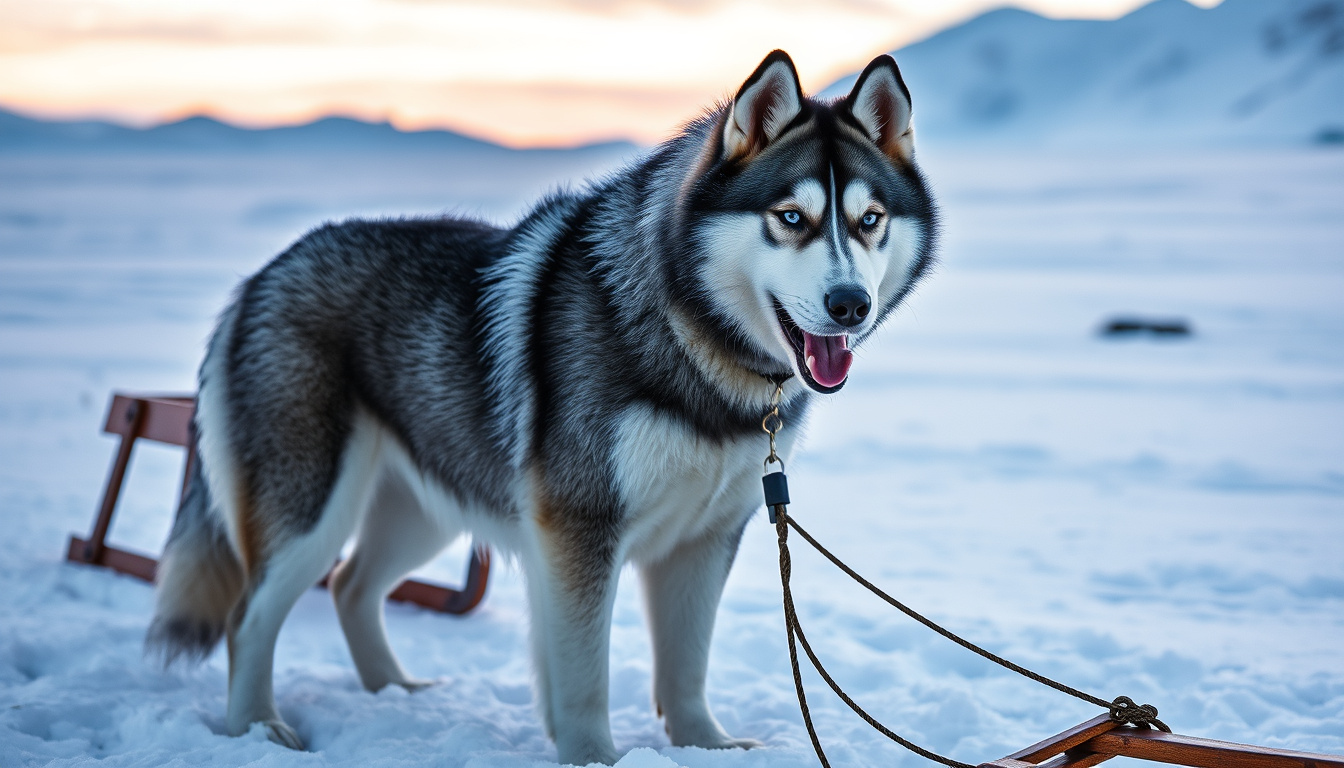
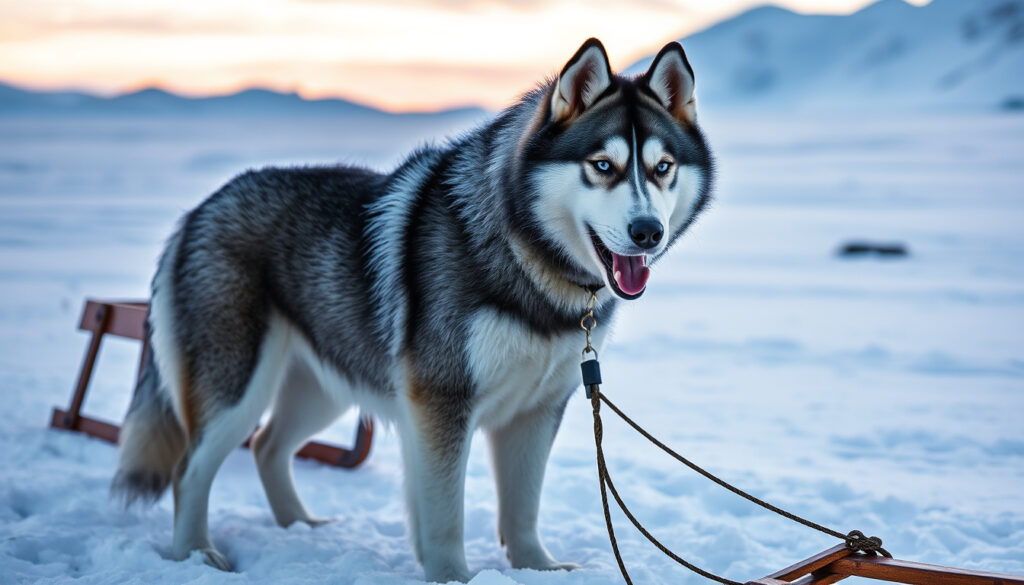
Few dogs look as ready for the Arctic as an Alaskan Malamute — and few are as easy to misread. This is a sled dog bred by the Mahlemut Inuit to haul heavy freight, according to The Kennel Club’s breed history, not a guard dog. The questions that matter — how big, how loud, how independent, how good with kids — all trace back to a working dog built for pulling sleds, not standing watch.
Typical weight: Females 75 lb; males 85 lb (UKC standard) · Typical height: Females 23 in; males 25 in at the shoulder · Coat type: Thick double coat; heavy shed · Lifespan: 10-14 years · Original job: Haul heavy freight over long distances
Quick snapshot
- Working dog bred to haul heavy freight (The Kennel Club breed history)
- Large Arctic spitz type (Britannica breed profile)
- Built for strength and endurance (UKC standard)
- Affectionate and loyal (The Kennel Club breed standard)
- Playful but dignified (The Kennel Club breed standard)
- Not a guard dog (SHCA standard comparison)
- High energy and exercise needs (Britannica breed profile)
- Heavy shedding double coat (UKC standard)
- Needs companionship; poor alone-time tolerance (Toronto Edition breed comparison)
- Heavier and more powerful (Toronto Edition breed comparison)
- Different vocal style (The Kennel Club breed standard)
- Steadier, more independent energy (Toronto Edition breed comparison)
The catch: six facts, one pattern — every key measurement points back to a working dog built for heavy freight, not for a quiet apartment.
| Metric | Alaskan Malamute |
|---|---|
| Size | Male 25 in / 85 lb; female 23 in / 75 lb (Britannica’s breed profile) |
| Coat | Thick double coat (United Kennel Club standard) |
| Lifespan | 10-14 years (Britannica) |
| Energy level | High |
| Alone-time tolerance | Low; needs companionship (Toronto Edition’s breed comparison) |
| Original job | Haul heavy freight over long distances |
Is an Alaskan Malamute a good family dog?
Most Malamute owners will tell you the breed can be a wonderful family dog — with conditions. The same qualities that made it a freight hauler make it affectionate but stubborn, loyal but independent.
What is an Alaskan Malamute?
- A large Arctic spitz-type dog originally bred for strength and endurance as a sled dog (Britannica’s breed profile).
- The breed standard describes it as affectionate, friendly, loyal, and generally not a one-man dog (see The Kennel Club quote below).
How much exercise does an Alaskan Malamute need?
- This is a working breed, and a walk around the block won’t cut it.
- Plan for vigorous daily exercise plus mental work that lets the dog use its pulling instincts.
- Without that outlet, a bored Malamute finds its own job — often digging, chewing, or howling.
Are Alaskan Malamutes good with children?
- With early socialization and supervision, yes; the breed’s friendly, adaptable temperament helps.
- Size is the real caveat: a dog this size can knock a small child over by accident.
- That is not aggression — it’s physics.
The pattern: a Malamute is a family dog for families that respect its working brain. If you want a dog that obeys without argument, this is not it.
Is a Malamute bigger than a husky?
Yes — in height, weight, and bone. The two breeds share sled-dog roots, but their jobs shaped different bodies.
What is the difference between an Alaskan Malamute and a Siberian Husky?
- Malamute standards: males about 25 in and 85 lb; females about 23 in and 75 lb.
- Siberian Husky standards: males 21-23.5 in and 45-60 lb; females 20-22 in and 35-50 lb (Siberian Husky Club of America standard).
- The Alaskan Malamute’s size is built for freight; the Husky’s size is built for sustained speed.
Are Malamutes calmer than huskies?
- That is the common comparison, and it mostly holds: Malamutes tend to be steadier and more independent, while Huskies are often more flighty and high-energy (Toronto Edition’s breed comparison).
- Individual training and breeding matter more than the label, so meet the parents before you assume.
The trade-off is simple: a Malamute gives you more mass and a calmer engine; a Husky gives you a lighter, quicker athlete. Neither is the right choice for a sedentary home.
Are Malamutes on the aggressive dog list?
This is where internet lists do real damage. No major kennel club standard describes the Malamute as human-aggressive, and the breed’s temperament section is about friendliness, not guarding.
What are the top 3 aggressive dogs?
- There is no single official “top 3 aggressive dogs” list; rankings depend on the publication and methodology (Country Living’s aggression-research review).
- Country Living’s overview notes that smaller breeds often appear more in aggressive-behavior reports than mid-sized and large dogs.
- That context matters: breed-specific fear often misses real risk factors like poor socialization and individual temperament.
Do Alaskan Malamutes have a high prey drive?
- The Kennel Club’s standard notes that the breed tends to show dominance to other dogs (The Kennel Club breed standard).
- This is dog-directed behavior, not human aggression.
- The Siberian Husky standard, by contrast, explicitly says the breed is not aggressive with other dogs (SHCA standard).
The Malamute’s “aggression” label is really a dominance issue aimed at other dogs, not people. A poorly socialized Malamute can be a handful at the dog park; a well-socialized one is a friendly, loyal companion.
The implication: “aggressive dog list” is a misleading shortcut. For a Malamute, the real caution flags are canine dominance and a strong prey drive, not a dangerous-human temperament.
Do Malamutes bark a lot?
Not the way many people expect. A Malamute is more likely to greet you with a howl or a grumble than a rapid-fire bark.
Do Malamutes howl?
- Yes — howling is part of the breed’s vocal repertoire, and it carries.
- A Malamute left alone too long may howl to call its pack back.
Are Malamutes talkative?
- Owners often describe the breed as “talkative”: whines, woofs, grunts, and yodels substitute for barking.
- This is not a constant-barker breed, but it is a vocal one.
The vocal style is a breed trait, not a training failure. If you need silence, a Malamute will test you.
Can you leave a Malamute alone?
Some dogs are fine with a long workday. The Malamute is not one of them.
How much attention does an Alaskan Malamute need?
- Malamutes are pack dogs by history; they were bred to work in teams, not to be kenneled solo.
- Long stretches alone can trigger digging, chewing, and howling.
- The breed’s poor alone-time tolerance is a common reason dogs end up in rescue (Toronto Edition’s family-suitability notes).
How can you leave a Malamute alone safely?
- Crate training, puzzle feeders, and gradual alone-time practice help, but they don’t replace companionship.
- A dog walker or doggy daycare is a practical solution for owners who work full time.
- If you can’t provide midday interaction, a Malamute may not be the right breed.
A bored Malamute doesn’t get lazy; it gets creative — digging, howling, and redecorating your home. The same drive that pulled freight for the Mahlemut will find its own job if you don’t give it one.
The practical read: don’t get a Malamute if you’re away nine-plus hours with no backup. It’s not a judgment on the dog — it’s a prediction about your sofa.
How close is a Malamute to a wolf?
Close enough to look wild, far enough away that the comparison is mostly cosmetic.
What is the origin of the Alaskan Malamute?
- The breed’s name comes from the Mahlemut Inuit people, who used these dogs for heavy hauling.
- This is an ancient Arctic spitz lineage, not a recent wolf cross.
Are Malamutes part wolf?
- No. Alaskan Malamutes are a fully domesticated dog breed (Britannica’s breed profile).
- The wolf-like face and thick coat reflect shared ancestors among ancient spitz dogs, not recent wolf breeding.
- Wolves and dogs also differ in behavior and physical development, even when they look similar.
The wolf rumor is the wrong story. The Malamute’s real ancestry is a working relationship with humans that goes back thousands of years.
Malamute vs. Husky: side by side
Four differences, one pattern: Malamute is the freight train, Husky is the trail runner.
| Trait | Alaskan Malamute | Siberian Husky |
|---|---|---|
| Build | Heavier, larger, more powerful | Medium-sized and lighter |
| Primary job | Heavy freight hauler | Endurance sled dog |
| Temperament | Affectionate, loyal, dog-dominant | Friendly and gentle (SHCA standard) |
| Alone-time tolerance | Low (Toronto Edition) | More independent, but still social |
The implication: if you want a dog that can pull a sled and live happily with a family, the Malamute’s size is part of the package. If you want a smaller, lighter athlete with a similar look, the Husky is the more sensible frame.
Alaskan Malamute specifications at a glance
A useful set of numbers, one bias: every spec reinforces the breed’s working-dog identity.
| Spec | Detail |
|---|---|
| Height | Male 25 in; female 23 in at the shoulder |
| Weight | Male 85 lb; female 75 lb |
| Coat | Thick double coat (United Kennel Club standard) |
| Lifespan | 10-14 years |
| Energy level | High |
| Alone-time tolerance | Low; needs companionship |
| Original job | Haul heavy freight over long distances |
Alaskan Malamute pros and cons
Upsides
- Affectionate and loyal with the whole family
- Striking, powerful working-dog build
- Playful and dignified at the same time
Downsides
- High exercise and mental-work demands
- Heavy seasonal shedding
- Poor alone-time tolerance and possible dog-directed dominance
The balance, for most owners, comes down to time: can you give a powerful working dog enough physical and social attention? If yes, the upsides tend to win.
What’s confirmed vs. what’s still unclear
Confirmed facts
- The Malamute is a large Arctic spitz breed originally bred for heavy freight hauling.
- The breed standard calls it affectionate, friendly, and loyal.
- Malamutes are heavier and larger than Siberian Huskies.
What’s unclear
- Any “top 3 aggressive dogs” list is a publication-specific ranking, not a scientific classification.
- Whether a Malamute is “calmer” than a Husky depends heavily on individual breeding and training.
- Local dangerous-dog classifications vary by jurisdiction, so there is no universal aggressive-dog registry.
The honest summary: breed traits are useful, but individual dogs and owners matter more than any list.
What breed standards actually say
“The Alaskan Malamute is affectionate, friendly, loyal, devoted, and generally not a one-man dog.”
— The Kennel Club breed standard
“The Siberian Husky is friendly and gentle, but also alert and outgoing.”
— Siberian Husky Club of America standard
The read across both standards: the Malamute’s reputation as a dangerous breed does not come from the kennel clubs. It comes from confusion between human-directed aggression and dog-directed dominance.
What this means for your household
Read the Malamute’s behavior as freight-pulling, and the picture snaps into focus. It is not a guard dog, not a wolf, and not an “aggressive breed” — it is a powerful working dog with a pack animal’s need for company. For a family that can supply exercise, structure, and almost constant companionship, the Malamute is a devoted and playful partner. For a first-time owner with a 9-to-5 job and no backup plan, the decision is clear: choose a different breed, or commit to the training and help a dog like this requires.
Related reading
- Mini Dachshund Guide: Pros, Cons, Cost & Health Risks
- Siberian Cat Breed Guide: Personality, Care & Pros/Cons
nationalkennelclub.com, kachinakennel.com, britannica.com, dogbreedinfo.com, cpb-us-w2.wpmucdn.com, pethelpful.com, quotidianocentro.it
Frequently asked questions
How much does an Alaskan Malamute cost?
Prices vary widely by region, breeder, and pedigree, so any single number would be misleading. Budget for quality food, vet care, a secure yard, and training classes.
What health problems are common in Alaskan Malamutes?
Like many large breeds, they can face hip dysplasia and bloat, so health-tested parents and responsible breeding matter.
How long do Alaskan Malamutes live?
Most breed comparisons put the lifespan at 10-14 years (Toronto Edition), though individual health and care matter more than the average.
How much do Alaskan Malamutes shed?
A lot. The thick double coat blows out heavily, so brushing several times a week is part of ownership.
Are Alaskan Malamutes hard to train?
They are intelligent and strong-willed, so consistent, reward-based training is essential. They respond best to firm but fair handlers.
Do Alaskan Malamutes get along with other dogs?
They can be same-sex dominant, so early socialization and supervision are essential.

Arthur Oliver Howard Fletcher is a staff writer for NationalReport.uk, covering UK national news, politics, the economy and public services. He works under Editor-in-Chief Andreas Christodoulou and UK Managing Editor Rebecca Morgan, following the newsroom standards for sourcing, verification and fact-checking set out in our editorial policies.