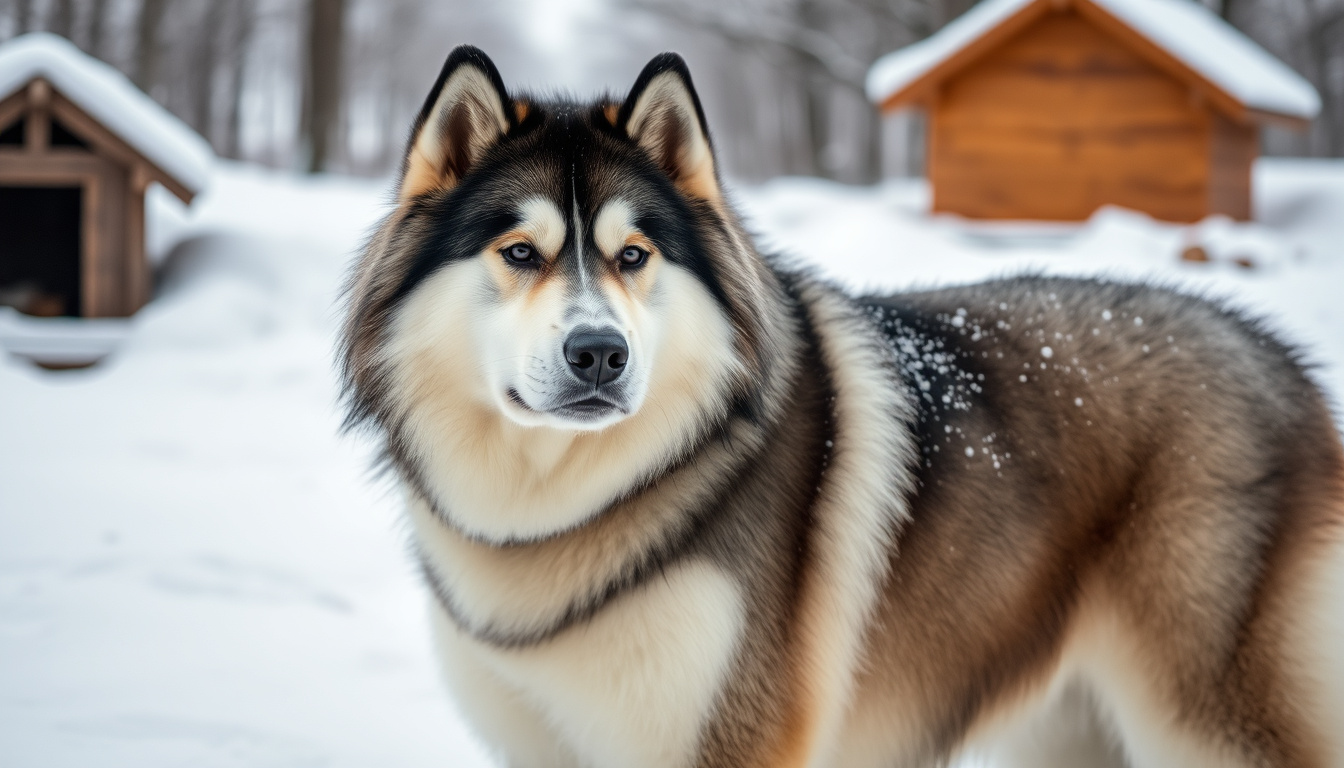
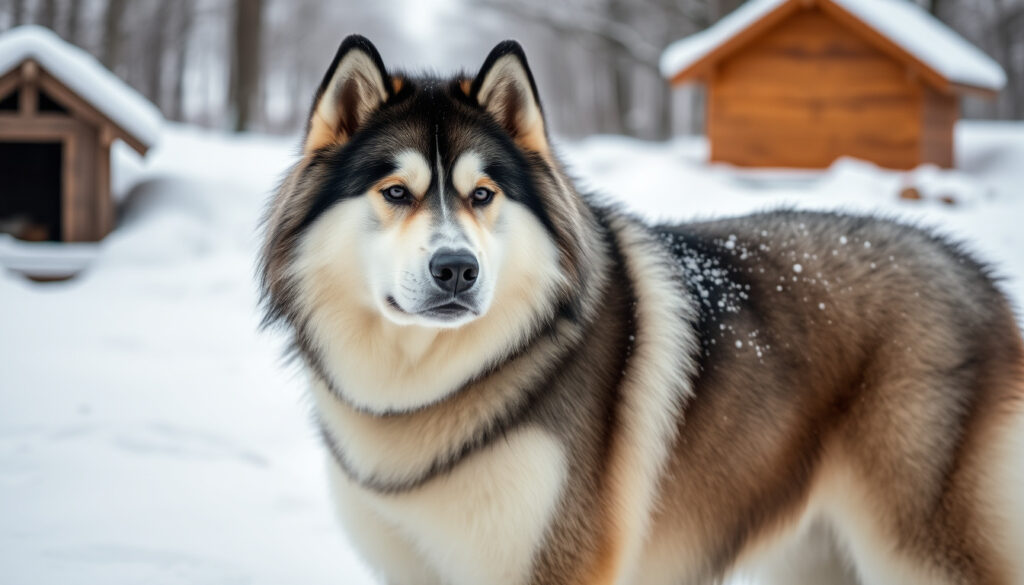
Anyone who’s met an Alaskan Malamute already knows the feeling: a massive, wolf-like dog with a plush coat and a surprisingly gentle nudge, but behind that striking appearance lies a working dog bred by the Mahlemut tribe to haul heavy loads across Arctic terrain. That heritage shapes everything from training to family compatibility — and it’s why this breed isn’t for everyone.
Height (males): 25 inches at shoulder ·
Weight range: 75–85 pounds (standard) ·
Coat type: Thick double coat ·
Life expectancy: 10–14 years ·
Temperament: Affectionate, loyal, playful, dignified
Quick snapshot
- Affectionate and loyal to family (American Kennel Club breed standard)
- Requires substantial daily exercise and heavy grooming (American Kennel Club comparison)
- Not typically listed in breed-specific dangerous-dog legislation (Rover breed comparison)
- Exact genetic proximity to wolves varies by study (DogNotebook comparison)
- Individual temperament can differ widely from breed averages (Rover breed comparison)
- Insurance company restrictions are not uniform across providers (American Kennel Club comparison)
- Ancient times: bred by the Mahlemut people for heavy hauling (American Kennel Club comparison)
- 1935: recognized by the American Kennel Club (American Kennel Club comparison)
- Growing popularity as family companions requires honest owner education (American Kennel Club comparison)
- Continued use in dog sports and working roles keeps the breed’s instincts alive (American Kennel Club comparison)
Here is a quick overview of the Alaskan Malamute’s key attributes.
| Attribute | Value |
|---|---|
| Origin | Alaska, USA |
| Breed Group | Working |
| Height (Male) | 25 inches |
| Weight (Male) | 75–85 lbs |
| Life Expectancy | 10–14 years |
| Temperament | Affectionate, Loyal, Playful, Dignified |
| Energy Level | High |
| Shedding | Heavy |
Is an Alaskan Malamute a good family dog?
Temperament and behavior around children
- The AKC breed standard describes the Alaskan Malamute as affectionate, friendly, and “not a one-man dog” — meaning it spreads its loyalty across the whole family (American Kennel Club breed standard).
- Adopt a Pet characterizes Malamutes as loyal, affectionate, intelligent, friendly, outgoing, playful, and willful (Adopt a Pet breed comparison).
- With proper supervision and early socialization, Malamutes can form strong, gentle bonds with children.
That said, the breed’s size and strength mean that interactions with small children should always be supervised. A Malamute that hasn’t learned bite inhibition as a puppy can accidentally knock over a toddler with a playful leap.
Training requirements and socialization
- Malamutes are intelligent but strong-willed, making them a challenge for first-time owners. The AKC notes that they require firm, consistent training from an experienced handler (American Kennel Club comparison).
- Early socialization with people, other dogs, and new environments is critical to prevent territorial behavior from developing.
The implication: a Malamute raised in a home with patient, confident owners who enforce boundaries from day one has a much better chance of being a reliable family dog.
Energy levels and exercise needs
- This breed was built to haul sleds all day. Without at least 60–90 minutes of vigorous daily exercise, Malamutes can become destructive or develop anxiety.
- Rover notes that both Malamutes and Huskies are friendly with people and are not good guard dogs, but Malamutes may do better as only pets (Rover breed comparison).
A family that wants a calm, low-maintenance lap dog should look elsewhere. The Malamute rewards active, experienced owners with deep loyalty but demands a serious time commitment for exercise and training.
The pattern: families that thrive with a Malamute are those that already lead an active outdoor lifestyle and treat the dog as a working partner, not a couch ornament.
Is a Malamute bigger than a husky?
Height and weight comparison
- The AKC standard gives male Malamutes a height of 25 inches at the shoulder and a weight of 75–85 pounds. Siberian Huskies, by contrast, stand 21–23.5 inches and weigh 45–60 pounds (American Kennel Club comparison).
- A Malamute can outweigh a Husky by 30 pounds or more — the difference between a dog you can lift and one you cannot.
Body structure differences
- Malamutes have a more robust, powerful build with a broad chest and heavy bone structure, bred for hauling freight. Huskies are leaner and faster, bred for pulling light sleds at speed.
- DogNotebook describes Malamutes as more laid-back indoors than Huskies, but also notes they can be more territorial (DogNotebook comparison).
Functional implications
- The size difference affects everything from food costs (a Malamute eats roughly 30% more per day) to the space required in a vehicle or home.
- Giant variations of Malamutes, sometimes bred outside the standard, can reach 130–200 pounds, though these are not recognized by the AKC as purebred.
Five traits, one pattern: the Malamute is the heavy-duty truck to the Husky’s sports car. Both are working breeds, but the Malamute was engineered for brute strength and endurance, not speed.
| Feature | Alaskan Malamute | Siberian Husky |
|---|---|---|
| Height (male) | 25 inches | 21–23.5 inches |
| Weight (male) | 75–85 lbs | 45–60 lbs |
| Build | Robust, powerful, broad chest | Leaner, lighter, agile |
| Temperament toward strangers | Reserved, dignified | Outgoing, friendly |
| Same-sex dog aggression risk | Higher (caution recommended) | Moderate |
| Daily exercise need | 60–90 minutes | 60–90 minutes |
| Barking tendency | Low (howls more) | Moderate |
| Original job | Freight hauling | Sled pulling (speed) |
The catch: if you want a dog that looks imposing but greets strangers warmly, a Husky is the better bet. If you want a more reserved, powerful companion that may be wary of unfamiliar dogs, the Malamute fits that profile.
Are Malamutes on the aggressive dog list?
Breed-specific legislation and insurance lists
- Alaskan Malamutes are not typically named in breed-specific legislation (BSL) in the United States, unlike Pit Bulls, Rottweilers, or Doberman Pinschers.
- Some insurance companies may restrict coverage based on breed, but this is not uniform. The AKC breed standard does not classify the Malamute as aggressive (American Kennel Club breed standard).
Aggression risk factors
- The AKC explicitly cautions that Malamutes are not always good with other dogs of the same sex, and recommends careful supervision around strange dogs (American Kennel Club comparison).
- Breedspective notes that Malamutes are more territorial and less social with strangers than Huskies (Breedspective comparison).
Temperament tests and studies
- Top Dog Tips cites U.S. dog-bite statistics reporting 15 attacks and 6 kills attributed to Alaskan Malamutes over the study period — compared to 83 attacks and 26 kills for Siberian Huskies (Top Dog Tips bite statistics).
- These numbers are raw counts, not adjusted for breed population size, but they suggest that Malamutes are involved in fewer incidents than Huskies.
Same-sex dog aggression is the most commonly cited behavioral risk for Malamutes — not aggression toward people. Prospective owners with multiple dogs of the same sex should plan for careful introductions and management.
The pattern: the Malamute is not an aggressive breed by nature, but its dominance and territorial instincts can surface without proper training. A well-socialized Malamute is generally safe around people; a poorly socialized one can be a liability with other dogs.
Do Malamutes bark a lot?
Vocalization patterns
- Malamutes are not heavy barkers. They are more likely to howl — a trait inherited from their spitz ancestors — and use a range of woo-woo sounds, whines, and grumbles to communicate.
- Adopt a Pet notes that both Malamutes and Huskies are vocal breeds, but Malamutes tend to be less yappy than many smaller dogs (Adopt a Pet breed comparison).
Howls and whines vs. barking
- Howling is triggered by sirens, other dogs, or separation anxiety. A bored Malamute left alone for hours may howl persistently, which can cause neighbor complaints.
- Whining is common when the dog wants attention, food, or to go outside — and Malamutes are not shy about asking.
Managing noise in a household
- Adequate exercise is the single most effective way to reduce unwanted vocalization. A tired Malamute is a quiet Malamute.
- Training exercises that reward quiet behavior, such as teaching a “quiet” cue, work well for this breed.
The trade-off: Malamutes are not nuisance barkers, but their howling and whining can be persistent if their needs aren’t met. Owners in apartments or close-neighbor settings should weigh this carefully.
What are the downsides of an Alaskan Malamute?
Grooming and shedding
- The Malamute’s thick double coat sheds heavily year-round, with two major “blowouts” per year where entire clumps of undercoat come out. Daily brushing during these periods is non-negotiable.
- Vacuuming, lint rollers, and accepting that your wardrobe will include dog hair are part of the deal.
Exercise requirements
- This breed needs 60–90 minutes of vigorous exercise daily — not just a walk around the block. Running, hiking, pulling a cart or sled, or structured play are all required.
- Without sufficient exercise, Malamutes become destructive: they dig, chew, and can develop obsessive behaviors.
Stubbornness and training challenges
- Malamutes are ranked among the most stubborn of the spitz breeds. They are intelligent but independent, and they often decide that a command is optional.
- Rover notes that Malamutes may do better than Huskies as only pets, but they can sometimes be aggressive with other dogs (Rover breed comparison).
The same traits that make Malamutes challenging — independence, strength, endurance — are exactly what make them magnificent for the right owner. The downside for one person is the upside for another.
The implication: the downsides are manageable if you know what you’re signing up for. The biggest risk is an owner who underestimates the breed’s needs and ends up with an under-exercised, under-socialized dog that develops behavioral problems.
How close is a Malamute to a wolf?
Genetic distance and DNA studies
- Genetic studies show that Alaskan Malamutes share a close DNA similarity with wolves compared to many modern breeds, but they are distinct breeds — not recent wolf hybrids (DogNotebook comparison).
- Malamutes are descendants of ancient sled dogs, not wolf-dog crosses. The similarity is due to their ancient lineage, not recent interbreeding.
Physical and behavioral similarities
- Malamutes share physical traits with wolves: erect ears, a thick double coat, a wolf-like face, and a curled tail. But their behavior is distinctly domestic — they are pack-oriented with humans, not shy or wild.
- Breedspective notes that Malamutes are more territorial and less social with strangers than Huskies, which some people misinterpret as “wolf-like” (Breedspective comparison).
Misconceptions and facts
- It is a common myth that Malamutes are part wolf. In reality, they are a pure breed with a lineage that predates modern wolf-dog hybrids by centuries.
- The AKC breed standard places the Malamute in the Working Group, not in any hybrid category (American Kennel Club breed standard).
Why this matters: the wolf DNA misconception can lead to unfair stigma or, conversely, to owners seeking a “wolf-like” dog without understanding the Malamute’s actual needs. The breed is a domestic working dog, not a wild animal.
Are Malamutes more aggressive than Huskies?
Comparative temperament analysis
- Both breeds are friendly toward people and are not good guard dogs, according to Rover (Rover breed comparison).
- DogNotebook states that Malamutes can be more territorial and dog-aggressive than Huskies, especially toward dogs of the same sex (DogNotebook comparison).
Breed-specific behavioral traits
- The AKC comparison says caution is suggested around other dogs for the breed pair, especially same-sex interactions (American Kennel Club comparison).
- Huskies are generally more outgoing and sociable with strangers, while Malamutes are more reserved and dignified.
Impact of training and socialization
- Aggression in either breed is strongly correlated with poor socialization, lack of exercise, and inexperienced handling — not genetics.
- A well-trained Malamute from a responsible breeder is no more dangerous than a well-trained Husky. The key variable is the owner.
The pattern: neither breed is inherently aggressive toward people. The Malamute’s higher territorial and dominance drive means it requires more careful management around other dogs, especially same-sex ones. For the average owner, the Husky is the more forgiving choice.
| Attribute | Alaskan Malamute | Siberian Husky |
|---|---|---|
| Stranger friendliness | Reserved | Outgoing |
| Same-sex dog aggression | Higher risk (AKC cautions) | Moderate risk |
| Human aggression (typical) | Very low | Very low |
| Guard dog suitability | Poor (too friendly) | Poor (too friendly) |
| Trainability | Stubborn, independent | Stubborn, but more eager to please |
| Bite incident count (U.S. data) | 15 attacks, 6 kills | 83 attacks, 26 kills |
The catch: the bite statistics are raw numbers, not adjusted for population. But they align with the breed’s temperament profile — Malamutes are less likely to bite than Huskies, but more likely to have issues with other dogs.
Pros and Cons
Upsides
- Deeply affectionate and loyal to family
- Playful and dignified — a regal companion
- Excellent with children when properly socialized
- Low barking tendency compared to most breeds
- Thrives in active, outdoor-oriented households
- Not typically on dangerous-dog lists
Downsides
- Heavy shedding year-round, with seasonal blowouts
- Requires 60–90 minutes of daily vigorous exercise
- Stubborn and challenging for first-time owners
- Same-sex dog aggression risk requires careful management
- Not ideal for apartments or sedentary homes
- High food and grooming costs
The trade-offs are clear: the Malamute’s loyalty and affection come with significant grooming and exercise demands, making it best suited for dedicated owners.
Timeline: The Alaskan Malamute Through History
- Ancient times — Alaskan Malamutes were bred by the Mahlemut tribe (Inupiat people) in what is now Alaska for hauling heavy loads across snow and ice.
- Early 20th century — The breed was used extensively in Arctic expeditions, including the 1925 serum run to Nome, for hauling supplies and medicine.
- 1935 — Recognized by the American Kennel Club as a member of the Working Group (American Kennel Club comparison).
- Modern day — Popular as family pets and in dog sports like skijoring, sledding, and weight pulling, but the breed’s working instincts remain strong.
The Malamute is not a modern designer breed. Thousands of years of selective breeding for strength and endurance have produced a dog that needs a job — and a family that understands that job comes first.
What’s Confirmed and What’s Unclear
Confirmed facts
- Alaskan Malamutes are a large, strong sled dog breed with a thick double coat.
- They are affectionate, loyal, and playful with their families (American Kennel Club breed standard).
- They require significant daily exercise and regular grooming.
- They are not typically classified as a dangerous breed by legislation.
- Same-sex dog aggression is a recognized risk (American Kennel Club comparison).
What’s unclear
- Exact genetic proximity to wolves varies by study; general consensus is they are ancient but not wolf hybrids.
- Individual temperament can vary widely, so breed traits may not apply to every dog.
- Insurance company restrictions based on breed are not uniform and change frequently.
- Bite statistics are not adjusted for breed population size, making direct comparisons imprecise.
The confirmed facts outweigh the uncertainties for most prospective owners, but individual variance remains a factor.
Quotes from Breed Experts and Sources
“The Alaskan Malamute is a loyal, devoted companion and playful in invitation, but generally impressive by its dignity after maturity.”
“Caution is suggested around other dogs for the breed pair, especially same-sex dog interactions.”
— American Kennel Club comparison of Malamutes and Siberian Huskies
“Malamutes are loyal and strong-willed. They are more territorial and less social with strangers than Huskies.”
— Breedspective comparison
“Both breeds are friendly with people and are not good guard dogs. Malamutes may do better than Huskies as only pets.”
— Rover breed comparison
For anyone considering an Alaskan Malamute, the choice is clear: this breed will ask for more than you expect — more exercise, more grooming, more patience — but it will give back a loyalty and presence that few other breeds can match. For the active, experienced owner who understands the working-dog mindset, the Malamute is a magnificent partner. For the casual owner looking for a low-maintenance family pet, the trade-offs are too steep.
dog-learn.com, k9web.com, malamute.pl, blog.dogsbite.org, thesmartcanine.com, dogmatchup.com, storysignal.uk
For those considering this breed, the Alaskan Malamute breed guide offers deeper insights into temperament and size.
Frequently asked questions
What is the average lifespan of an Alaskan Malamute?
Alaskan Malamutes typically live 10 to 14 years, which is standard for a breed of this size. Regular veterinary care, a healthy diet, and proper exercise can help maximize lifespan.
How big does a giant Alaskan Malamute get?
Giant Alaskan Malamutes, which are not recognized by the AKC as a standard variety, can reach 130 to 200 pounds. These oversized dogs come from selective breeding outside the breed standard and may carry higher health risks, including joint problems.
What is the correct pronunciation of ‘Alaskan Malamute’?
The correct pronunciation is AL-uh-skan MAL-uh-moot. The name comes from the Mahlemut tribe, an Inupiat group in Alaska that originally bred the dogs.
How much exercise does an Alaskan Malamute need daily?
Alaskan Malamutes require at least 60 to 90 minutes of vigorous exercise every day. This should include running, hiking, pulling, or structured play — not just a leisurely walk. Without it, they can become destructive or develop behavioral issues.
Do Alaskan Malamutes get along with other pets?
Malamutes can get along with other dogs, especially if raised together, but the AKC warns that same-sex aggression is a risk. They may not be reliable with cats or small animals due to their high prey drive. Early socialization is essential.
What are the common health issues in Alaskan Malamutes?
Common health issues include hip dysplasia, bloat (gastric dilatation-volvulus), hypothyroidism, and eye conditions such as cataracts and progressive retinal atrophy. Responsible breeders test for these conditions.
Are Alaskan Malamutes good with children?
Yes, with proper supervision and socialization. The AKC breed standard describes the Malamute as affectionate and friendly, and they can form strong bonds with children. However, their large size and strength mean that interactions with young children should always be supervised.
The FAQs address common questions for prospective owners.
For prospective owners, the decision is clear: if you can meet the exercise, grooming, and training demands, the Alaskan Malamute will reward you with a loyalty and presence unlike any other breed. If you’re looking for a low-maintenance family dog, the trade-offs are too steep. Read our full Alaskan Malamute Breed Guide for more details on care and ownership, or check out our Mini Dachshund Guide for a comparison with a smaller breed option.

Arthur Oliver Howard Fletcher is a staff writer for NationalReport.uk, covering UK national news, politics, the economy and public services. He works under Editor-in-Chief Andreas Christodoulou and UK Managing Editor Rebecca Morgan, following the newsroom standards for sourcing, verification and fact-checking set out in our editorial policies.