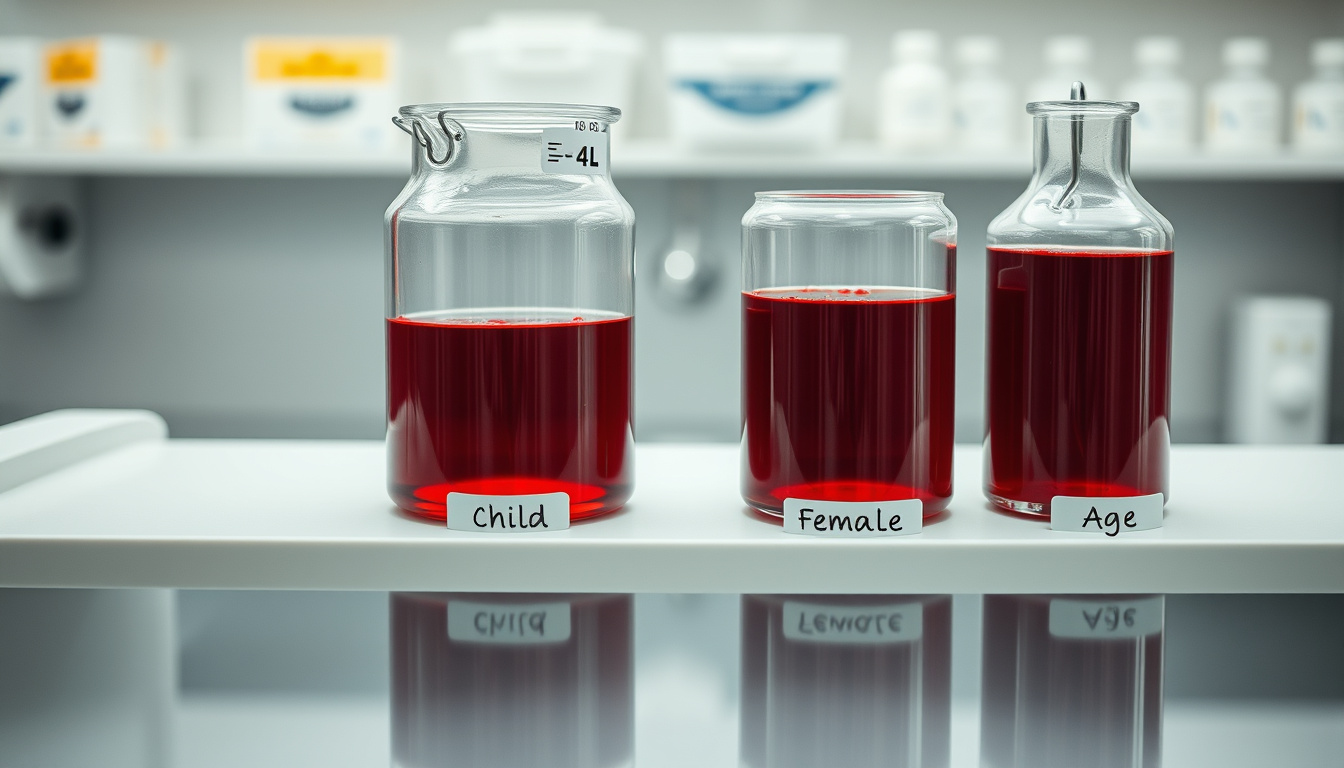
Most textbooks cite around 5 liters for an average adult, but blood volume shifts depending on whether you’re male or female, an infant or an adult, pregnant or not. The full picture involves body weight ratios, demographic variations, and precise formulas that doctors actually use.
Average adult: 5 liters ·
Average female: 4.5 liters ·
Average male: 5.5 liters ·
Infant per kg: 85–100 ml ·
70 kg person: 5 liters
Quick snapshot
- 5 liters average in healthy adults (Healthline)
- Males: 5–6 liters; Females: 4–5 liters (Wikipedia – Blood volume)
- Precise ml/kg ratios for pregnant women (only percentage ranges available)
- Regional altitude variations lack exact numerical thresholds
- Pregnancy plasma peaks at 34–36 weeks (Harvard BioNumbers)
- Infant TBV highest at end of first month (105 ml/kg) (Harvard BioNumbers)
- Blood volume formulas guide clinical transfusions and fluid therapy
- Pregnancy increases require careful monitoring during delivery
These figures establish a baseline for comparing demographic variations across the lifespan.
| Demographic | Blood Volume | Source |
|---|---|---|
| Average total | 5 liters | Healthline |
| Per kg body weight | 70 ml | Wikipedia – Blood volume |
| Male adult | 5.5 liters | Wikipedia – Blood volume |
| Female adult | 4.5 liters | Wikipedia – Blood volume |
| Infant | 75–80 ml/kg | HealthCentral |
| Child (>1 year) | 70–75 ml/kg | Wikipedia – Blood volume |
| Full-term neonate | 85 ml/kg | Healthline |
| Pregnant woman | 30–50% more | Harvard BioNumbers |
How many liters of blood does the human body have?
The human body contains approximately 5 liters of blood on average, though this figure varies considerably by individual factors. Healthline reports that blood makes up roughly 7% of body weight, which aligns with the widely accepted 70 ml per kg formula used in clinical settings.
Adult averages
Adult males typically carry 5–6 liters, while adult females average 4–5 liters. Wikipedia – Blood volume cites 70–75 ml/kg for adult males and approximately 65 ml/kg for adult females. This difference stems from body composition—males on average have more muscle mass, which requires greater blood supply for oxygen delivery.
Factors affecting volume
Beyond sex, blood volume changes with altitude. Vinmec notes that people living at high altitudes produce more erythropoietin, prompting the body to generate additional red blood cells to compensate for lower oxygen availability. Fitness level also plays a role—endurance athletes often have higher plasma volumes than sedentary individuals.
Sex-based differences aren’t trivial in clinical settings—underestimating female blood volume can lead to overtransfusion during surgery, according to research in Interact Cardiovasc Thorac Surg.
How much blood is in a 70 kg person?
A 70 kg adult contains approximately 5 liters of blood, following the standard clinical formula of 70 ml per kilogram of body weight. This estimate works well for average-sized adults but becomes less accurate for very thin or obese individuals, where lean body mass provides a better calculation basis.
Volume per body weight
The 70 ml/kg rule serves as the baseline for most clinical calculations. Wikipedia – Blood volume documents that adult males require 70–75 ml/kg while adult females need approximately 65 ml/kg due to physiological differences in body composition. For a 70 kg male, this translates to roughly 5.25 liters; for a 70 kg female, approximately 4.55 liters.
Calculation methods
Clinicians use more precise formulas depending on context. A 2018 study published in Interact Cardiovasc Thorac Surg establishes gender-specific formulas: ideal body weight multiplied by 75 ml/kg for males or 65 ml/kg for females yields total blood volume. Age adjustments apply as well—adults under 65 use 70 ml/kg while those 65 and older use 60 ml/kg, reflecting physiological changes in vascular capacity.
These gender- and age-specific formulas reveal why a one-size-fits-all approach fails in clinical practice.
| Group | ml/kg ratio | Notes | Source |
|---|---|---|---|
| Adult male | 70–75 | Standard clinical benchmark | Wikipedia – Blood volume |
| Adult female | 65 | Lower due to body composition | Wikipedia – Blood volume |
| Child (>1 year) | 70–75 | Similar to adult ratio | Wikipedia – Blood volume |
| Full-term neonate | 85 | Higher per kg than adults | Healthline |
| Premature neonate | 95 | Highest per kg ratio | YouTube – Medical Video |
| Infant (1 mo–1 y) | 70–80 | Transitional phase | YouTube Shorts |
| Pregnant woman | 30–50% increase | Peaks at 34–36 weeks | Harvard BioNumbers |
| Elderly (>65) | 60 | Reduced vascular capacity | PubMed |
The conventional 70 ml/kg formula systematically underestimates blood volume in pregnant patients because it doesn’t account for plasma expansion—researchers from Interact Cardiovasc Thorac Surg specifically warn this inaccuracy affects haemodilution predictions.
Total blood in human body in litres in male and female
Male and female blood volumes differ systematically due to factors including body size, muscle mass, and hormonal influences. While an average adult male carries approximately 5.5 liters, the average adult female holds around 4.5 liters—a difference of roughly one liter that has significant implications for medical dosing and transfusion protocols.
Male vs female differences
When normalized to lean body mass rather than total weight, the gap narrows considerably. Research published in Wiley – AJH shows females carry approximately 14 g/kg lean body mass while males carry about 15 g/kg. A large paediatric study in PMC – Archives of Disease in Childhood documents red cell volume per body weight at 25.3 ± 4.7 ml/kg for males versus 22.4 ± 4.88 ml/kg for females, though these differences diminish when plasma volume is normalized to lean body mass (57.8 ± 9.1 ml/kg for males vs 58.3 ± 10.5 ml/kg for females).
By age groups
Blood volume per kilogram changes throughout the lifespan. HealthCentral reports that infants and young children have 75–80 ml/kg, with the highest values occurring in the first four weeks of life (85–105 ml/kg). Children aged 6–12 years settle at approximately 70 ml/kg, similar to adult ratios. Our Blood Institute confirms children roughly follow this 70 ml/kg pattern through pre-adolescence.
For pediatric dosing, clinicians should calculate from actual weight rather than age estimates—PMC – Archives of Disease in Childhood demonstrates substantial individual variation even within the same age group.
How many litres of blood can a human lose before dying?
The human body can survive losing up to 40% of its blood volume with proper medical intervention, but losing more than that threshold typically results in fatal outcomes without immediate transfusion. Understanding these thresholds matters for emergency medicine, surgical planning, and trauma response protocols.
Fatal loss thresholds
Rapid loss of 20–30% of blood volume causes mild to moderate shock, characterized by rapid heartbeat, pale skin, and anxiety. Losing 30–40% causes severe shock with confusion, clammy skin, and declining blood pressure. Beyond 40%, irreversible organ damage begins, and without emergency intervention, death follows within hours.
Survival limits
The critical factor isn’t just volume but rate of loss. A healthy adult can survive losing 4 liters of blood over 24 hours if fluids are replaced, but rapid hemorrhage of 2 liters in minutes overwhelms compensatory mechanisms. Medical protocols typically trigger transfusion when hemoglobin drops below specific thresholds rather than waiting for clinical shock signs to appear.
The implication is that trauma teams must prioritize hemorrhage control and rapid transfusion over volume replacement in acute bleeding scenarios.
A person weighing 70 kg with 5 liters of blood would lose their entire circulating volume if they lost 100%—survival is physiologically impossible at that threshold, regardless of medical intervention. For the average adult, losing 40% (approximately 2 liters for an average male) represents the functional limit of survivability.
Is 2 liters a lot of blood?
Two liters represents approximately 40% of a healthy adult’s total blood volume, which places it squarely in the life-threatening range. While not immediately fatal with treatment, this amount triggers measurable physiological distress and requires prompt medical attention to prevent shock progression.
Blood loss stages
Blood loss progresses through clinically defined stages. Class I hemorrhage (up to 15% of blood volume, roughly 750 ml in an average adult) causes minimal symptoms. Class II (15–30%, or 750 ml–1.5 liters) produces elevated heart rate and slight blood pressure changes. Class III (30–40%, or 1.5–2 liters) brings obvious shock signs including tachycardia, hypotension, and altered mental status. Class IV (>40%) represents immediately life-threatening shock.
Effects of 2 liters
Losing 2 liters (the 40% threshold for an average adult) causes rapid heart rate exceeding 120 beats per minute, significantly lowered blood pressure, confusion or anxiety, decreased urine output, and cool, clammy skin as the body attempts to redirect blood to vital organs. Without transfusion, organ perfusion fails within minutes to hours depending on the patient’s baseline health.
What this means is that emergency departments must treat a 2-liter hemorrhage as a surgical emergency, not a medical one requiring immediate intervention.
Upsides
- Blood volume is well-documented across demographics with validated clinical formulas
- Predictable per-kg ratios enable accurate dosing for transfusions and anesthesia
- Pregnancy increase is well-characterized (peaks at 34–36 weeks)
- Survival thresholds for blood loss are clinically established
Downsides
- Precise ml/kg for pregnant women lacks primary source confirmation
- Altitude variation data remains qualitative rather than quantitative
- Individual variation within groups can be substantial
- Conventional 70 ml/kg formula underestimates female blood volume
“A healthy woman bearing a normal sized fetus will increase her plasma volume by an average of about 1250 ml, a little under 50% of the average non-pregnant volume.”
— Hytten F., Author, Blood volume changes in normal pregnancy
“The conventional formula is unable to predict the actual haemodilution rate accurately.”
— Researchers, Interact Cardiovasc Thorac Surg (2018 study)
“Pregnant people usually have anywhere from 30 to 50 percent more blood volume than women who are not pregnant.”
— Rachel Nall, MSN, CRNA, Healthline Medical Author
The implications of these variations extend well beyond academic interest. For anesthesiologists calculating induction doses, trauma surgeons preparing for hemorrhage, or obstetricians managing delivery hemorrhage risk, accurate blood volume estimation isn’t optional—it’s foundational to patient safety. The clinical formulas documented in peer-reviewed surgical research specifically call out the dangers of applying a one-size-fits-all 70 ml/kg formula to female patients, where it systematically underestimates circulating volume by roughly 10–15%.
Related reading: How Much Water Should You Drink a Day · Why Am I Always Cold
Frequently asked questions
Can a person have 7 liters of blood?
Yes, pregnant women can carry up to 7 liters—roughly 50% more than their non-pregnant baseline. Healthline reports that pregnancy increases blood volume by 30–50%, while Harvard BioNumbers documents plasma volume increases of approximately 1250 ml in healthy pregnancies. Large adult males with substantial body mass may also approach 6–7 liters using the 75 ml/kg formula at higher body weights.
Can you lose 4 litres of blood and survive?
Surviving a 4-liter blood loss (approximately 80% of total volume for an average adult) is physiologically improbable without immediate massive transfusion protocols. The survivable threshold sits at around 40% total volume loss for healthy adults. Losing 4 liters would exceed this threshold by a factor of two, causing irreversible hypovolemic shock despite aggressive intervention. In surgical settings with rapid transfusion support, trauma teams have occasionally saved patients approaching this volume loss, but outcomes remain poor.
How many litres of blood in human body child?
Children over one year have approximately 70–75 ml/kg blood volume, according to Wikipedia – Blood volume. Our Blood Institute specifies children aged 6–12 years follow roughly 70 ml/kg. An average 7-year-old weighing 22 kg would carry approximately 1.5–1.65 liters. Blood volume as a percentage of body weight is slightly higher in children (8–9%) compared to adults (7–8%) according to Vinmec.
How many litres of blood in human body when pregnant?
Pregnant women typically carry 30–50% more blood than non-pregnant women. A woman with a non-pregnant volume of 4.5 liters could reach 5.85–6.75 liters during pregnancy. Healthline describes this as approximately 0.3–0.4 additional gallons (1.1–1.5 liters). Plasma volume peaks at 34–36 weeks of gestation, according to Harvard BioNumbers, with a documented increase of about 1250 ml over non-pregnant baseline.
How many units of blood in human body?
One unit of donated blood equals approximately 450–500 ml. An average adult with 5 liters contains roughly 10–11 units of blood. Blood banks and clinical settings measure transfusion in units precisely for this reason—each unit represents a standardized volume that allows accurate dosing. A trauma patient receiving 6 units (approximately 2.7–3 liters) has received about half their total blood volume.
Minimum blood level in human body?
The minimum viable blood volume for an average adult is approximately 60% of normal—around 3 liters for a typical 5-liter adult. Below this threshold, the circulatory system cannot maintain adequate perfusion pressure despite compensatory mechanisms. This minimum varies by individual health status, age, and how rapidly volume loss occurs. Clinical protocols define transfusion thresholds based on hemoglobin concentration (typically below 7–8 g/dL) rather than exact volume percentages.
How many liters of blood can you lose?
Adults can survive losing up to 40% of their blood volume with immediate medical treatment—approximately 2 liters for an average 5-liter adult. Beyond this threshold, hypovolemic shock becomes irreversible without massive transfusion. The rate of loss matters as much as total volume—a 1-liter hemorrhage occurring within minutes is far more dangerous than the same volume lost over hours. Clinical classification divides hemorrhage into four classes, with Class IV (>40%) representing immediately life-threatening blood loss.

Arthur Oliver Howard Fletcher is a staff writer for NationalReport.uk, covering UK national news, politics, the economy and public services. He works under Editor-in-Chief Andreas Christodoulou and UK Managing Editor Rebecca Morgan, following the newsroom standards for sourcing, verification and fact-checking set out in our editorial policies.