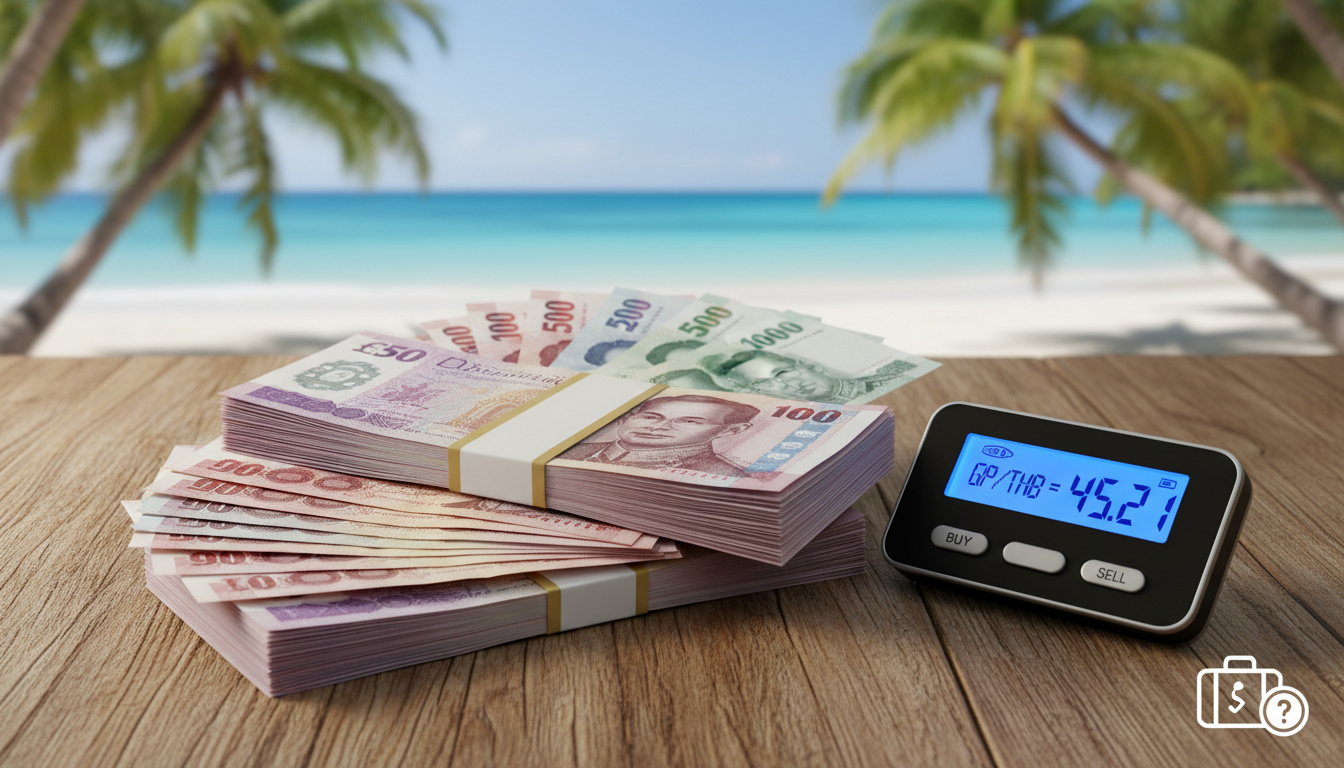
The sterling to baht exchange rate determines how far British currency stretches across Thailand’s tourism hotspots and business districts. Mid-March 2026 data positions the conversion between approximately 42.92 and 43.55 Thai baht per pound, though intraday movements continuously reshape this figure.
Travelers and expatriates monitoring the pound to thai baht dynamic face a landscape shaped by UK inflation pressures, Thai economic resilience, and broader US dollar fluctuations. Recent volatility—a 2.03% weekly decline followed by sharp daily recoveries—underscores the importance of timing conversions strategically.
This examination provides verified mid-market rates, historical context through 2026, and practical guidance for securing optimal exchange values without speculative forecasting.
What is the Current Pound to Thai Baht Exchange Rate?
As of mid-March 2026, the pound sterling buys between 42.92 and 43.55 Thai baht depending on the source and timestamp. Wise data recorded a rate of 43.5130 THB on March 19, while Xe reported 42.8613 THB on March 15, illustrating the pair’s sensitivity to market sessions.
43.51 THB
+0.52%
41.69 – 43.81
Moderate-High
Key Market Indicators
- Weekly Decline: The pair dropped 2.03% over seven days despite intraday recoveries.
- 2026 Peak: 43.5532 THB recorded on March 18, per ExchangeRates.org.uk data.
- Year-to-Date Average: 42.4383 THB represents the mean conversion value for 2026.
- Recent Low: 41.6861 THB on February 28 marks the worst rate this year.
- Dollar Correlation: GBP/USD at 1.33276 influences baht cross-rate calculations.
- Daily Amplitude: March 15 saw the largest 24-hour movement at +0.521%.
| Metric | British Pound (GBP) | Thai Baht (THB) |
|---|---|---|
| Currency Symbol | £ | ฿ |
| ISO Code | GBP | THB |
| Central Bank | Bank of England | Bank of Thailand |
| Introduction Date | 8th Century (decimal 1971) | 1897 (decimal 1928) |
| Subunit | Penny (1/100) | Satang (1/100) |
| Common Usage | United Kingdom | Thailand |
| Fiat Status | Fiat | Fiat |
| Exchange Rate Regime | Floating | Managed Float |
What is the Historical GBP to THB Rate?
Historical data reveals significant fluctuations within the first quarter of 2026 alone. ExchangeRates.org.uk archives show a 4.4% spread between the year’s nadir and peak, with sterling testing support near 41.70 THB before rallying above 43.50 THB.
March 2026 Performance
The month opened at 42.1521 THB on March 3, establishing a baseline before volatile swings. Alanchand data tracked the ascent to 42.9 THB by March 18, followed by an interday surge to 43.5 THB on March 19—a movement of nearly 1.4% within hours.
Annual Volatility Patterns
Three-month statistics compiled by exchange rate monitors indicate a consistent average of 42.3 THB, with the maximum reaching 43.3 THB. The one-year performance shows a net decline of 1.29%, suggesting gradual sterling weakness against the baht despite short-term recoveries.
Mid-market rates represent the midpoint between global buy and sell prices. Consumer rates at banks and airports typically deduct 2-5% from these figures through spreads and fees.
What is the Pound to Thai Baht Forecast?
Predictive modeling for the sterling-baht pair remains constrained by limited forward-looking data sets. Analysis focuses primarily on 2026 observed performance rather than speculative 2025 projections, which remain unavailable in current financial databases.
Immediate Trajectory
Current momentum suggests continued volatility within the 42.00-44.00 THB channel. The recent rejection of sub-42.00 levels indicates potential support, though resistance near 43.80 THB has capped advances during March trading sessions.
Long-term Uncertainties
Absence of specific 2025 forecasts from major financial institutions limits certainty. Rate determination depends heavily on unresolved Bank of England monetary policy trajectories and Thailand’s tourism sector recovery metrics—factors resisting quantifiable prediction.
Exchange rate predictions carry significant uncertainty. Past performance does not indicate future results, and unexpected geopolitical or macroeconomic events can render short-term forecasts obsolete within hours.
Where to Get the Best Pound to Thai Baht Exchange Rate?
Execution venue significantly impacts realized exchange values. Wise and Revolut currently offer rates tracking closer to mid-market levels than traditional banking channels, though fee structures vary by transaction size.
Digital Transfer Platforms
Mobile applications provide continuous rate monitoring capabilities essential for timing conversions. Revolut updates pricing in real-time to reflect interbank fluctuations, while Wise maintains historical data sets allowing users to identify favorable entry points for large transfers.
Physical Exchange Strategies
For travelers requiring cash baht, ATM withdrawals in Thailand typically outperform airport kiosks and hotel exchange desks by 3-7%. Card-based transactions processed through multi-currency accounts eliminate double-conversion penalties common with standard debit cards.
Avoid exchanging currency at airport terminals or hospitality venues where margins exceed 5%. Instead, withdraw from Thai ATMs using cards with zero foreign transaction fees, or preload digital wallets when rates favor sterling strength.
When Did Key GBP to THB Rate Movements Occur?
Chronological analysis of 2026 reveals specific dates when sterling experienced significant revaluation against the baht.
- : Sterling hits annual low of 41.6861 THB amid UK economic data releases.
- : Rate stabilizes at 42.1521 THB as markets absorb fiscal policy announcements.
- : Exchange-Rates.org confirms 2026 average at 42.386 THB.
- : Largest single-day gain of +0.521% recorded on Xe platforms.
- : Peak rate of 43.5532 THB achieved before profit-taking.
- : Slight retracement to 43.5146 THB maintains elevated levels.
What Do We Know for Certain About GBP to THB Rates?
Distinguishing verified data from market speculation helps manage exchange expectations.
Established Data
- Mid-market rates between 42.92-43.55 THB valid for mid-March 2026
- 2026 annual high: 43.5532 THB (March 18)
- 2026 annual low: 41.6861 THB (February 28)
- Year-to-date average: 42.4383 THB
- Seven-day decline measured at 2.03%
Uncertain Factors
- Specific 2025 forecast models
- Precise impact of Bank of England policy shifts
- Bank of Thailand intervention thresholds
- Future USD strength correlation coefficients
- Tourism sector recovery velocity impacts
Why Does the Pound to Thai Baht Rate Fluctuate?
Currency valuation between the United Kingdom and Thailand reflects divergent economic cycles and monetary frameworks. Sterling responds to domestic inflation metrics, fiscal policy decisions—including measures related to consumer support such as Pensioner Energy Saving Advice—and trade balance dynamics.
The Thai baht maintains relative resilience through tourism revenue inflows and export competitiveness, though it remains susceptible to regional capital flow shifts. Recent GBP weakening correlates with broader dollar strength (GBP/USD at 1.33276), creating cross-pressure in the sterling-baht pair as both currencies navigate global liquidity conditions.
Compared to other Southeast Asian currencies, the baht’s managed float regime allows controlled flexibility, whereas sterling operates under full floating conditions. This structural difference occasionally amplifies volatility during periods of global risk aversion.
What Do Financial Data Sources Say?
Primary data aggregators provide the foundation for rate monitoring.
The GBP to THB exchange rate has decreased by 2.03% over the last 7 days, with the largest 24-hour move recorded at +0.521% on March 15.
— Wise Currency Data, March 2026
The best exchange rate for 2026 was 43.5532 THB on March 18, while the worst was 41.6861 THB on February 28, yielding an average of 42.4383 THB.
— ExchangeRates.org.uk Historical Archive
Key Takeaways on Pound to Thai Baht
The sterling-baht exchange rate currently trades near 43.51 THB, operating within a 2026 channel of 41.69 to 43.81 THB. Travelers and transfer specialists should prioritize mid-week conversions when volatility typically decreases, utilize digital platforms over physical exchanges, and monitor Exchange Rate Pound to Dollar movements as leading indicators for broader sterling strength. Real-time verification remains essential as rates shift continuously across global trading sessions.
Frequently Asked Questions
How do I convert GBP to THB accurately?
Use mid-market rate calculators from verified financial data providers. Multiply your sterling amount by the current rate (approximately 43.51 THB per £1), then account for platform fees which typically range 0.5-2% below the displayed rate.
Is GBP stronger than THB?
Yes. One pound sterling purchases over 43 Thai baht, indicating significantly greater relative value. However, purchasing power parity varies by local price levels.
What is the best pound to baht rate for Thailand travel?
Optimal rates occur through Thai ATMs using zero-fee cards or digital wallets like Revolut/Wise at mid-market pricing. Avoid airport exchanges where spreads exceed 5%.
Why does the GBP to THB rate change daily?
Floating exchange rates respond to UK and Thai economic data releases, interest rate differentials, geopolitical events, and USD strength fluctuations within 24-hour global trading cycles.
Should I exchange pounds before traveling to Thailand?
Minimal cash exchange is advisable pre-departure. Carry small sterling notes for immediate expenses, then utilize ATMs or digital payment apps upon arrival for superior rates.
How do transfer services compare to banks?
Specialist services typically offer rates 2-4% closer to mid-market than high-street banks, with lower fixed fees for transfers exceeding £1,000.

Arthur Oliver Howard Fletcher is a staff writer for NationalReport.uk, covering UK national news, politics, the economy and public services. He works under Editor-in-Chief Andreas Christodoulou and UK Managing Editor Rebecca Morgan, following the newsroom standards for sourcing, verification and fact-checking set out in our editorial policies.