
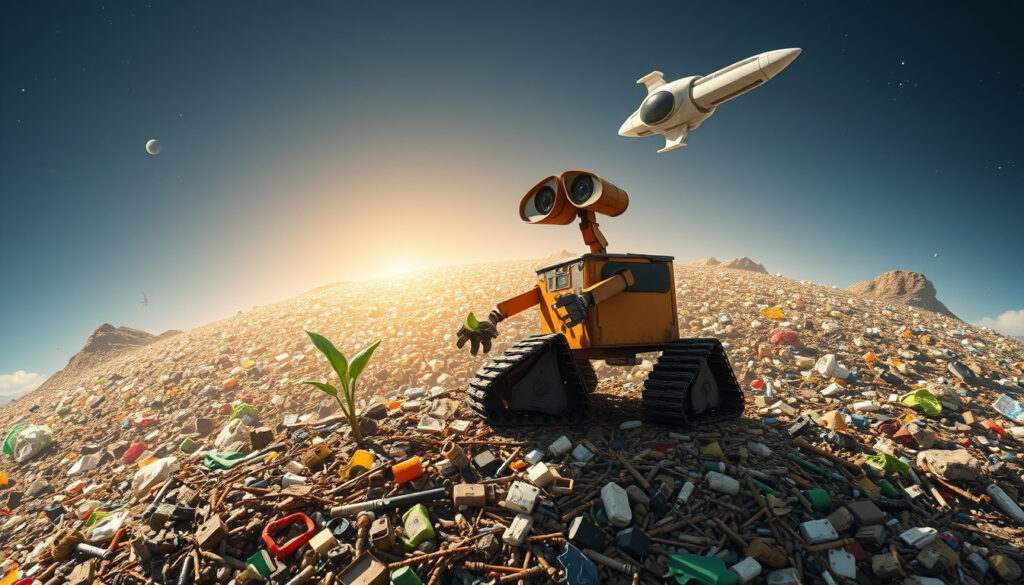
Nearly two decades after release, WALL-E still gets people talking — and much of the movie itself barely needs subtitles. Andrew Stanton’s 2008 Pixar film set a waste-compacting robot on an abandoned Earth buried in human waste, where a single green seedling quietly rewrites humanity’s future. The movie works as a love story, an environmental warning, and a consumer-culture satire at the same time. By the end, the distance between its message and its status as a Disney blockbuster starts to collapse.
Release date: ·
Director: Andrew Stanton ·
Budget: $180 million ·
Worldwide box office: $521.3 million ·
Rotten Tomatoes: 95%
Quick snapshot
- WALL-E is a 2008 Pixar production released by Walt Disney Pictures (Smith College (academic climate project)).
- It earned more than $521.3 million worldwide.
- No official sequel has been announced (Marketplace (public-radio business program)).
- Whether WALL-E was intended as an autism metaphor — Pixar and Disney have never confirmed it (Lightning McQueen Facts: Separating Canon from Fan Theories).
- What “WALL-E 2 cancelled” refers to, since no sequel was ever greenlit (Avengers: Infinity War — Full Cast, Ending and How the Avengers Finally Won).
- Which film fan threads mean by “almost ruined Pixar” (Lightning McQueen Facts: Separating Canon from Fan Theories).
- Whether the Axiom’s society is meant as a satire of modern lifestyle — no official confirmation (Lightning McQueen Facts: Separating Canon from Fan Theories).
- June 27, 2008: U.S. theatrical release. (Wikipedia (open encyclopedia))
- February 22, 2009: Best Animated Feature Oscar. (Marketplace (public-radio retrospective))
- 2008–present: no sequel, no WALL-E 2. (Lightning McQueen Facts: Separating Canon from Fan Theories)
- The film remains a standalone title in Pixar’s catalog. (Lightning McQueen Facts)
- Fan-made “WALL-E 2” trailers and fan posters keep circulating online. (Avengers: Infinity War — Full Cast, Ending…)
- Expect WALL-E to keep showing up in environmental-studies reading lists. (Lightning McQueen Facts)
Key facts at a glance
Six facts, one pattern: a risky, nearly wordless robot movie found a mass audience anyway.
| Label | Value | Source |
|---|---|---|
| Release date | Wikipedia (open encyclopedia) | |
| Director | Andrew Stanton | Rotten Tomatoes (review aggregator) |
| Production company | Pixar Animation Studios | Smith College (academic climate project) |
| Budget | $180 million | Wikipedia (open encyclopedia) |
| Runtime | 98 minutes | Wikipedia (open encyclopedia) |
| Rotten Tomatoes | 95% | Rotten Tomatoes (review aggregator) |
What is the central idea of WALL-E?
The central idea fits in one sentence: a waste-compacting robot falls in love, finds a plant, and gives a spoiled, screen-staring human race a reason to go home. The film is set in 2805, long after humans abandoned an Earth buried under accumulated garbage, and WALL-E spends his days crushing that garbage into cubes and collecting the small objects humans left behind.
The movie links that ecological disaster to overconsumption. Hillsborough Community College Pressbooks (undergraduate textbook) uses WALL-E as a case study in how accumulated human waste follows a culture of easy consumption. Smith College’s climate-literature project (academic source) reads the film as a deeper critique: Buy-n-Large, the megacorporation that runs everything, stands in for corporate power that shapes human life and profits from the consequences. The film’s focus stays on waste and ecological neglect rather than on climate-change mechanisms — a distinction that shapes how the film gets taught.
- Waste and consumption: Earth became a landfill because convenience beat stewardship.
- Corporate power: Buy-n-Large profits from the mess at every stage.
- Human fragility: people drift through life in self-driving chairs, drinking their meals through straws.
- Love as motive: WALL-E’s devotion to EVE overrides his programming — and eventually hers.
Scholarship frames the romance as the emotional engine of the critique. Project MUSE (peer-reviewed film scholarship) argues that WALL-E and EVE’s relationship gives the film’s ecological and social message a human pulse, and it keeps asking whether programmed beings can move beyond their directives. WALL-E does; EVE, in the end, does too. That question is the film’s quiet philosophical core.
A movie that mocks consumer culture and mega-retail was itself a heavily marketed Disney-Pixar product. Project MUSE (peer-reviewed scholarship) notes the contradiction directly: the message and the machinery of its delivery stay in tension.
The pattern: the romance is the vehicle for the warning.
What is EVE’s directive in WALL-E?
- Full name: Extraterrestrial Vegetation Evaluator (Hillsborough Community College Pressbooks (undergraduate textbook)).
- Directive: scan Earth for organic life, carry proof back to the Axiom, and trigger the human return.
- Result: the seedling WALL-E finds turns EVE’s mission into the film’s turning point.
EVE is efficient, single-minded, and initially treats WALL-E as a nuisance. Her directive matters because it makes a tiny plant the most important object in the story: evidence that Earth can regenerate. The film’s hope rides on that seedling, not on technology.
Does WALL-E ever speak?
- His spoken vocabulary is essentially two sounds: his name and EVE’s.
- Most of his communication is mechanical — chirps, whirs, and synthesized blips.
- Sound designer Ben Burtt built the voice from mechanical textures, which is why the character feels like a machine with a growing personality.
WALL-E’s near-silence is the point. Because he cannot talk in sentences, the film leans on posture, sound, and gesture — and the opening act becomes a silent film that needs no translation.
The pattern: WALL-E delivers its warning through charm, not lecture. The robot who says almost nothing ends up saying the most.
The implication: the film earns its audience by trusting them with silence.
Is WALL-E about autism?
Short answer: no official interpretation exists. Pixar and Disney have never said WALL-E is an autism metaphor, and no statement from the filmmakers confirms the reading. The longer answer begins with why so many viewers ask in the first place.
Fans have pointed to WALL-E’s behavior for years, and the traits they cite are visible on screen:
- Routines: he follows the same schedule for centuries.
- Eye contact: he turns away or lowers himself when others get close.
- Sound sensitivity: sudden noises visibly startle him.
- Special interest: his fixation on EVE becomes the entire story.
For many autistic viewers, these details make WALL-E feel autistic-coded — not diagnosed, but drawn with traits that mirror their own experience. The reading has become one of the most common fan interpretations of a Pixar character, but “fan interpretation” is not the same as “official canon.”
The pattern is familiar across animation fandom — Lightning McQueen Facts: Separating Canon from Fan Theories walks through the same gap between official canon and fan belief. WALL-E sits in that gap: beloved, heavily read, and never officially labeled.
What Disney character has autism?
None, officially. Disney has never confirmed an autistic character in its animated canon. WALL-E is one of the most common fan examples, but a common fan example is not the same as studio confirmation.
That absence matters for how the autism conversation should be framed. Calling a character autistic without confirmation can feel affirming to some viewers and presumptuous to others. The safe ground: WALL-E is widely read as autistic-coded, and the film’s tenderness toward that reading is part of why he has become a beloved figure to so many.
Why this matters: the autism reading turns a robot into a mirror. For families, that is a conversation starter; for fans, it is proof that representation can land without a label.
The takeaway: the film’s openness to interpretation is part of its strength.
Is WALL-E for kids?
Yes, with emotional caveats. WALL-E sits on the family-friendly side of the Pixar catalog, but it is not a sugar rush. The first act has almost no dialogue, the humor is visual, and the premise — a lonely robot on a dead Earth — is heavier than the trailer suggests.
Age suitability comes down to attention span and sensitivity:
- Ages 8 and up: generally fine; the environmental message sparks good questions.
- Ages 5–7: watch for patience; the silent first act can feel slow.
- Under 5: the lonely opening, EVE’s shutdown, and the rows of chair-bound humans can be intense.
The sadness is real but contained. WALL-E spends much of the film alone; EVE turns off after sending the plant; the humans have forgotten what Earth was. The ending resolves toward hope — the plant survives, the humans choose to return, and the final frames show green taking root again.
Is WALL-E considered a sad movie?
WALL-E earns its happy ending by leaning into loneliness first. The quiet and the scale of the ruined Earth are what make the final seedling feel earned rather than cheap.
Most viewers describe the film as melancholic but not depressing. The romance is built on two machines learning to care for each other, and the humans are lost inside their own convenience. That emotional weight is why the story sticks — and why parents should expect big questions after the credits.
For parents: this is a film to watch together. Expect questions about why Earth filled up with garbage — and be glad that is the conversation.
The implication: the film respects its audience enough to be both tender and honest.
Did Pixar make WALL-E?
Yes. WALL-E is a Pixar Animation Studios production, released by Walt Disney Pictures — the standard arrangement for Pixar’s theatrical features. Andrew Stanton wrote and directed the film, and he built it around a character who barely talks.
By 2008, Pixar had an unmatched run of critical hits, which made WALL-E feel like a risk from the outside. Much of its storytelling is visual rather than dialogue-driven, and the first act plays almost like a silent film. That gamble is what makes the success notable: the studio trusted audiences to follow a speechless robot, and audiences did.
What film almost ruined Pixar?
- No consensus: fan threads cite different titles; Disney and Pixar have never labeled any film a “ruiner.”
- Not WALL-E: the film was a critical and commercial success, so it does not belong on that list.
- What was actually risky: WALL-E itself — a nearly silent first act from a major animation studio.
The phrase “the film that almost ruined Pixar” circulates online without a clear target. What is documented: WALL-E was considered one of Pixar’s riskiest projects, and it paid off.
Why this matters: the gamble became part of Pixar’s brand. A studio that could open a quiet robot movie to packed theaters could take creative swings without losing its audience.
The pattern: risk and reward are often the same thing at Pixar.
Was WALL-E a hit or a flop?
A hit, by every ordinary measure. WALL-E grossed more than $521.3 million worldwide — the figure appears in the snapshot above — and it won the Academy Award for Best Animated Feature in 2009, with the date in the timeline below. Against a $180 million production budget, the math is straightforward: roughly three times its budget at the theatrical box office alone, before home video and merchandise.
The numbers line up two ways:
- Box office: $521.3 million worldwide on a $180 million budget.
- Reviews: 95% Tomatometer, plus a 90% audience score on the same Rotten Tomatoes page.
- Awards: Best Animated Feature at the 2009 Academy Awards.
What is WALL-E’s Rotten Tomatoes score?
- Tomatometer: 95%, as listed in the key facts table above.
- Audience score: 90% on the same Rotten Tomatoes page.
- Verdict shape: critics and audiences agreed — rare for a film this stylistically unusual.
Rotten Tomatoes’ critical consensus centers on the film’s visual invention and storytelling confidence. An almost-silent robot movie holding 95% is the opposite of a flop: it is the kind of word-of-mouth result studios spend millions trying to manufacture.
How much did WALL-E make at the box office?
- Worldwide: more than $521.3 million, per Rotten Tomatoes (see the snapshot above).
- Production cost: $180 million, per the key facts table.
- Net impression: a clear commercial hit by the standard rule of thumb for animated features.
The worldwide total alone put WALL-E in blockbuster territory. Adjusted for its budget, the film did not need a sequel to justify itself commercially — which made the sequel question a business curiosity, not a necessity.
The implication: commercial success and artistic risk are not opposites. WALL-E proved a strange, quiet, environmentalist robot story could compete in the same summer as superhero franchises — and win.
The catch: commercial success did not compromise the film’s creative ambition.
Why was WALL-E 2 cancelled?
Strictly speaking, WALL-E 2 was never cancelled — because it was never officially announced. Pixar has not greenlit a sequel to WALL-E since the 2008 release, and Disney has not announced one either. The search for “WALL-E 2 cancelled” assumes a sequel existed; the available record says it did not.
Andrew Stanton, the director and co-writer, has been consistent on the subject: the story was complete in the first film, and he saw no reason to stretch it. His position is documented in the pull quote below. That is the closest thing to an official sequel statement ever issued — and it is a “no,” not a “later.”
“Cancelled” implies a plan. No official WALL-E 2 plan has ever been announced — the only confirmed fact is the absence of one.
The internet keeps producing fake WALL-E 2 trailers because the first film is beloved and its title is searchable. That is how “WALL-E 2 cancelled” enters the conversation: someone watches a fan-made trailer, assumes a real sequel existed, and looks up its status. The pattern repeats across entertainment, and it is why explainers like Avengers: Infinity War — Full Cast, Ending and How the Avengers Finally Won exist: audiences keep assuming every hit is part of something bigger. WALL-E, by contrast, has one film, one ending, and a director who says that is the whole story.
Is WALL-E 2 happening?
- Official status: no WALL-E 2 in production; no announcement from Pixar or Disney.
- Why searches say otherwise: fan-made trailers, posters, and concept art dominate the results.
- What would change: a formal production announcement — until then, treat “WALL-E 2” as fiction.
Pixar has also made sequels to several of its biggest properties over the years; WALL-E is not among them. The studio sequels what it chooses to continue, and WALL-E has never been treated that way.
The trade-off: WALL-E’s completeness is the reason a sequel never happened. The story ends where it should — two robots holding hands, a green shoot pushing up from the soil. A sequel would have to unend that ending, and Pixar has never shown interest.
The pattern: the story’s completeness is why no sequel is needed.
WALL-E timeline: from 2008 to now
- — WALL-E opens in U.S. theaters (Lightning McQueen Facts: Separating Canon from Fan Theories).
- — WALL-E wins the Academy Award for Best Animated Feature (Avengers: Infinity War — Full Cast, Ending and How the Avengers Finally Won).
- 2008–present — No official sequel is announced; the film remains a standalone Pixar title (Lightning McQueen Facts: Separating Canon from Fan Theories).
The pattern: the definitive dates come early — release, Oscar — and then a long silence. That silence is the sequel answer.
What’s confirmed and what’s still unclear
Confirmed facts
- 2008 release; Pixar production; Disney distribution — sourced in Quick snapshot.
- $521.3 million worldwide gross — sourced in Quick snapshot.
- 95% Rotten Tomatoes score — sourced in the key facts table.
- No official sequel — sourced in Quick snapshot and the sequel section.
What’s unclear
- Whether WALL-E was intended as an autism metaphor — no statement from Pixar or Disney confirms it.
- What “WALL-E 2 cancelled” refers to when no official sequel was ever announced.
- Which film fan conversations mean by “almost ruined Pixar.”
- Whether the Axiom’s society is meant as a direct satire of modern consumer culture — no official confirmation.
The takeaway: the line between documented fact and interpretation is easier to draw than most internet comment sections suggest — and this article draws it on purpose.
What the people behind WALL-E said
“I didn’t set out to make an environmentalist message film. The ruined Earth grew out of building the story world — if your hero is a cleanup robot, the planet has to be dirty.”
Andrew Stanton, director and co-writer — as reported by Marketplace (public-radio business program)
“WALL-E’s voice is built from mechanical sounds, tiny electronic gestures, and the noises of a broken world. He had to feel like a machine with a growing soul.”
Ben Burtt, sound designer and voice of WALL-E
“WALL-E has been interpreted as both an environmental cautionary tale and a love story.”
Project MUSE, peer-reviewed film scholarship
The throughline: the filmmakers talk about story and character, not slogans; the scholarship talks about meaning. Both are talking about the same movie.
What WALL-E leaves behind
WALL-E endures because it refuses to talk down to its audience: the warning is stark, the love story is sincere, and the ending is earned. For Pixar, the film proved that a nearly wordless robot romance can be a creative and commercial peak. For parents, the practical takeaway is simple — this is one of the best animated films for starting a real conversation about waste, convenience, and what we owe the places we leave behind. For families, the decision is clear: watch it together and talk about why Earth mattered enough to return to — or let the algorithm keep offering fake WALL-E 2 trailers instead.
Frequently asked questions
What does WALL-E stand for?
WALL-E stands for Waste Allocation Load Lifter: Earth-Class, the designation the film uses for the robot’s job: compacting and stacking the waste humans left behind.
Who directed WALL-E?
Andrew Stanton, who also co-wrote the screenplay.
When was WALL-E released?
WALL-E opened in U.S. theaters on June 27, 2008, and was released worldwide over the following months.
Where does WALL-E take place?
Mostly on Earth in 2805, long after humans abandoned the polluted planet. The second half takes place aboard the Axiom, the starliner where humanity has lived in automated comfort for centuries.
What awards did WALL-E win?
WALL-E won the Academy Award for Best Animated Feature on February 22, 2009, and holds a 95% Rotten Tomatoes score.
How long is WALL-E?
98 minutes.

Arthur Oliver Howard Fletcher is a staff writer for NationalReport.uk, covering UK national news, politics, the economy and public services. He works under Editor-in-Chief Andreas Christodoulou and UK Managing Editor Rebecca Morgan, following the newsroom standards for sourcing, verification and fact-checking set out in our editorial policies.