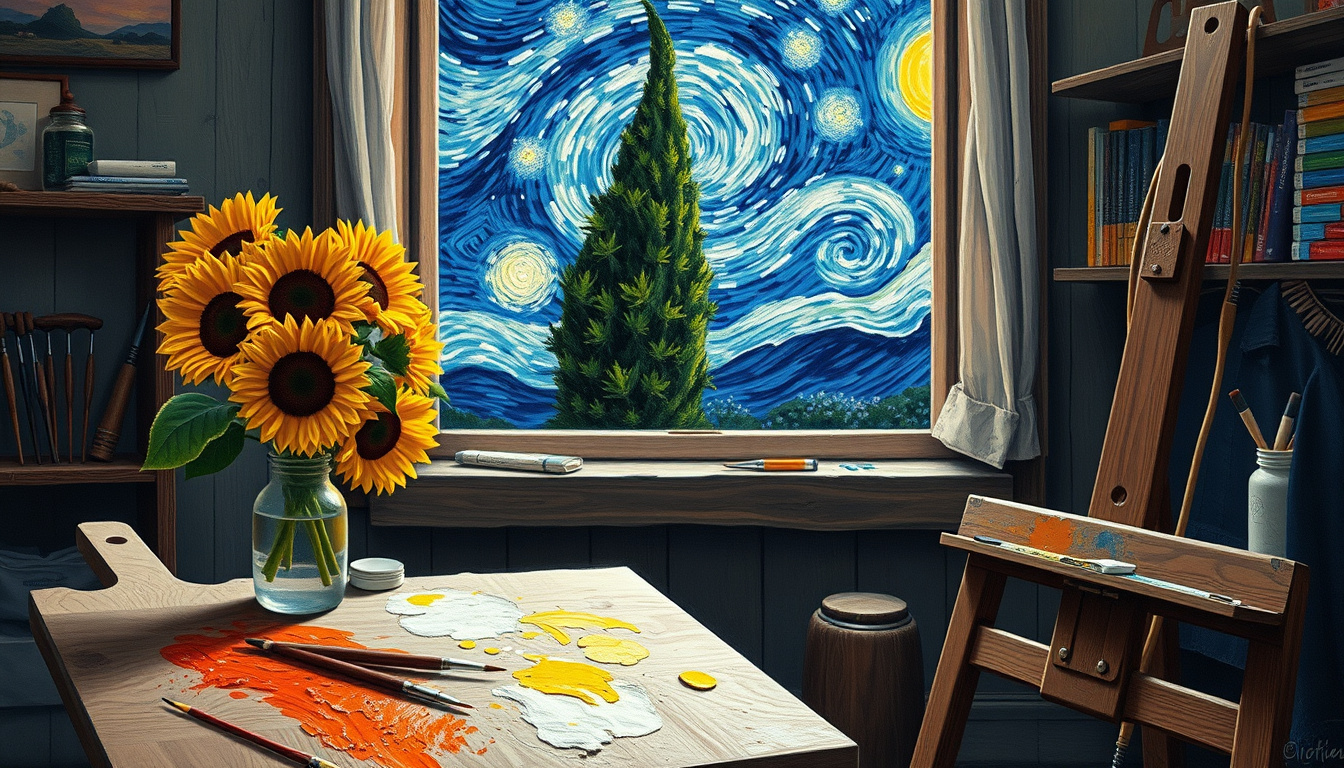
Few painters trigger the same double take as Vincent van Gogh — a man who died believing he had failed, with just a handful of canvases sold in his lifetime (The Red Vineyard is the one most commonly cited as confirmed, according to the Van Gogh Museum), and whose work now anchors entire museum wings and auction headlines. Which movement did he belong to? How did he build those ridged, unprintable surfaces? Why did The Starry Night disappoint him? Can a real Van Gogh actually be bought? The answers are rawer than the myth.
Born: March 30, 1853 ·
Died: July 29, 1890 ·
Movement: Post-Impressionism ·
Oil Paintings: 860 ·
Active Years: 10 (1880–1890) ·
Lifetime Sales: Fewer than 10 (The Red Vineyard confirmed)
Quick snapshot
- Post-Impressionist: Van Gogh is grouped with the generation that reacted against Impressionism (Kröller-Müller Museum).
- Volume: more than 860 oil paintings in roughly a decade (The Met’s Van Gogh essay).
- Lifetime sale: The Red Vineyard is the painting most often cited as sold while he lived (Van Gogh Museum collection).
- Mental-health diagnosis: the precise condition remains debated (Van Gogh Museum mental health).
- Cause of death: suicide versus accident is still argued (The Met’s Van Gogh essay).
- Sales ledger: the exact number of lifetime sales is unknown (Van Gogh Gallery).
- 1880 — he resolved to become an artist after working as a lay preacher in Belgium’s Borinage (Van Gogh Museum biography).
- 1888 — Arles crisis: after Paul Gauguin’s departure, Van Gogh mutilated his ear (Van Gogh Museum ear incident).
- 1889 — painted The Starry Night while at the Saint-Rémy asylum (The Met’s Van Gogh essay).
- Institutions, not the market: most major works sit in public collections such as the Van Gogh Museum and MoMA (Van Gogh Museum collection).
- When a canvas does appear at auction, the art market treats it as a global event (Van Gogh Gallery).
- Forgery risk makes provenance verification the first step for any buyer (Van Gogh Gallery).
Seven facts do the heavy lifting here — one pattern: a commercial failure in his lifetime who now fills the most-visited art institutions on earth.
| Attribute | Detail |
|---|---|
| Full Name | Vincent Willem van Gogh |
| Born | March 30, 1853, Zundert, Netherlands (Van Gogh Museum biography) |
| Died | July 29, 1890, Auvers-sur-Oise, France (The Met’s Van Gogh essay) |
| Movement | Post-Impressionism (Kröller-Müller Museum) |
| Medium | Oil on canvas (Kröller-Müller Museum) |
| Famous Works | The Starry Night, Sunflowers, Irises, The Potato Eaters (Van Gogh Museum works) |
| Influence | Expressionism, Fauvism, Modern Art (The Met’s Van Gogh essay) |
What art movement was Van Gogh part of?
Post-Impressionism — with the caveat that the label behaves more like a bucket than a movement. The Kröller-Müller Museum in the Netherlands, one of Europe’s largest Van Gogh collections, classifies him with the generation that pushed beyond Impressionism and stresses individual expression over shared rules. He did not sign a manifesto, join a school, or exhibit under the banner; critics applied the label after his death while trying to organize the messy aftermath of Impressionism.
Van Gogh’s own road to that label ran through the Impressionists themselves. In Paris, from 1886 to 1888, he lived with his brother Theo and studied modern painting up close — lighter colors, broken brushwork, the whole optical revolution. Then he took those tools and redirected them: less about how light looks, more about what color feels like (Van Gogh Museum on his colors).
Why is Van Gogh not an impressionist?
- Priority: Impressionists pinned down the play of light and atmosphere; Van Gogh went after inner states and symbolic charge (Kröller-Müller Museum).
- Color: Impressionist color stayed tied to observation; Van Gogh pushed it into expressive territory (Van Gogh Museum on his colors).
- Brushwork: Impressionists broke strokes for optical shimmer; Van Gogh’s strokes carry directional, sculptural force (The Met’s Van Gogh essay).
The three differences do more than classify; they explain why museum visitors feel a Van Gogh before they finish reading the label. The Impressionists wanted truth to the eye. Van Gogh wanted truth to the gut — and he used their technical vocabulary to get there.
What is Van Gogh’s style called?
Post-Impressionism was never a coordinated school. As the Van Gogh Gallery puts it, the artists grouped under the term — Cézanne, Gauguin, Van Gogh — developed separate responses to Impressionism rather than sharing one unified technique (Van Gogh Gallery). The label describes a century, not a style.
Within Post-Impressionism, Van Gogh’s personal style keeps attracting tighter descriptions: expressive, proto-Expressionist, colorist. The most useful single label may be the one he wrote to Theo in 1888: “Instead of trying to reproduce exactly what I have before my eyes, I use color arbitrarily to express myself more forcefully.” That approach is now called expressive color, and it makes his canvases legible as a parallel language to reality.
Three comparisons make the split visible — one pattern: Impressionism recorded the eye, Post-Impressionism recorded the self.
| Point of comparison | Impressionism | Post-Impressionism |
|---|---|---|
| Primary subject | Light, atmosphere, everyday scenes | Emotion, memory, inner experience (Kröller-Müller Museum) |
| Color | Naturalistic — matched to observation | Expressive — often arbitrary, chosen for impact (Van Gogh Museum) |
| Brushwork | Broken, feathery, optical | Thick, directional, sculptural impasto (The Met’s Van Gogh essay) |
The implication: keep calling Van Gogh an Impressionist and you erase the rebellion. He used their tools — bright palettes, broken strokes — to chase something they had deliberately set aside: the artist’s own inner weather.
What painting techniques did Van Gogh use?
The short version: oil paint, applied with brush and palette knife, at a thickness that makes the canvas surface physically raised. The longer version explains why that remains unusual more than a century later. Most painters built smooth glazes; Van Gogh built relief.
Did Van Gogh use oil or acrylic?
- Mature works: oil on canvas, in layers thick enough to catch raking light (Kröller-Müller Museum).
- Acrylic: impossible — synthetic polymer paints did not reach the market until the 1930s (The Met’s Van Gogh essay).
- Early training: pen, charcoal, and Indian ink; he was a draftsman first (Kröller-Müller Museum).
The oil-versus-acrylic question sounds like trivia, but it explains the texture. Oil stays workable long enough to be pushed, scraped, and overlaid; fast-drying acrylic would never have allowed the Starry Night sky. The Kröller-Müller collection also shows the road taken: Van Gogh came to oil painting late, after years of drawing, and he treated the brush with the same draftsman’s discipline.
What technique was used to paint Starry Night?
The Starry Night’s sky is a field of short, layered arcs — each stroke loaded with paint and guided in a curve. The cypress anchors the left side; the moon and stars spin above; the surface feels like sculpted weather.
Painted in June 1889 while Van Gogh was a patient at the asylum in Saint-Rémy, The Starry Night is impasto at full confidence (The Met’s Van Gogh essay). He layered contrasting colors — deep blues against pale gold — and dragged them in swirling directions, so the composition vibrates without any smooth passage. The technique came from the same experiments he ran in Paris, where he tested Impressionist broken brushwork and the dot-based touch of Neo-Impressionism, then adapted both rather than following either as a rigid system (Van Gogh Museum).
The pattern: a Van Gogh surface is a skeleton of visible strokes, and the emotion arrives through that skeleton instead of despite it. Understanding the mechanics makes the paintings no less moving — it gives the feeling somewhere to stand.
What painting made Van Gogh famous?
None of them, while he was alive. The correct answer is the least romantic one in art history: he became famous after his death, and the engine of that fame was his sister-in-law, Jo van Gogh-Bonger, who published the letters, arranged exhibitions, and built the market by hand (Van Gogh Museum on Jo van Gogh-Bonger). The works we call his masterpieces — Sunflowers, Irises, The Starry Night — were mostly ignored during his lifetime.
How long was Van Gogh a painter?
- Start: he decided to become an artist in 1880, after his time as a lay preacher in Belgium’s Borinage (Van Gogh Museum biography).
- Serious training: drawing lessons with Anton Mauve in The Hague in 1881 (Van Gogh Museum biography).
- Total career: roughly ten years, ending with his death in July 1890 — more than 2,100 works, including over 860 oil paintings (The Met’s Van Gogh essay).
Ten years is a short career by any measure, and Van Gogh packed it unevenly: the dark peasant scenes of Nuenen, the color breakthrough in Paris, the sun and breakdown in Arles, the asylum year in Saint-Rémy, the final sprint in Auvers-sur-Oise.
How many paintings did Van Gogh sell?
- Confirmed: The Red Vineyard, sold during his lifetime (Van Gogh Museum Red Vineyard).
- Likely total: fewer than ten; no complete ledger survives (Van Gogh Gallery).
- Posthumous turn: Jo van Gogh-Bonger’s exhibitions and letter publications turned the unsold inventory into the most desired work on earth (Van Gogh Museum on Jo van Gogh-Bonger).
The old story — “he sold exactly one painting” — is a simplification. Modern accounts treat the number as very few, with The Red Vineyard as the single most commonly cited confirmed example. Whatever the count, the market verdict at the time was unambiguous: Van Gogh died poor and officially unsuccessful.
The same painter who now sets nine-figure records at auction and anchors blockbuster museum shows sold almost nothing while alive. The difference between those two realities is not the painting — it is the years of posthumous devotion from a sister-in-law who refused to let the work disappear.
What this means: the phrase “what painting made him famous” has a better answer than any single title. The artwork stayed constant; the audience arrived later — organized, catalogued, and persuaded by Jo van Gogh-Bonger.
Why did Van Gogh not like Starry Night?
Because he thought it was a failure — an “exaggeration” that had drifted away from nature. That judgment is one of the most useful self-criticisms in art history, because it tells you exactly what Van Gogh was trying to do: not decorate a night sky, but translate it into paint without losing its truth (The Met’s Van Gogh essay).
What is the black thing in the painting ‘Starry Night’?
- Identity: it is a cypress tree — dark, flame-shaped, pushed into the left foreground (The Met’s Van Gogh essay).
- Symbolism: cypresses were a recurring motif in Van Gogh’s Arles and Saint-Rémy work; he kept returning to their dark, restless silhouette (Van Gogh Museum cypresses).
- Stylistic role: the cypress acts as a dark anchor that makes the bright swirling sky feel even brighter.
The cypress was not a mistake or a shadow; it was Van Gogh’s chosen punctuation mark. In The Starry Night, its height connects the earth to the sky — which is exactly where the painting’s drama lives. His dissatisfaction came from a stricter standard: he wanted the scene to stay true to what the eye could at least imagine, and The Starry Night struck him as pushed too far.
The painting Van Gogh dismissed is now a global synonym for originality. That reversal is not an accident — it is the verdict of a century of viewers who found the “exaggeration” precisely what the ordinary night sky was missing.
The trade-off: The Starry Night became iconic because of everything Van Gogh thought he had gotten wrong — the excess, the invention, the nerve. His failure, by his own rules, became the image everyone recognizes.
Are any Van Gogh paintings for sale?
The honest answer: almost never the ones you know by name. The major works live in public institutions — the Van Gogh Museum in Amsterdam, MoMA in New York, the Musée d’Orsay in Paris — and public collections do not sell their canonical objects (Van Gogh Museum collection).
- Institutional lock: most famous canvases are museum property; the open market only sees what estates and private owners release.
- When something appears: the event becomes international news, with prices that run into nine figures (Van Gogh Gallery).
- The forgery trap: because the financial upside is huge, fake Van Goghs circulate constantly; serious buyers verify provenance through experts and scientific analysis (Van Gogh Gallery).
The question behind the question is usually “could I ever own one?” The plain reply: if a work is cheap, it is not a Van Gogh. The few canvases that genuinely change hands are rarely the household names; they are smaller works, drawings, or pieces with complicated histories, and even those sell for sums most collectors will never touch.
For buyers, the price itself is the first red flag. An “affordable Van Gogh” is almost certainly someone else’s work. The second flag is confidence: any seller who skips provenance research or scientific pigment analysis is asking you to buy a fairy tale.
The consequence: expect the open market for Van Gogh to stay thin, expensive, and dangerous. The masterpieces you can name will remain on museum walls; the bargains you are offered will be, with overwhelming probability, not Van Gogh’s.
Did Van Gogh have any lovers?
Yes, and the relationships failed in ways that shaped his work. The two most consequential names are Sien Hoornik, with whom he built a household in The Hague, and his widowed cousin Kee Vos-Stricker, who refused his proposal (Van Gogh Museum love and loneliness).
- Sien Hoornik: Van Gogh’s most serious romantic partnership; the relationship ended badly, like most of his intimate life.
- Kee Vos-Stricker: his proposal was rejected, a rebuff that hit him hard and fed a pattern of isolation.
- Artistic echo: the solitude shows in his self-portraits and in paintings like The Potato Eaters, where human bodies sit together yet each carries a private weight.
Van Gogh’s emotional biography is not gossip; it is context for the paintings. The same intensity that made his brushwork so demanding made his personal attachments painful. He proposed, cared, fought, and was rejected — and then returned to the studio, the one world he could control.
The pattern: Van Gogh loved the way he painted — completely, without negotiation — and both the loving and the painting carried the same cost. The stability that eluded him in relationships found a home on the canvas.
How to see Van Gogh’s technique like a working artist
Five steps, in the order a conservator or painter would probably take them — each one changes how you read the surface:
- Move in close. Impasto catches light physically; the ridges throw tiny shadows and shift as you move (Kröller-Müller Museum).
- Follow the stroke direction. Van Gogh’s brushwork moves like a current; trace how a stroke enters and leaves the cypress or the sky (The Met’s Van Gogh essay).
- Find the color pairs. He made contrast the engine of his method — oranges against blues, yellows against violets (Kröller-Müller Museum).
- Hunt for the ghost of an earlier painting. Van Gogh occasionally reused canvases, so traces of older compositions can survive beneath the finished surface (Van Gogh Museum canvas reuse).
- Step back and watch the optical mix. Up close, the surface is fractured dabs; at a distance, it snaps into a vibrating whole — which is the point of the entire method.
The implication: the mad-genius angle has been overworked. The more accurate wonder is craft — a man who worked like a muralist on canvases that fit a room, and who let every stroke stay visible, as if he could not bear to hide the effort.
Van Gogh’s life in seven dates
Seven dates carry most of the biography — one pattern: a slow professional start, a ten-year burst, and a violent stop.
| Date | Event | Reference |
|---|---|---|
| March 30, 1853 | Born in Zundert, Netherlands | Van Gogh Museum biography |
| 1869 | Joined the art dealer Goupil & Cie | The Met’s Van Gogh essay |
| 1881 | Moved to Etten; began painting seriously and took drawing lessons from Anton Mauve | Van Gogh Museum biography |
| 1886 | Moved to Paris, shared lodgings with Theo, and absorbed modern painting | Van Gogh Museum biography |
| 1888 | In Arles: painted the Sunflowers series; crisis after Gauguin’s departure; mutilated his ear | Van Gogh Museum ear incident |
| 1889 | Admitted to the Saint-Rémy asylum; painted The Starry Night | The Met’s Van Gogh essay |
| July 29, 1890 | Died in Auvers-sur-Oise from a gunshot wound | The Met’s Van Gogh essay |
Whether the final wound was self-inflicted or accidental remains unsettled; the surviving evidence supports both readings, and partisans on each side have argued for over a century (The Met’s Van Gogh essay).
What the dates hide is the pace. Paris is eighteen months that permanently changed his palette; Arles is a few months of sun, friendship, and collapse; Saint-Rémy is a year of asylum routine and the most famous night sky in Western art. The pattern is compression, and the dates only make sense if you notice how little time was actually involved.
What we know, and what we don’t
The record is strong on work and weak on psychology; the split below is deliberately honest about both sides.
Confirmed facts
- He was a Post-Impressionist painter (Kröller-Müller Museum)
- He produced more than 2,100 artworks, including over 860 oil paintings, within roughly ten years (The Met’s Van Gogh essay)
- He sold The Red Vineyard during his lifetime; the total number of lifetime sales was very small (Van Gogh Museum Red Vineyard)
- He suffered severe mental-health crises and was hospitalized at Saint-Rémy (Van Gogh Museum mental health)
- His posthumous fame rests substantially on Jo van Gogh-Bonger’s exhibitions and letter publications (Van Gogh Museum on Jo van Gogh-Bonger)
What’s unclear
- His precise psychiatric diagnosis has never been established (Van Gogh Museum mental health)
- Whether his death was suicide or an accident is still contested (The Met’s Van Gogh essay)
- The exact number of paintings sold in his lifetime is unknown (Van Gogh Museum Red Vineyard)
- The full story of his friendship with Gauguin — including the ear episode — has gaps no source fully closes (Van Gogh Museum ear incident)
- Attribution disputes surface regularly whenever unfamiliar canvases appear on the market (Van Gogh Gallery)
The balance is the point: the confirmed side rests on museum archives and early documents, while the unclear side contains the very things people usually think they know. Treat any confident retelling of Van Gogh’s mental state or death as an interpretation wearing a fact’s coat.
The voices behind the legacy
Van Gogh’s letters to Theo are the closest thing to a live recording of his mind; Jo’s posthumous campaign is the reason we still read them. Two voices, separated by grief, built the reputation together.
Instead of trying to reproduce exactly what I have before my eyes, I use color arbitrarily to express myself more forcefully.
— Vincent van Gogh, letter to Theo, 1888 (Van Gogh Museum on his use of color)
Without Jo van Gogh-Bonger’s decades of exhibitions, letter publications, and biography-writing, Vincent van Gogh would probably never have become the artist the world now measures.
— The Van Gogh Museum on Jo van Gogh-Bonger’s role (Van Gogh Museum biography of Jo van Gogh-Bonger)
The upshot: between Vincent’s letters and Jo’s exhibition halls, the legacy has two authors. One painted; the other made sure the paintings were seen.
The real legacy
Van Gogh’s career compresses the whole shape of artistic risk: produce at full intensity for ten years, trust a tiny circle, die uncertain, and let the work argue afterward. The paintings won — not because the market corrected itself, but because Jo van Gogh-Bonger built a public for them, exhibition by exhibition, letter by letter. For collectors, the choice is clear: accept that authenticated Van Goghs are museum assets and treat any bargain as a red flag, or let the work belong to everyone and simply go stand in front of it.
Related reading
- David Lynch: Films, Twin Peaks, Unsettling Style and Legacy — another obsessive creator whose style refused to sit quietly inside its time.
- Susan Sontag: A Guide to Her Life, Works, and Legacy — a very different kind of maker, but the same question about how an inner life becomes public work.
vggallery.com, vangoghmuseum.nl, vggallery.com, vangoghmuseum.nl, vangoghmuseum.nl
Frequently asked questions
Did Van Gogh cut off his whole ear?
In December 1888, during the crisis in Arles that followed his split with Paul Gauguin, Van Gogh mutilated his left ear. That much is documented; whether it was the entire ear or part of it is described differently across sources, and the biographical shorthand remains “cut off his ear” (Van Gogh Museum).
How did Vincent van Gogh die?
He died on July 29, 1890, in Auvers-sur-Oise, from a gunshot wound. Whether the shot was self-inflicted or fired by someone else has never been conclusively established (The Met’s Van Gogh essay).
Where can I see Van Gogh’s Starry Night?
The most famous version hangs in the Museum of Modern Art (MoMA) in New York, one of the institutions that anchor Van Gogh’s public presence. It is effectively never on the open market (Van Gogh Museum collection).
What is the meaning of Sunflowers?
The Sunflowers series, painted in Arles in 1888, is Van Gogh’s most famous demonstration of a single subject pushed through color and brushwork. The meaning is not hidden symbolism; it is the proof that one motif could carry an entire language of paint (Van Gogh Museum sunflowers).
Who owns the most Van Gogh paintings?
The Van Gogh Museum in Amsterdam holds the largest group of his works, inherited through the artist’s family. Other major concentrations sit in MoMA in New York and the Musée d’Orsay in Paris (Van Gogh Museum collection).
Why are Van Gogh paintings so expensive?
Because the authenticated supply is fixed — most major works sit in museums — while global demand keeps climbing. When a genuine canvas does reach auction, the price becomes a global event, with nine-figure results (Van Gogh Gallery).
Did Van Gogh have brothers or sisters?
Yes; he grew up with several siblings. The decisive relationship was with his younger brother Theo, who supported him financially and emotionally, shared lodgings with him in Paris, and received the letters that now document his life (Van Gogh Museum Theo).

Arthur Oliver Howard Fletcher is a staff writer for NationalReport.uk, covering UK national news, politics, the economy and public services. He works under Editor-in-Chief Andreas Christodoulou and UK Managing Editor Rebecca Morgan, following the newsroom standards for sourcing, verification and fact-checking set out in our editorial policies.