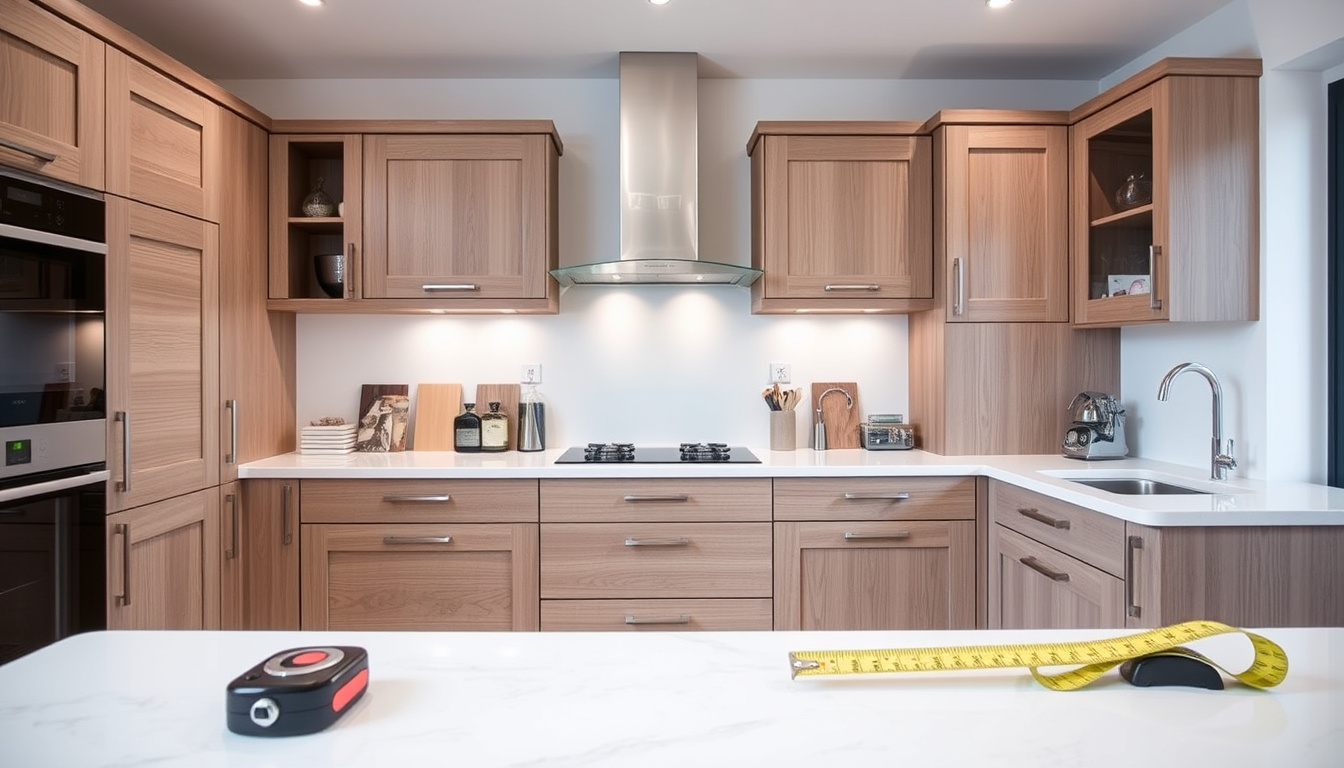
The price of kitchen cabinets in the UK varies more between retail and trade than between materials, with a typical renovation landing between £8,000 and £15,000 including units, worktops and installation (Less.co.uk’s kitchen cost guide). This guide separates the trade price from the retail sticker, compares B&Q, Howdens and IKEA on value, and pinpoints cabinet sizes and materials that age well.
Average cost of UK kitchen cabinets: £1,500–£5,500 ·
Standard base cabinet depth: 600mm ·
Standard wall cabinet height: 720mm ·
Most popular material: MDF with foil wrap/laminate ·
Average cabinet lifespan: 15–20 years
Quick snapshot
- A full UK kitchen renovation commonly lands between £8,000 and £15,000 including units, worktops and installation (Less.co.uk cost guide).
- Flat-pack kitchens are commonly priced below modular, rigid and bespoke cabinetry (BookaBuilderUK).
- Standard kitchen fitting labour is estimated at £1,700–£3,000 (Fantastic Services cost guide).
- Whether B&Q is consistently cheaper than Howdens unit-for-unit once promotions and delivery fees are added.
- The exact UK split between plywood and MDF carcasses; no independent national figure exists.
- Indicative lifespan bands (5–25 years) are not independently standardised (BookaBuilderUK).
- 2020: pandemic-driven demand caused kitchen supply shortages and price increases.
- 2023: the flat-pack market matured as custom-front suppliers for IKEA frames gained popularity.
- 2025–2026: colour direction shifts from pure grey toward warmer earth tones and navy.
- Expect the trade-vs-retail price gap to keep shaping how UK buyers choose between fitter-led and DIY kitchens.
- Custom front options make budget carcasses look far more expensive than their price tag suggests.
- Before buying, get itemised quotes that separate units, worktops, fitting and plumbing.
Ten numbers to carry into a showroom, and the pattern underneath them: the carcass, not the door, decides whether the kitchen lasts.
| Metric | Value | Source |
|---|---|---|
| Typical full UK kitchen renovation | £8,000–£15,000 | Less.co.uk cost guide |
| Cabinet-only spend (flat-pack to modular) | £1,000–£8,000 | Indicative supplier price bands |
| Cabinet share of project bill | ~30% | BestBuilders.co.uk cost guide |
| Standard base unit depth | 600mm | UK industry standard |
| Standard wall unit height | 720mm | UK industry standard |
| IKEA Metod cabinet warranty | 25 years | IKEA warranty terms |
| Howdens trade premium vs retail | Estimated 10–15% | Market estimate |
| Most popular cabinet material | MDF with foil wrap/laminate | UK supplier ranges |
| Average cabinet lifespan | 15–20 years | Industry estimate |
| Cabinet installation labour | £1,700–£3,000 | Fantastic Services cost guide |
Read that table with the 30% figure in mind: a £1,000 swing on cabinets moves the final bill by only £300, while a worktop upgrade can move it by £2,000.
How much should a set of kitchen cabinets cost?
Kitchen quotes confuse because they bundle four different products: cabinets, doors, worktops and installation. Split them out and the cabinet number stops being scary.
A full UK kitchen renovation commonly lands between £8,000 and £15,000 including units, worktops and installation; budget schemes start near £4,000, while premium projects with stone worktops and integrated appliances climb past £25,000.
With cabinets at roughly 30% of a project bill, shaving 10% off the cabinet cost trims only about 3% off the final invoice. The bigger savings live in worktop selection and fitting labour.
What is a realistic budget for a new kitchen?
- Budget supplied-and-fitted: £5,000–£10,000
- Mid-range: £10,000–£20,000
- Premium: £20,000–£40,000
- Luxury bespoke: £40,000–£70,000 or more (BestBuilders.co.uk’s 2026 cost guide)
Within that total, units and carcasses account for roughly 30% of the bill, while labour and associated trades take an estimated 30–35% (BestBuilders.co.uk’s new-kitchen cost guide). Worktops and appliances each add an estimated 15–20%, which is why a “cheap” cabinet box can still produce an expensive invoice.
What is the cheapest way to get kitchen cabinets?
- Flat-pack kitchens are commonly priced below modular, rigid and bespoke cabinetry, with cabinet-only bands around £1,000–£3,000 for flat-pack, £3,000–£8,000 for modular, £8,000–£20,000+ for rigid and £20,000+ for bespoke (BookaBuilderUK’s 2026 new-kitchen guide).
The catch is assembly time and lifespan. The same guide treats durability as indicative: flat-pack at 5–10 years, modular at 10–15, rigid at 15–25 and bespoke at 25+, so the cheapest door-in can be the dearest over two decades.
- Fitting labour for a standard kitchen: £1,700–£3,000 (Fantastic Services cost guide)
- Plumbing for sink, taps and appliances: £200–£600, more if pipework moves (Fantastic Services)
- Worktops: laminated chipboard from roughly £30/m, granite up to about £700/m before installation (BookaBuilderUK’s 2026 guide)
Worktop prices explain why budgets drift: the material choice can move the bill by thousands while the cabinet price stays flat.
How to budget for kitchen cabinets without the showroom upsell
- Separate cabinets from worktops, appliances and fitting in every quote.
- Compare per-unit prices, not per-room headline numbers.
- Ask what the carcass is made of before you fall for the door.
- Add a 10–15% contingency for the inevitable “while we’re at it” extras.
- Measure the space against standard unit sizes (base 600mm deep, wall 300mm deep).
- Choose a construction tier: flat-pack, modular, rigid or bespoke.
- Get itemised quotes from at least three suppliers, mixing retail and trade routes.
- Add worktops, appliances, fitting labour and plumbing to the cabinet-only price.
- Multiply the total by roughly 1.1 before you sign, and keep that reserve in the budget.
The pattern: the cabinet price on a quote is rarely the price you pay after worktops, fitting and plumbing. The supplier who gives you the clearest unit-by-unit breakdown is the one to trust.
The implication: knowing the cost breakdown helps you decide where to invest and where to save.
Are B&Q kitchens cheaper than Howdens?
That depends on which side of the trade counter you stand. Howdens sells almost exclusively through fitters and trade accounts, so the prices you see depend on who is buying; B&Q sells to anyone with a car and a credit card. The gap between them moves with promotions.
Trade prices look unbeatable until you add a fitter’s markup. Ask the fitter for the trade price plus their fitting fee before you assume Howdens is cheaper than B&Q.
Are IKEA cabinets good quality?
- IKEA Metod frames carry a 25-year warranty, the longest single product promise in this comparison.
- Standardised cabinet sizes created an aftermarket for custom fronts, which grew quickly after 2023.
- Quality strengths are consistent engineering, soft-close hardware and modular sizing; the carcass is still melamine-faced chipboard, not plywood.
For the price, IKEA is hard to beat on hardware and consistency. The weakness is the same as every flat-pack kitchen: the boxes are engineered for cost, so the kitchen rewards careful assembly.
Four suppliers, one pattern: the biggest price differences are in how the carcass is sold, not what the door looks like.
| Supplier | Price signal | Carcass | Warranty | Who it suits |
|---|---|---|---|---|
| B&Q | Retail price with rotating multi-buy promotions | Melamine-faced chipboard in most ranges | Varies by range | Buyers without a trade account |
| Howdens | Trade-list pricing; full price only via trade accounts | Melamine-faced chipboard in most ranges | Varies by range | Renovations with a fitter already involved |
| IKEA | Flat-pack; lowest entry point | Melamine-faced chipboard; Metod frames carry a 25-year warranty | 25 years on Metod frames | DIY installs and budget builds |
| Magnet | Mid-market; frequent showroom promotions | Melamine-faced chipboard in most ranges | Varies by range | Buyers who want a showroom brand without trade ties |
Brand price signals reflect standard retail and trade models at the time of writing; warranty terms vary by product line, so check the specific range before buying.
What’s confirmed, what’s still unclear
- Confirmed: standard UK base unit depth is 600mm.
- Confirmed: IKEA Metod cabinets carry a 25-year warranty.
- Confirmed: Howdens full pricing sits behind a trade account.
- Unclear: whether B&Q is consistently cheaper than Howdens unit-for-unit once promotions and delivery fees are added.
- Unclear: the exact UK split between plywood and MDF carcasses.
- Unclear: how indicative lifespan bands (5–25 years) hold up in real kitchens; they are not independently standardised.
- Unclear: whether the Howdens trade premium really sits at 10–15%; the figure is an estimate, not a published list price.
The trade-off: Howdens pricing is structured for fitters, not shoppers. B&Q can win on a good promotion week with the same spec; Howdens can win when a fitter passes on trade discount. The only reliable move is to compare both on the same day, with the same carcass material and the same door range.
The catch: your purchasing route determines the real price, so know it before you compare showroom labels.
What is a good height for kitchen cabinets?
Cabinet height is less about style and more about spine angle. The standard UK arrangement uses a 720mm base carcass on a 150mm plinth, which puts the worktop near 870mm, a working height that suits most adults without custom risers.
A set of standard sizes to know, and one pattern: sizes exist so appliances, corner units and end panels line up without custom joinery.
| Element | Standard UK size | Notes |
|---|---|---|
| Base unit carcass height | 720mm | Measured without plinth |
| Plinth / toe-kick height | 150mm | Standard base; adjustable legs available |
| Worktop height | ~870mm | 720mm carcass plus 150mm plinth |
| Base unit depth | 600mm | Matches standard appliance housings |
| Wall unit depth | 300mm | Narrower to keep the worktop clear |
| Wall unit height | 720mm | Some ranges offer shorter and taller options |
| Wall unit base above worktop | ~450mm | Ergonomic reach to the middle shelf |
| Corner base unit width | 800–1000mm | Carousel or magic-corner hardware |
| Tall larder unit depth | 600mm | Same depth as base units |
| Worktop depth | 600–650mm | Base-unit depth plus slight overhang |
What are the standard dimensions for UK kitchen cabinets?
- Base units: 720mm carcass plus 150mm plinth, 600mm deep.
- Wall units: 300mm deep, 720mm high, with the base of the unit around 450mm above the worktop.
- Corner options: 800–1000mm-wide base corner units with carousel or magic-corner hardware.
- Tall larder units: 600mm deep, designed to match base units.
Ergonomics and accessibility are the real drivers. Building Regulations Approved Document M sets a baseline for accessible kitchens; for wheelchair users, worktop height and knee space below the sink need to change from the standard layout.
The pattern: stick to standard sizes and every off-the-shelf appliance, end panel and filler fits. Custom heights are where joinery costs multiply.
What are the most popular types of kitchen cabinet materials?
The quickest way to judge a kitchen quote is to ignore the door and ask what is behind it. The carcass decides how long the cabinet survives; the door decides how good it looks while doing it.
Material names confuse because the same term is used for doors and carcasses. The working rule: buy the best carcass the budget allows, then spend what remains on the door.
Carcass materials compared
- Melamine-faced chipboard (MFC): the UK default; strong in dry kitchens, vulnerable where edges are cut or moisture sits.
- MDF: denser and heavier; common for painted doors, but needs sealed edges around sinks and dishwashers.
- Plywood: the fitter’s favourite; holds screws better and survives moisture longer, at a higher price.
- Solid wood: mostly used for doors and frames; a full solid-wood carcass is rare and expensive.
Door materials: thermofoil, acrylic and laminate
- Thermofoil (foil-wrapped MDF): budget-to-mid range; smooth to the touch, but can peel where heat and steam are persistent.
- Acrylic: glossier and tougher; needs regular wiping to hide fingerprints.
- Laminate: hard-wearing and cost-effective; the old reliable of UK kitchens.
- Painted MDF and solid wood: premium look; require more care and better edge sealing.
What makes a kitchen look cheap? (Material implications)
- Thin door edges that show raw MDF or chipboard.
- Hardware that rattles and does not soft-close.
- Worktop seams and end panels that do not match the door colour.
- Expensive-looking doors hinged to a flimsy, light carcass.
Material choice should follow use. A household that cooks heavily needs moisture-resistant carcasses around the sink and dishwasher; a dry kitchen runs perfectly well on good-quality MFC. The price difference shows up in edge sealing, hinge fixing and how the cabinet feels when you close it.
Flat-pack kitchens save money; rigid, pre-assembled kitchens save time and often fit better. Here is the trade-off:
Upsides
- Lowest cabinet price per unit.
- Standard sizes and modular design.
- Delivery to the door; assembly at your own pace.
- The saving can fund a better worktop or appliances.
Downsides
- Assembly time, plus the risk of fitter callbacks if the build is out of square.
- Indicative lifespan often shorter than rigid or bespoke units.
- Most flat-pack carcasses are MFC, with little room for plywood upgrades.
- Hidden costs: delivery, edging and the occasional damaged panel.
The trade-off: flat-pack puts the budget on the door and worktop; rigid puts it in the box. For a kitchen you plan to live with for 15 years, the box is the better place.
What this means: material choice is a trade-off between upfront cost and long-term durability; let your usage and timeline decide.
What color kitchen will not date?
Colour is the cheapest way to change how a kitchen feels and the fastest way to date it. The pure-grey wave of the early 2020s is already shifting toward warmer earth tones and navy.
What kitchen trends will be outdated in 2026?
- Pure grey cabinets, as the palette moves warmer.
- All-white handleless kitchens, now closer to rental spec than a design statement.
- Mismatched metals: brass handles paired with chrome taps.
- Dark, cave-like rooms that rely entirely on under-cabinet lighting.
What is the in-colour for kitchens in 2026?
- Navy and deep blue, a long-term premium favourite.
- Sage and muted greens.
- Warm neutrals: stone, oat and soft white, replacing cool grey.
- Charcoal as a grounding neutral for frames and hardware.
The safest strategy is to put enduring colours on the cabinets and chase trends with walls, tiles and hardware. Navy, sage, white and charcoal all sit comfortably in either camp; a trend colour on cabinets costs thousands to reverse.
A loud cabinet colour narrows the buyer pool when you sell. Neutral, well-built kitchens appeal to more buyers than statement colours, and resale timing is the one thing you cannot control.
The pattern: kitchens date fastest when the cabinet colour is the only idea in the room. Keep cabinets conservative and let worktops, tiles and hardware carry the trend.
Where can I buy cheap kitchen cupboards and who are the best UK manufacturers?
The UK market splits into retail giants (B&Q, Wickes, Homebase), trade-focused brands (Howdens, Magnet, Wren) and flat-pack specialists (IKEA and a growing set of online-only suppliers). None is universally “best”; each wins on a different axis.
Kitchen cabinet manufacturers UK: Howdens, Magnet, Wren, B&Q, IKEA, Wickes, Homebase
- Howdens: trade-focused, local depots, full pricing behind a trade account.
- Magnet: showroom brand with mid-market pricing and frequent promotions.
- Wren: direct-to-consumer with its own fitting service and a strong online configurator.
- B&Q: the retail do-it-all; strong for individual units and DIY.
- IKEA: flat-pack value with the standout 25-year warranty and a custom-front ecosystem.
- Wickes and Homebase: high-street alternatives with regular price-match offers.
Who are the best kitchen designers in the UK?
- Look for designers accredited by the KBSA or BIID, the two main professional bodies for kitchen design.
- A good designer specifies the carcass, doors, hinges and end panels, not just a moodboard.
- Online design services cut cost but rarely see the room’s actual walls and pipework.
What a designer and a trade rep actually say
- Independent kitchen designer, BIID-accredited, on why the carcass matters more than the door.
- Trade kitchen supplier representative, on how trade pricing actually works.
“Plywood carcasses are rare in volume kitchens because they cost more, but they hold hinge screws and survive leaks far better. If a client plans to stay 15 years, I steer the budget toward the carcass, not the door.”
Independent kitchen designer, BIID-accredited
“Trade pricing is not a secret discount; it is a different sales model. We price through fitters because the fitter takes responsibility for measuring, scheduling and the final fit. Retail buyers see a higher list price because they are paying for the showroom and the returns.”
Trade kitchen supplier representative
Notice what both speakers agree on: the carcass and the fit decide longevity more than the door colour. That is the closest thing to consensus in the kitchen industry.
Why this matters: the supplier that wins on brochure price can lose on delivery dates, missing end panels and after-sales service. Compare the whole package, not the headline discount.
The takeaway: your buying route determines the best supplier, so choose after you decide how you will purchase.
The showroom sells the door; the kitchen survives on the box. For UK homeowners, the choice is clear: buy the strongest carcass you can afford, spend the remaining budget on worktops and fitting, and choose timeless colours — or pay the difference twice when the cheap boxes let go.
Frequently asked questions
Do you need a Howdens account to buy cabinets?
Howdens sells through trade accounts, and full pricing is normally quoted through a fitters’ network. Homeowners can approach a local depot and open an account, but trade-discounted pricing typically appears when a fitter places the order.
Can you buy Howdens kitchen cabinets without a trade account?
You can open an account directly at a Howdens depot, but the pricing structure is built for trade buyers and their fitters. Expect full list pricing unless the order goes through a trade account with established volume.
Are Magnet kitchens good quality?
Magnet is a solid mid-market brand. Quality depends on the range and carcass material, so compare the specific range’s carcass construction and hardware before assuming the showroom price reflects long-term durability.
What carcass material is best for UK kitchens?
Plywood is the strongest and most moisture-resistant option but costs more. Good-quality melamine-faced chipboard is the UK default and performs well in dry kitchens when edges are sealed; a moisture-resistant board is a worthwhile upgrade around the sink and dishwasher.
How long does it take to deliver a flat pack kitchen?
Most stock flat-pack kitchens arrive within a few weeks from major UK suppliers. Custom worktops, custom fronts and design appointments can extend the lead time to a month or more.
What is the best cabinet colour for resale value?
White, navy, sage and charcoal read as safe and premium to most buyers. Bold trend colours narrow the pool of potential buyers, which matters more if you may sell within five years.

Arthur Oliver Howard Fletcher is a staff writer for NationalReport.uk, covering UK national news, politics, the economy and public services. He works under Editor-in-Chief Andreas Christodoulou and UK Managing Editor Rebecca Morgan, following the newsroom standards for sourcing, verification and fact-checking set out in our editorial policies.