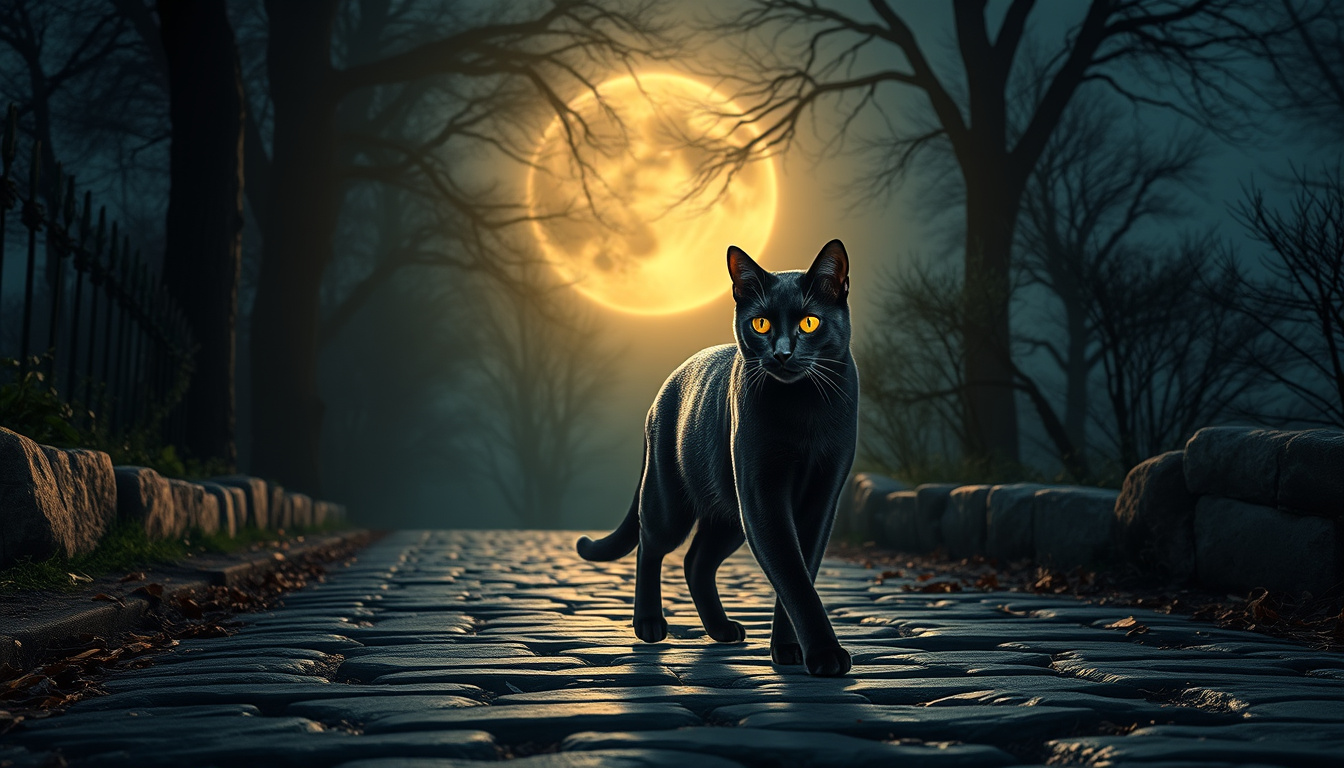
If you’ve ever had a black cat sprawl across your keyboard mid-sentence, you already know the color rarely matches the personality. Black is one of the most common coat colors in domestic cats, and it comes from a dominant pigment gene rather than a “type” of cat — which is why black-cat breeds are just breeds that happen to wear black (PetMD (veterinary fact sheet)).
Coat color: One of the most common coat colors in domestic cats · Genetics: Dominant allele at the TYRP1 B locus · Breed status: A coat color, not a single breed · UK belief: Black cats are traditionally lucky in the UK · Female black cats: Not rare — the color isn’t sex-linked · Marvel namesake: Felicia Hardy debuted in The Amazing Spider-Man #194 (1979)
Quick snapshot
- Black is a common coat color in domestic cats — not a breed (PetMD (veterinary fact sheet)).
- Female black cats aren’t rare; the color isn’t sex-linked (Zoorithm (genetics explainer)).
- UK folklore traditionally treats black cats as lucky (Wikipedia (encyclopedic overview)).
- The exact origin of black-cat superstitions isn’t precisely documented. (Furriq (owner-survey analysis))
- Adoption-rate gaps by coat color shift with the shelter and the dataset. (Furriq (owner-survey analysis))
- There’s no standardized evidence of a distinct “black cat personality” (Furriq (owner-survey analysis)).
- Bombay cats were developed in the 1950s and joined CFA championship classes in 1976 (Chewy (pet-care education)).
- Marvel’s Felicia Hardy debuted as Black Cat in The Amazing Spider-Man #194 (1979) (Marvel (official character page)).
- Choose a black cat by temperament and grooming load, not coat color.
- Plan a slow, resource-rich introduction if you add a second cat.
- Know whether your search means the animal or the Marvel character.
Six facts anchor the black-cat conversation, and they sort into different buckets: genetics, breed status, regional folklore, and comic-book canon.
| Fact | What it means |
|---|---|
| Definition | A black cat is any domestic cat with black fur — purebred or mixed-breed. |
| Coat genetics | Black fur comes from a dominant allele at the TYRP1 B locus. |
| Breed status | Black is a coat color, not a recognized single breed. |
| UK belief | In the UK, black cats are traditionally considered lucky. |
| Female black cats | Black coat color is not sex-linked, so females are no rarer than males. |
| Marvel namesake | Felicia Hardy debuted as Black Cat in The Amazing Spider-Man #194 (1979) (Marvel (official character page)). |
What are 10 common black cat breeds?
Short answer: no breed is “the black cat breed,” because black is a color, not a bloodline. Cats.com puts it plainly: black cats aren’t a breed category; they’re a coat color found across many breeds and mixed-breed domestic cats (Cats.com (cat care database)). Petful’s 2025 guide names American Shorthair, Persian, Maine Coon, Sphynx, and Devon Rex as breeds that regularly come in solid black (Petful (2025 breed guide)).
The ten that show up most often in those guides and in adoption listings:
- Bombay — the only breed developed specifically to be black (PetMD (veterinary fact sheet)).
- British Shorthair — the usual answer when someone asks what breed a “British black cat” is.
- American Shorthair — solid black is a common variant.
- Persian — solid black is a common variant.
- Maine Coon — solid black is a common variant.
- Oriental Shorthair — commonly listed among solid-black breeds.
- Norwegian Forest Cat — commonly listed among solid-black breeds.
- Cornish Rex — commonly listed among solid-black breeds.
- Sphynx — hairless, and black is a standard variant.
- Scottish Fold — commonly listed among solid-black breeds.
What breed is a British black cat?
- The “British black cat” in most searches is a black British Shorthair.
- British Shorthairs carry the same dominant black gene as any other black cat.
- Without registration papers, a solid-black British cat is more likely a mixed-breed domestic cat than a pedigree British Shorthair.
If someone in the UK points at a solid black cat and asks what breed it is, “black British Shorthair” is the polite guess, and “mixed-breed domestic cat” is the safer default without papers.
How rare is a 100% black cat?
- Solid black is common; it’s one of the most frequent coat colors in domestic cats.
- “100% black” usually means no white markings — and that isn’t rare either.
- What some call “100% black” can look grayish- or brownish-black in different lighting, depending on pigment depth (PetsCare (pet-care explainer)).
The real rarity isn’t a black coat — it’s a black coat that stays pure black in every light.
Black cat breed vs mixed-breed black cat
- A “black cat breed” in daily life is usually a mixed-breed domestic cat with a black coat.
- Breed registries recognize black across many breeds, but shelters are full of black cats with no breed label at all.
- Color alone can’t confirm a breed; pedigree paperwork is the only reliable proof.
So when someone insists their shelter cat is a Bombay, the honest response is: it’s a black domestic cat first, and a Bombay only if the paperwork says so.
Ten breeds, one pattern: the black coat is the least useful way to tell them apart — coat length, body size, and energy level are what actually differ.
| Breed | Solid black? | Distinguishing notes |
|---|---|---|
| Bombay | Yes — the defining color | Often bred with a miniature-panther look (Cats.com (cat care database)); created in the 1950s (Chewy (pet-care education)). |
| British Shorthair | Yes | The usual match for “British black cat” searches. |
| American Shorthair | Yes | Solid black is a common variant. |
| Persian | Yes | Solid black is common in Petful’s 2025 guide (Petful (2025 breed guide)). |
| Maine Coon | Yes | Solid black is a common variant. |
| Oriental Shorthair | Yes | Frequently listed among solid-black breeds. |
| Norwegian Forest Cat | Yes | Frequently listed among solid-black breeds. |
| Cornish Rex | Yes | Frequently listed among solid-black breeds. |
| Sphynx | Yes | Hairless; solid black is a standard variant. |
| Scottish Fold | Yes | Frequently listed among solid-black breeds. |
The implication: if you’re choosing a cat, the black coat answers almost nothing. It’s the breed behind the color that sets shedding habits, activity needs, and coat care.
Are black cats good luck or bad luck?
Both — it depends on where you’re standing. Wikipedia’s overview of the color ties black cats to witches and to both good- and bad-luck symbolism across European folklore (Wikipedia (encyclopedic overview)). Cats.com frames the “bad luck” version as a cultural superstition with roots in European folklore rather than biology (Cats.com (cat care database)). The same coat flips to good luck in the UK and Japan.
Are black cats lucky in the UK?
- Yes — UK folklore traditionally treats black cats as good luck.
- The same good-luck reading appears in Japanese folklore.
- Neither belief changes what the cat is: a domestic feline with a dominant black coat.
In the UK, a black cat crossing your path is more often read as a good sign — a neat reversal of the version that made black cats a symbol of misfortune elsewhere in Europe.
What is the old wives’ tale about black cats?
- The familiar tale treats a black cat crossing your path as an omen — bad in some regions, good in others.
- Old wives’ tales about black cats are folklore; they don’t describe real behavior differences.
- The color’s “luck” is assigned by geography, not by the cat.
The same black coat that unsettled parts of Europe was a good-luck charm in the UK and Japan. Superstition travels by geography; the gene doesn’t.
The pattern: every “lucky” or “unlucky” label traces back to regional folklore, never to the cat’s biology — which is why a black cat in London and a black cat in Madrid are genetically the same cat with opposite reputations.
What does a black cat symbolize?
Black cats carry a surprisingly consistent symbolic stack around the world: mystery, independence, magic, and protection. In some regional folklore, the black cat was believed to protect a home from evil spirits (Wikipedia (encyclopedic overview)) — a useful corrective to the witch-adjacent reputation.
What do black cats protect you from?
- In folklore: evil spirits and misfortune.
- In real life: nothing color-specific — behavior is shaped by socialization and environment, not pigment (Zubair Khalid (veterinary behavior notes)).
- The protective reputation is a story people tell about the color, not a job description the cat signed up for.
Black Cat in pop culture: Marvel, anime, and sneaker searches
- Marvel’s Black Cat is Felicia Hardy — a fictional character, not an animal (Marvel (official character page)).
- She debuted in The Amazing Spider-Man #194 (1979) — five decades of comic history attached to the name.
- Outside comics, the same two words label anime, video games, and sneaker colorways, so search intent for “black cat” splits hard.
That split matters when a search returns a comic-book page and you wanted a breed list: same two words, different entity. Separating them is the same editorial job as Lightning McQueen facts and fan theories — established canon versus popular rumor.
Why this matters: the symbol is assigned by the audience, not the animal. The cat doesn’t know it’s a symbol at all.
Why are girl black cats rare?
Here’s the myth-buster: female black cats are not rare. According to Zoorithm’s cat-genetics explainer, black coat color is not linked to sex chromosomes, so male and female kittens inherit it in roughly equal proportions (Zoorithm (genetics explainer)). The confusion likely comes from orange cats, where the color is sex-linked and females are the less common version.
Are black cats usually male or female?
- Neither — black cats occur in roughly equal proportions in males and females.
- Claims that black cats are more often female are myth, not data.
- A black female kitten is produced by the same dominant B allele that makes black males black.
How does black coat color inheritance work?
- Black fur comes from eumelanin pigment; veterinary guides describe the trait as dominant (PetMD (veterinary fact sheet)).
- In simplified coat-genetics terms, the black variant sits at the TYRP1 B locus, and it isn’t sex-linked.
- Because the locus is autosomal, both sexes inherit and express it equally.
When someone says female black cats are rare, they’re probably thinking of orange cats — where sex-linked genetics really do skew the ratio.
The trade-off: the “rare female black cat” myth sounds harmless, but it has a real cost — it makes ordinary black kittens seem like curiosities instead of what they are: perfectly standard cats waiting for a home.
Will two black cats get along?
Coat color has no vote in cat friendships. Zubair Khalid’s veterinary behavior notes state that there’s no scientific evidence coat color alone predicts temperament or aggression (Zubair Khalid (veterinary behavior notes)). Furriq’s write-up of a large owner survey found coat-color effects on aggression were small — and they weren’t strongest in solid-black cats (Furriq (owner-survey analysis)). So “will two black cats get along?” is the wrong question; the right one is “will these two cats get along?”
Do black cats like to cuddle?
- Some black cats are lap cats; others keep their distance.
- That split tracks individual temperament, shaped by socialization and environment — not coat color (Zubair Khalid (veterinary behavior notes)).
Are cats happier with a second cat?
- It depends on age, personality, and early socialization, not coat color.
- Kittens and highly social adults often adapt well; territorial older cats may need more time.
- Slow introductions and separate resources are the difference between a bonded pair and a cold war.
A second cat can be a companion or a stressor. Personality and a slow introduction decide which one you get — the black coat just makes the matching set.
If you’re new to cat ownership, pair this introduction plan with the Human cat years chart and calculator to set expectations for each cat’s life stage.
The implication: the best predictor of a happy two-cat home isn’t a color swatch — it’s the cats’ social history and the resources you give them.
How to introduce two cats safely: a step-by-step guide
Whether both cats are black or one is a tabby, the sequence is the same — and it runs on patience, not color.
- Start with a base camp. Keep the new cat in its own room with food, water, a litter box, and hiding spots for at least a few days.
- Swap scents. Rub a cloth on each cat and leave it in the other cat’s space, so they meet through smell before they meet face to face.
- Feed on opposite sides of the door. Mealtimes near the closed door build a positive association with the other cat’s scent.
- Run short, supervised meetings. Begin with a few minutes at a time and extend them as tension drops.
- Provide more resources than cats. Separate food bowls, water stations, litter boxes, and perches prevent competition before it starts.
- Watch the warning signs. Hissing early on is normal; persistent chasing, blocking, or hiding means you moved too fast — step back a stage.
The most common reason pairings fail is speed. Hissing is normal early on; persistent blocking or hiding is the signal to slow back down.
Why this matters: a rushed introduction turns two perfectly good cats into two stressed roommates. Weeks of patience now beat months of hissing later.
Confirmed facts vs what’s still unclear
After sorting the evidence, three facts hold up and four questions stay open.
Confirmed facts
- Black is a common coat color in domestic cats — not a breed (PetMD (veterinary fact sheet)).
- Female black cats are no rarer than males; the color isn’t sex-linked (Zoorithm (genetics explainer)).
- UK folklore traditionally treats black cats as lucky (Wikipedia (encyclopedic overview)).
What’s unclear
- The exact origin of black-cat superstitions isn’t precisely documented.
- Whether black cats are adopted at different rates than other colors varies by shelter and dataset.
- There’s no standardized evidence of a distinct “black cat personality.”
- What counts as “100% black” shifts with lighting — coats can read as grayish- or brownish-black in different conditions (PetsCare (pet-care explainer)).
What this means: the confident claims are the documented ones — genetics, folklore, and history. The fog is where shelter data, superstition origins, and personality labels still do their work.
What the research says about black cat behavior
Two sources summarize the behavioral evidence about as clearly as it gets.
“There is no scientific evidence that a coat color alone predicts a cat’s temperament or aggression.”
— Zubair Khalid (veterinary behavior notes)
“Owner-survey data shows coat-color effects on aggression were small — and solid-black cats weren’t the group with the strongest effects.”
— Furriq (owner-survey analysis)
Neither source denies that individual black cats can be affectionate or aloof — it says the color doesn’t predict which one you’ll get. The pattern: personality claims about black cats usually tell you more about the storyteller than the cat.
The takeaway
The black cat is a cat first and a color second — and that single fact untangles most of the confusion around breeds, luck, and behavior. Whether shelters adopt out black cats at lower rates varies by dataset, but the old superstition remains the usual suspect. For a first-time adopter, the choice is clear: pick the cat whose temperament fits your home, not the one whose color matches your sofa — or you’ll be solving a behavior mismatch that had nothing to do with the black fur.
scienceinsights.org, en.wikipedia.org, cats.com, alibaba.com
Frequently asked questions
Why does my black cat have white patches?
Black coat color and white markings come from different genetic systems. The B locus controls whether the coat produces black pigment, while separate white-spotting genes decide where white patches appear — so a black cat can easily carry white fur on its chest, paws, or belly.
Can a black cat have yellow eyes?
Yes. Eye color is controlled separately from coat color, and black cats frequently have copper, amber, or yellow eyes.
Do black cats shed more than other cats?
No. Shedding tracks coat length and season, not coat color. A longhaired black Persian will shed more than a shorthaired black British Shorthair, and a black Sphynx doesn’t shed at all because it has no coat.
How often should I groom a black cat?
Shorthaired black cats usually do fine with a weekly brushing; longhaired breeds such as the Persian, Maine Coon, and Norwegian Forest Cat need several sessions a week. Hairless Sphynx cats shift the task to skin care instead. The color is irrelevant to all of it.
Is a Bombay the only fully black cat breed?
The Bombay is the only breed developed specifically to be black — a point covered in the breed section above — but several other breeds also standardize solid black coats (Petful (2025 breed guide)). “Fully black” is common; “only a Bombay can be black” is the myth.

Arthur Oliver Howard Fletcher is a staff writer for NationalReport.uk, covering UK national news, politics, the economy and public services. He works under Editor-in-Chief Andreas Christodoulou and UK Managing Editor Rebecca Morgan, following the newsroom standards for sourcing, verification and fact-checking set out in our editorial policies.