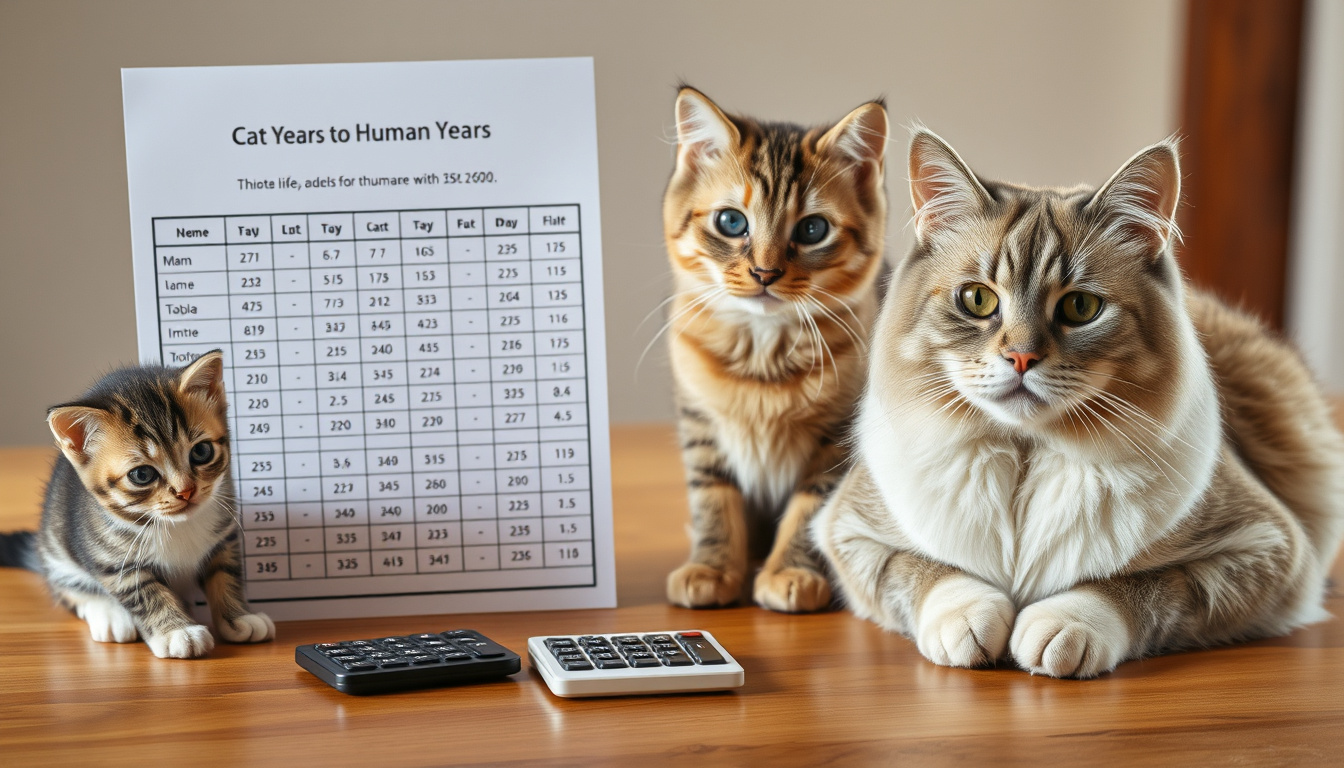
If you’ve ever tried to figure out your cat’s age in human years, you’ve probably heard the old saying: one cat year equals seven human years. It’s a tidy shortcut, but veterinarians have a more accurate way to measure.
1 cat year: ≈15 human years ·
2 cat years: ≈24 human years ·
Each extra cat year after 2: ≈4 human years ·
15 cat years: ≈76 human years ·
20 cat years: ≈96 human years
Quick snapshot
- 1 cat year ≈ 15 human years (Cornell Feline Health Center (veterinary research center))
- 2 cat years ≈ 24 human years (Cornell Feline Health Center (veterinary research center))
- After age 2, each cat year adds ≈4 human years (Cornell Feline Health Center (veterinary research center))
- Exact conversion varies by breed, health, and individual development
- Some sources use 25 human years at age 2 rather than 24
- The term “naughtiest age” is not a standardized scientific category
- The exact human year equivalent for a given cat age can vary by source (e.g., 10 cat years as 53 vs 56)
- The 2021 AAHA/AAFP feline life-stage guidelines were published on (American Animal Hospital Association (veterinary association))
- Use life-stage-based care rather than a flat multiplier for aging cats
- Watch for behavioral changes tied to kitten, adolescent, and senior stages
- For newly adopted cats, expect the 3-3-3 adjustment rule to play out over three months
The conversion from cat years to human years follows the 15/24/+4 model used by veterinary experts.
| Cat age | Human age equivalent | Life stage |
|---|---|---|
| 1 year | ≈15 years | Kitten |
| 2 years | ≈24 years | Junior / Young adult |
| 3 years | ≈28 years | Prime |
| 5 years | ≈36 years | Prime |
| 7 years | ≈44 years | Mature |
| 10 years | ≈56 years | Mature / Senior |
| 12 years | ≈64 years | Senior |
| 15 years | ≈76 years | Geriatric |
| 20 years | ≈96 years | Geriatric |
How old is my cat in human years?
- A 1-year-old cat is roughly equivalent to a 15-year-old human (Cornell Feline Health Center (veterinary research center)).
- A 2-year-old cat is roughly equivalent to a 24-year-old human (Cornell Feline Health Center (veterinary research center)).
- After age 2, each additional cat year is roughly equal to 4 human years (Cornell Feline Health Center (veterinary research center)).
Human cat years chart
- 10 cat years ≈ 53 human years (Cornell Feline Health Center (veterinary research center))
- 12 cat years ≈ 61 human years (Cornell Feline Health Center (veterinary research center))
- 15 cat years ≈ 73 human years (Cornell Feline Health Center (veterinary research center))
Human cat years calculator
To quickly estimate your cat’s human age: count the first year as 15, the second year as 9 more (bringing you to 24), then add 4 years for each birthday after that. If your cat is 6 years old, the math is 15 + 9 + (4 × 4) = 40 human years.
Cat life-stage equivalents
The AAHA/AAFP guidelines divide a cat’s life into four age-related stages plus end of life: kitten (birth to 1 year), young adult (1 to 6 years), mature adult (7 to 10 years), and senior (older than 10 years) (American Animal Hospital Association (veterinary association)). The fifth end-of-life stage is not age-specific (AAHA/AAFP guideline PDF (official clinical guidance)).
The 7-year rule oversimplifies feline aging. Cats mature quickly in their first two years, then their aging slows to about 4 human years per cat year — a pattern no single multiplier can capture (Cornell Feline Health Center (veterinary research center)).
Are cat years 7 human years?
- The common shortcut of 1 cat year = 7 human years is not supported by veterinary life-stage guidelines (Cornell Feline Health Center (veterinary research center)).
- Cats reach sexual and social maturity much faster than the 7-year rule suggests (American Animal Hospital Association (veterinary association)).
- A cat’s aging rate slows after the second year, adding about 4 human years per cat year (Cornell Feline Health Center (veterinary research center)).
Why the 7-year rule is inaccurate
Cornell Feline Health Center notes that a one-year-old cat is physiologically similar to a 16-year-old human, not a 7-year-old child (Cornell Feline Health Center (veterinary research center)). That early spike alone makes the linear multiplier untenable.
What changes at age 2
By age 2, a cat is roughly similar to a 21-year-old human (Cornell Feline Health Center (veterinary research center)). After that, growth slows into a steadier 4-years-per-year pattern.
How to estimate conversion instead
Use the 15/24/+4 model: 15 human years at cat age 1, 24 human years at cat age 2, then 4 human years for every additional cat year. For a 10-year-old cat, that formula gives 15 + 9 + (8 × 4) = 56 human years.
Veterinary care is life-stage-dependent. An owner who believes a 2-year-old cat is a 14-year-old human will miss the developmental reality: this is a young adult with adult nutritional and behavioral needs (American Animal Hospital Association (veterinary association)).
Is 15 very old for a cat?
- A 15-year-old cat is roughly 76 in human years under the standard 15/24/+4 model (Cornell Feline Health Center (veterinary research center)).
- 15 years is considered geriatric in feline life-stage guidelines (AAHA executive summary (veterinary association)).
- Senior and geriatric cats benefit from more frequent veterinary monitoring (Cornell Feline Health Center (veterinary research center)).
What 15 cat years equal in human years
Using the Cornell-aligned 15/24/+4 framework, a 15-year-old cat lands at about 76 human years (Cornell Feline Health Center (veterinary research center)). Some sources round the second-year value to 25, which shifts the final number slightly — but the care implications stay the same.
Senior and geriatric cat care markers
The AAHA/AAFP life-stage guidelines classify cats older than 10 years as senior, with end of life as a separate stage that can occur at any age (American Animal Hospital Association (veterinary association)). Cats at 15+ years need closer attention to weight, kidney function, thyroid health, and mobility.
A 15-year-old cat is not just “old” — it’s entered the geriatric stage of the official veterinary framework. For owners, that means the threshold for checkups should change from yearly to twice-yearly, with bloodwork as the default, not the exception.
What is the naughtiest age for a cat?
- There is no formal scientific metric for the naughtiest age, but feline adolescence is commonly the most challenging behavior phase.
- The transition from kitten to adult, roughly 6 to 18 months, is associated with peak activity and boundary testing.
- Behavioral expectations should be tied to life stage rather than a flat human-years formula.
Kitten and adolescent behavior
Kittens and adolescent cats show the kind of high-energy, exploratory behavior that owners often describe as naughty. During the 6–18 month window, cats test boundaries: climbing curtains, knocking objects off shelves, and demanding play at odd hours. These behaviors line up with the AAHA/AAFP young adult stage that runs to 6 years (American Animal Hospital Association (veterinary association)).
When cats are most active and playful
Activity levels track developmental stage, not a human-age formula. A 6-month-old kitten is, in human terms, a toddler — but its behavior resembles a teenager more than a baby. The gap between these two framings is exactly where the 7-year myth causes confusion.
Managing boundary-testing behavior
Owners can reduce unwanted behavior by scheduling active play sessions, providing vertical space, and using puzzle feeders. The 3-3-3 rule (for newly adopted cats) also applies to adolescent energy: expect 3 days of adjustment, 3 weeks of routine-building, and 3 months before the cat’s real personality settles in.
The same energy that makes a 1-year-old cat “naughty” is what keeps it healthy. Owners who punish adolescent behavior risk creating anxiety; owners who redirect it get a well-adjusted adult cat.
The implication: understanding the naughtiest age helps owners tailor their expectations and training to the cat’s developmental stage.
What is the 3-3-3 rule of cats?
- The 3-3-3 rule is a rescue and shelter guideline for cat adjustment after adoption.
- It stands for 3 days to decompress, 3 weeks to learn the household routine, and 3 months to feel fully at home.
- The timeline reduces owner frustration and explains behavior changes in a newly adopted cat.
- 3 days: decompression — For the first three days, most adopted cats hide, refuse food, or stay frozen in one spot. The rule tells owners to leave the cat alone, provide a quiet room, and let the cat set the pace. Misreading this as rejection is the most common adoption failure point.
- 3 weeks: learning the routine — By week three, the cat usually figures out feeding times, litter box placement, and which humans are safe. This is when play behavior starts to emerge — including the “naughty” phase that catches owners off guard.
- 3 months: feeling at home — Around the three-month mark, cats typically show their real temperament. The 3-3-3 rule sets that expectation deliberately, so owners don’t label a cat as “broken” during the adjustment window when it is still decompressing (PubMed Central (biomedical literature archive)).
If you want to see how the 3-3-3 rule applies to a specific adoption story, take a look at Jim Rosenthal: Family, Crufts, and What He Does Now — a good reminder that pet-focused adjustments happen far beyond just cats. And for another perspective on animal-human bonds, Robert Irwin: Age, Net Worth, Family, and Personal Life shows how wildlife experience shapes expectations around animal behavior.
Confirmed facts and what’s still unclear
Confirmed facts
- 1 cat year ≈ 15 human years (Cornell Feline Health Center (veterinary research center))
- 2 cat years ≈ 24 human years (Cornell Feline Health Center (veterinary research center))
- Each cat year after 2 adds about 4 human years (Cornell Feline Health Center (veterinary research center))
- 15-year-old cats are senior/geriatric (American Animal Hospital Association (veterinary association))
What’s unclear
- Exact conversion varies by breed, health, and individual development
- Some sources use 25 human years at age 2 rather than 24
- The term “naughtiest age” is not a standardized scientific category
- The exact human year equivalent for a given cat age can vary by source (e.g., 10 cat years as 53 vs 56)
The pattern: confirmed facts form the basis of reliable age conversion, while unclear points remind owners that individual variation matters.
What the experts say
Feline aging is not a linear process. The first two years of life carry enormous developmental change, and a fixed multiplier like 7 does not reflect what we see clinically.
Veterinary feline medicine association
The 3-3-3 rule is the single best tool we have to prevent returns. Owners who understand it stop interpreting normal fear as failure.
Shelter adoption coordinator
Adolescent cats aren’t trying to be difficult; they’re working through a developmental stage. Managing that phase well makes the difference between a cat that stays and a cat that gets surrendered.
Feline behavior specialist
Summary
Human cat years aren’t a puzzle to solve with a multiplier — they’re a reflection of real biological stages, from kitten to geriatric. For owners, the choice is straightforward: follow the 15/24/+4 model and the AAHA life-stage guidelines, or keep relying on a 7-year rule that underestimates early development and overestimates later aging. For a 15-year-old cat, the consequence is clear: schedule that extra veterinary visit, or miss the early warning signs that geriatric cats so often hide.
aaha.org, aaha.org, aaha.org, aaha.org, almanac.com, aaha.org, carecredit.com, theconversation.com
Frequently asked questions
How old is a 10-year-old cat in human years?
A 10-year-old cat is roughly 56 human years under the 15/24/+4 model. Cornell Feline Health Center gives a similar estimate of about 53 human years for age 10 (Cornell Feline Health Center (veterinary research center)).
At what age is a cat considered senior?
According to the AAHA/AAFP feline life-stage guidelines, a cat is considered senior at 10 years and older. The mature adult stage runs from 7 to 10 years (American Animal Hospital Association (veterinary association)).
How do I calculate cat years?
Use the 15/24/+4 method: 15 human years for the first cat year, 24 human years for the second, then 4 human years for each cat year after that.
Do indoor cats live longer than outdoor cats?
Indoor cats generally live longer because they face fewer risks from traffic, predators, and infectious disease. Current veterinary life-stage guidelines focus on age-based care rather than making a formal indoor-outdoor distinction.
Does breed affect how cats age?
Yes. Breed can influence certain health conditions and life expectancy, which means two cats of the same age may show very different aging patterns. The 15/24/+4 formula provides a general reference, but individual health matters more.
Why do cats age faster in their first two years?
Cats reach sexual and social maturity quickly. By 1 year, a cat is physiologically similar to a 16-year-old human, and by 2 years, similar to a 21-year-old human (Cornell Feline Health Center (veterinary research center)).

Arthur Oliver Howard Fletcher is a staff writer for NationalReport.uk, covering UK national news, politics, the economy and public services. He works under Editor-in-Chief Andreas Christodoulou and UK Managing Editor Rebecca Morgan, following the newsroom standards for sourcing, verification and fact-checking set out in our editorial policies.