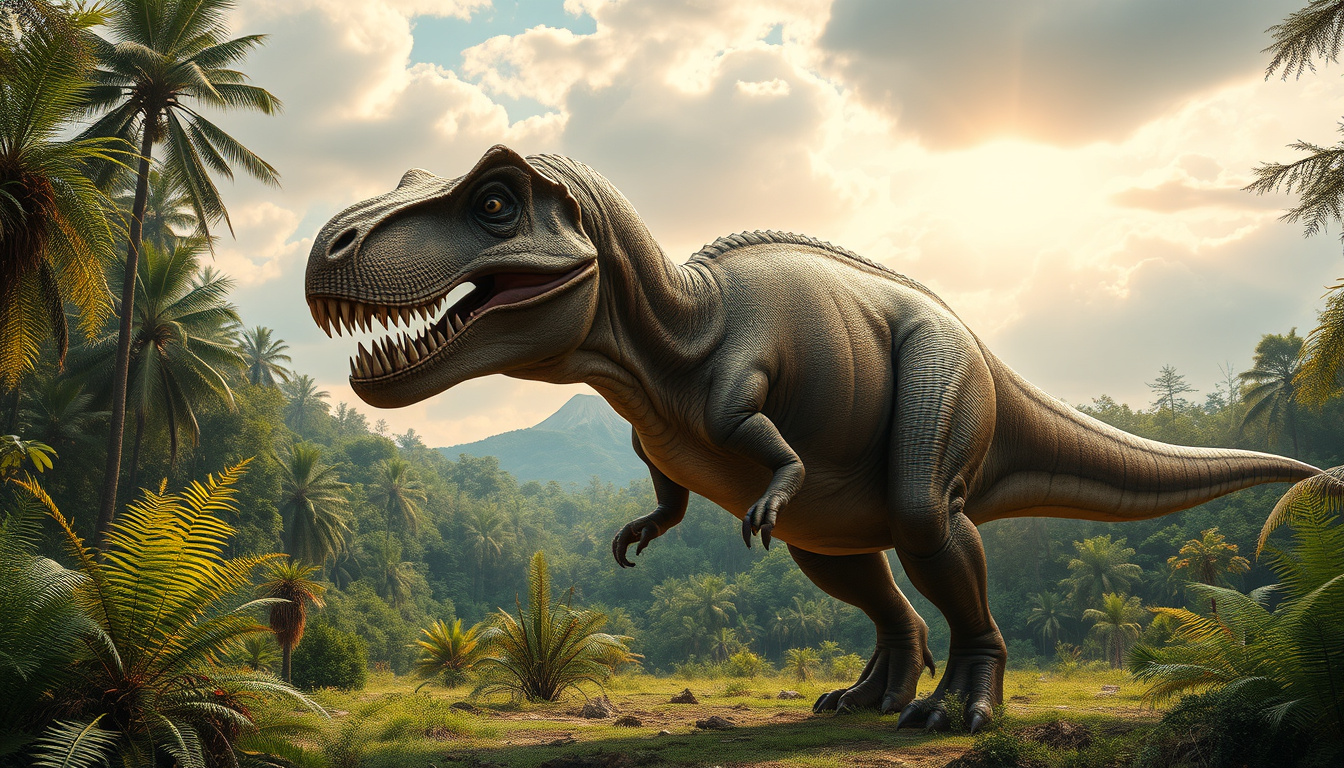
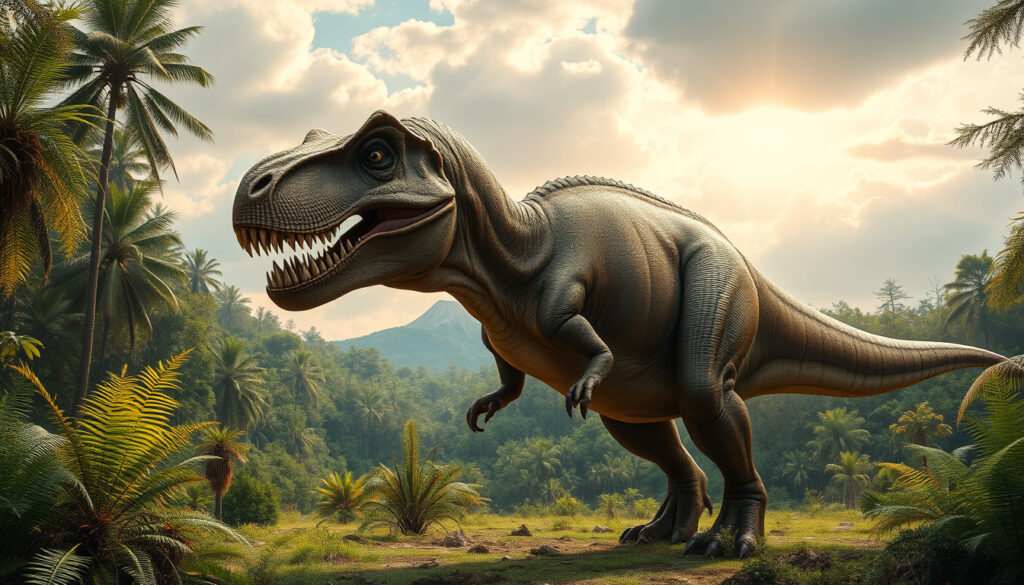
Almost everyone can picture a Tyrannosaurus rex: jaws open, short arms, feet planted like a building, but the real animal is more interesting than the poster version. Fossil evidence places it in western North America during the Late Cretaceous, roughly 68–66 million years ago, according to the Smithsonian Institution (U.S. national museum).
Length: over 12 meters ·
Diet: Carnivore
Quick snapshot
- One of the largest tyrannosaurids, with a deep skull and long balancing tail (Smithsonian National Museum of Natural History (federal research museum))
- Exact skin color, feather coverage on adults, vocalizations, and social behavior remain unknown (Wikipedia (open encyclopedia))
- Late Cretaceous presence, 68–66 million years ago, followed by end-Cretaceous extinction (American Museum of Natural History (New York research museum))
- Size estimates keep moving as new specimens reach museum collections (Britannica (encyclopedic reference))
Six fields, one pattern: this was an animal built on extremes.
| Field | Value |
|---|---|
| Scientific name | Tyrannosaurus rex (American Museum of Natural History (New York research museum)) |
| Superfamily | Tyrannosauroidea (American Museum of Natural History (New York research museum)) |
| Family | Tyrannosauridae (Smithsonian National Museum of Natural History (federal research museum)) |
| Skull length | About 1.5 meters (National Museums Scotland (national natural history museum)) |
| Period | Late Cretaceous, 68–66 million years ago (Smithsonian Institution (U.S. national museum)) |
| Extinction | End-Cretaceous, about 66 million years ago (Wikipedia (open encyclopedia)) |
What did Tyrannosaurus rex really look like?
Physical characteristics
- Wide head and long, thick tail, shared with other tyrannosaurs
- Deep skull that made the body look front-heavy
In silhouette, T. rex looks like a walking fortress: head forward, tail trailing, legs planted underneath. The wide head was the animal’s main tool, and the tail worked as a counterweight.
The trade-off is visible in every skeleton. A skull that large needs a heavy body to anchor it, so the legs turn into pillars and the arms shrink into small appendages.
T. rex’s anatomy is a warning against assuming big predators are slow: the heavy skull and tail suggest power, not speed.
The pattern: T. rex’s anatomy is optimized for power, not speed, making it a specialized predator in its ecosystem.
Skin and feathers
- No adult T. rex fossil yet preserves skin that settles the feather question
- There is no direct proof that adult T. rex had feathers, and no direct proof it did not
The green scaly monster of the movies is a guess. Paleontologists have good evidence that some close relatives of T. rex had feathers, but the answer for T. rex itself is still open.
What this means: the next spectacular fossil could rewrite the image of T. rex overnight.
Size and proportions
- Large enough that “city bus” is the standard comparison
- Hind limbs far longer than the forelimbs
Size is relative, but T. rex’s size is not. It was a giant in its ecosystem, and even a modest 12-meter adult would loom over any prey that stood its ground.
The pattern: every part of the body is exaggerated except the arms.
What are 10 interesting facts about the Tyrannosaurus rex?
- The name Tyrannosaurus rex is commonly translated as “tyrant lizard king.” (Britannica (encyclopedic reference))
- T. rex was a bipedal carnivorous dinosaur. (National Museums Scotland (national natural history museum))
- Its forelimbs were short, and each ended in two clawed digits, according to Wikipedia’s overview. (Wikipedia (open encyclopedia))
- T. rex laid eggs, based on the standard dinosaur reproductive model. (Wikipedia (open encyclopedia))
- Adult body mass is estimated at 4,000 to 7,000 kg. (Britannica (encyclopedic reference))
- How fast T. rex could run is still debated; no fossil settles a top speed.
- Whether adult T. rex had feathers is unresolved.
- Skin color is unknown.
- Social behavior, including group hunting, is debated.
- Vocalizations are unknown.
The implication: most of what people “know” about T. rex comes from a handful of museum exhibits and one famous film franchise. The real research is younger and stranger than the poster suggests.
How old did Tyrannosaurus rex live to be?
Maximum age estimates
- Growth rings from the oldest known specimen show it died at 28 years old.
- After reaching full size, T. rex could have lived for another decade.
Age is written in bone. Growth rings are the dinosaur equivalent of tree rings, and they give paleontologists a rare window into how fast T. rex grew and how long it lasted.
Why this matters: lifespan shapes behavior. An animal that takes nearly two decades to reach full size cannot afford to be careless with its life.
A longer life means more years vulnerable to injury and starvation—so T. rex’s heavy build may be as much about survival as about predation.
The implication: lifespan constraints shaped T. rex’s growth strategy and survival tactics.
How did T. rex have babies?
Egg-laying and nesting
- T. rex laid eggs, like other dinosaurs.
- Direct fossil evidence of T. rex nests and hatchlings is rare.
Reproduction in T. rex is mostly a puzzle built from comparisons. Because it belongs to the same large predator group as birds and crocodilians, scientists infer egg-laying, but the details of nesting and parental care are not written in the current fossil record.
The trade-off: the less we know, the more room there is for confident speculation dressed up as fact.
What killed the last dinosaur?
End-Cretaceous extinction
- The end-Cretaceous extinction happened about 66 million years ago.
- The leading explanation is a large asteroid impact that collapsed ecosystems worldwide.
T. rex was a top predator, but no predator survives when its prey base disappears. The Chicxulub impact and the climate chaos that followed removed the bottom of the food chain, and the great tyrant lizard went down with it. Birds, the surviving branch of the dinosaur family tree, are a reminder that evolution does not stop at a species boundary—a theme explored in Charles Darwin: Biography, Theory, and Personal Life.
The most famous extinction of all time almost never appears in the museum labels next to T. rex skeletons—because the story is about the whole ecosystem, not just one species.
The upshot: the extinction event that ended the dinosaurs also removed the foundation of the entire ecosystem.
Timeline signal: T. rex through time
- 68–66 million years ago: T. rex lived in western North America; 66 million years ago: The end-Cretaceous extinction removed non-avian dinosaurs. (Britannica (Hell Creek discoveries))
The timeline is short in human terms. T. rex’s entire known history fits inside the last few million years of the Cretaceous, which makes its dominance and fall a rapid, dramatic arc.
Confirmed facts vs. open questions
Confirmed facts
- Late Cretaceous presence (68–66 million years ago), bipedal carnivore, large skull and strong bite, grew to more than 12 meters in large adults (Britannica (encyclopedic reference))
Open questions
- Exact coloration
- Feather coverage on adults
- Vocalizations
- Social behavior
- Exact maximum lifespan
The balance of evidence is clear on the basics and thin on the details. That split is normal in paleontology, where a single new skeleton can flip a “fact” back into a hypothesis.
Quotes and perspectives
The skull was massive, and the tail was long and thick, helping balance the body.
Smithsonian National Museum of Natural History
Tyrannosaurus rex was a bipedal, carnivorous dinosaur with a skull around 1.5 metres long.
National Museums Scotland
Both museums agree on the animal’s broad anatomy, but the details—feathers, color, speed, social life—are where the certainties end. For science educators, the choice is not about picking sides; it is about presenting T. rex as a creature with a known skeleton and a lively, unresolved biology.
The takeaway for anyone writing about dinosaurs: T. rex is not a simple story. The skeleton is long settled, but the living animal—its skin, speed, sounds, and social life—is still being argued over. For science communicators, the responsible move is to show the evidence and name the uncertainty, not to present every new guess as a breakthrough.
amnh.org, ebsco.com, britannica.com, australian.museum, smithsonianmag.com, a-z-animals.com
Frequently asked questions
How fast could a T. rex run?
Speed estimates vary widely, and no fossil directly measures speed. Most researchers treat high top-end estimates with caution.
Did T. rex have feathers?
There is no direct proof that adult T. rex had feathers, and no direct proof that it did not. Feathers are known in some related dinosaurs, so the question remains open.
What did T. rex eat?
T. rex was a carnivore, and fossil evidence places it among the top predators of its ecosystem.
Where did T. rex live?
T. rex lived in western North America, in areas that are now Montana and Wyoming.
How big was a T. rex brain?
Brain size is not covered in detail by the sources in this guide. Relative to its body, T. rex had a modest brain, but intelligence is difficult to reconstruct from fossils.
How did T. rex hunt?
Whether T. rex was an active hunter, a scavenger, or both is still debated. Its bite was powerful, but the hunting strategy left few direct traces.
Is T. rex related to birds?
Yes—birds are the surviving lineage of theropod dinosaurs, which makes T. rex a distant relative of modern birds.
For educators and writers, presenting T. rex accurately means acknowledging both the well-established facts and the active debates that continue to shape paleontology.

Arthur Oliver Howard Fletcher is a staff writer for NationalReport.uk, covering UK national news, politics, the economy and public services. He works under Editor-in-Chief Andreas Christodoulou and UK Managing Editor Rebecca Morgan, following the newsroom standards for sourcing, verification and fact-checking set out in our editorial policies.