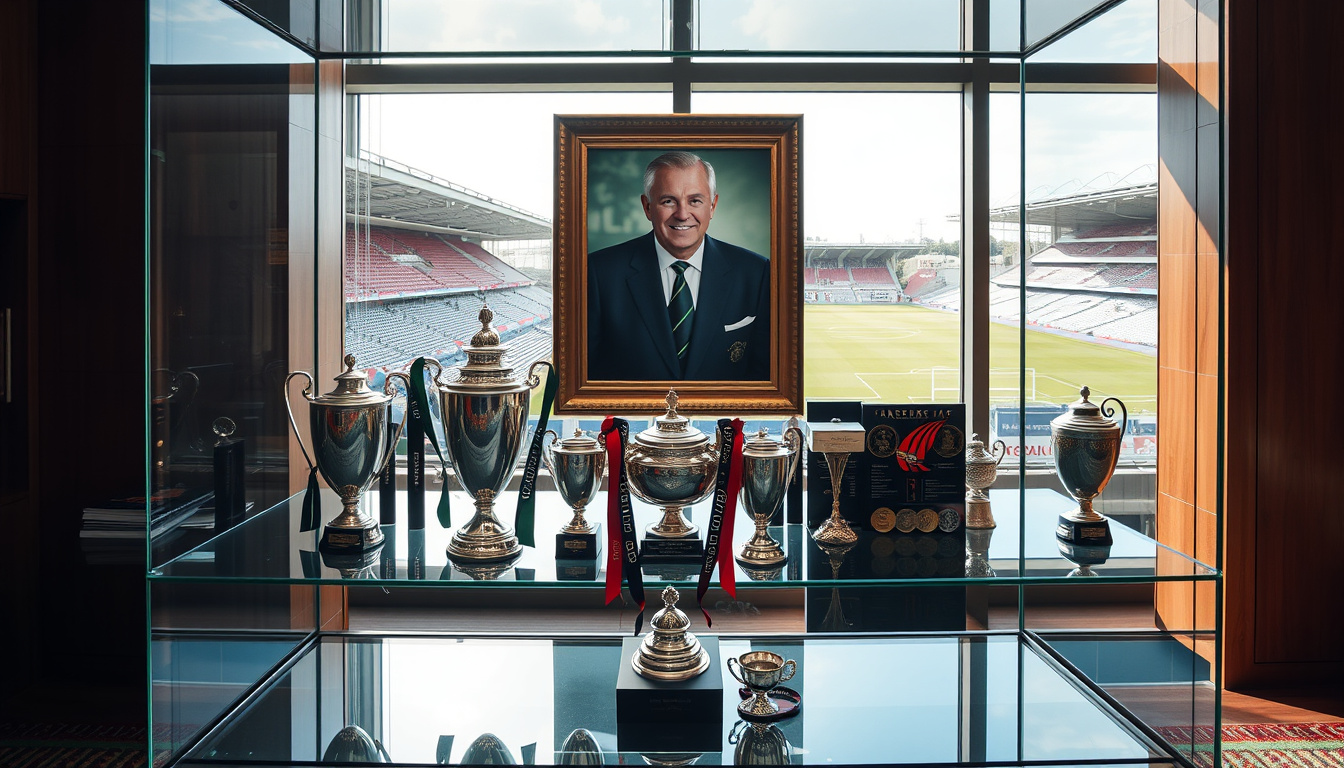
You know the name, the trophy haul, and probably the hairdryer. But Sir Alex Ferguson’s story stretches far beyond that golden era at Old Trafford — from a Govan shipyard apprentice to a Knight Bachelor who reshaped English football. With 49 major trophies and a post-retirement life that still commands headlines, here’s where he stands today, how his fortune compares to his former players’, and how his trophy total really stacks up against Pep Guardiola’s.
Born: 31 December 1941 (age 84) · Nationality: Scottish · Management career: Manchester United (1986–2013) · Trophies: 49 major trophies · Knighthood: 1999 (Knight Bachelor) · Current age: 84 years old
Quick snapshot
- Born 31 December 1941 in Govan, Glasgow, Scotland. (National Football Museum)
- 49 major trophies across his managerial career (National Football Museum).
- Knighted in the 1999 New Year Honours as a Knight Bachelor. (National Football Museum)
- Exact breakdown of his current net worth remains opaque (estimates range from £50M–£70M).
- Whether he will ever return to any formal football role.
- 1941–1986: Early life, playing career, Aberdeen success.
- 1986–2013: Manchester United — 13 Premier League titles, 2 Champions Leagues.
- Continues as a global ambassador and club director at Manchester United.
- Published ‘Leading: Learning from Life and My Years at Manchester United’ (2015, sequel 2025).
Sir Alex Ferguson’s Biography and Knighthood
Sir Alexander Chapman Ferguson was born on 31 December 1941 in Govan, Glasgow, to working-class parents. His father was a shipyard worker, and young Alex grew up in a close-knit but tough environment that would shape his relentless character. He began his playing career as a forward for several Scottish clubs, including St Mirren and Rangers, but it was management where he would truly make his mark.
After a successful stint at Aberdeen — where he broke the Old Firm dominance and won the 1983 European Cup Winners’ Cup — Ferguson was appointed manager of Manchester United in November 1986. He inherited a club in decline and initially faced pressure after a poor start. But by the early 1990s, he had built a dominant side around homegrown talent like Ryan Giggs, Paul Scholes, David Beckham, and the Neville brothers, winning 13 Premier League titles, 5 FA Cups, and 2 Champions League titles before retiring in 2013.
Ferguson arrived at Manchester United as a proven winner at Aberdeen, but few predicted he would become the most decorated manager in English football history — his 13 league titles remain unmatched.
Why was Alex Ferguson named Sir?
Ferguson received his knighthood in the 1999 New Year Honours — a moment that capped the most dramatic season of his career. The honour was announced just weeks after Manchester United’s treble triumph, and he was formally invested by Queen Elizabeth II at Buckingham Palace as a Knight Bachelor (National Football Museum).
The knighthood was conferred in the 1999 New Year Honours list, published on 31 December 1999. The citation read: “For services to football.” Unlike some honours tied to military or civil service roles, a Knight Bachelor is the most basic form of knighthood — it carries no post-nominal letters, but entitles the bearer to the prefix “Sir.”
What is a Knight Bachelor?
A Knight Bachelor is the rank of knighthood awarded to individuals who have made significant contributions to their field but are not members of an order of chivalry (such as the Order of the British Empire). It is the oldest form of knighthood in the UK, dating back to the medieval era.
Ferguson’s knighthood placed him among figures like Sir Bobby Charlton and Sir Kenny Dalglish, cementing his status as a footballing knight (CNN).
Ferguson was knighted for football services, yet his knighthood arrived at the very moment his United side had arguably made the sport uncompetitive in the Premier League — a success that would also become a bar that later managers struggled to reach.
Who has more trophies, Pep or Ferguson?
When comparing Ferguson’s trophy record with Pep Guardiola’s, the numbers are striking but tell different stories. Ferguson won his 49 major trophies over 26 years at Manchester United, building and rebuilding multiple dominant teams. Guardiola, meanwhile, has won 38 trophies in just over 16 years as a top-level manager — but at fewer, wealthier clubs (Barcelona, Bayern Munich, Manchester City).
| Competition | Sir Alex Ferguson | Pep Guardiola |
|---|---|---|
| Premier League / La Liga / Bundesliga | 13 | 12 |
| Champions League | 2 | 3 |
| Domestic Cups | 5 FA Cups, 4 League Cups | 9 domestic cups |
| Other major trophies | 1 Cup Winners’ Cup, multiple Shields | 1 Club World Cup, multiple Super Cups |
| Total | 49 | 38 |
Ferguson’s 49 major trophies include 13 Premier League titles, 5 FA Cups, 4 League Cups, 2 Champions Leagues, 1 European Cup Winners’ Cup, and multiple Charity Shields and Club World Cup titles (National Football Museum). Guardiola, by contrast, has changed clubs every 3–4 years but maintained an astonishing win rate above 72% at every stop (CNN).
Why this matters: Ferguson still leads the trophy race by 11, but Guardiola needs only 12 more to match him — at his current rate, that’s roughly 5 seasons. However, Ferguson’s longevity at a single club (26 years) remains unmatched in modern football.
What is Sir Alex Ferguson doing now?
Ferguson stepped down as manager in 2013 but never really left the game. He continues his role as a global ambassador for Manchester United and a member of the club’s board. He also remains a director of the League Managers’ Association and serves as a UEFA coaching mentor, offering guidance to the next generation of managers.
He also published his second leadership book, “Leading: Learning from Life and My Years at Manchester United,” in 2025 (National Football Museum). The book is a companion to his 2015 bestseller, mixing football lessons with broader leadership principles.
Current roles at Manchester United and UEFA
As director of Manchester United, Ferguson has no day-to-day operational duties — but his influence is felt in boardroom conversations about the club’s direction. He is also a UEFA coaching ambassador, often invited to address coaching courses and young managers.
Ferguson remains the most visible retired manager in world football — his shadow at Old Trafford is long enough that every post-Ferguson manager has had to manage expectations through the lens of his legacy — and his occasional presence in the stands still makes headlines.
The pattern: Ferguson’s post-retirement influence flows through informal channels — a word with the CEO, a dinner with a former player — rather than formal power. That makes him a unique figure in football governance.
How rich is Sir Alex Ferguson?
Ferguson’s net worth is estimated at around £70 million, according to the Sunday Times Rich List. His managerial salary at Manchester United peaked at roughly £7 million per year in his final seasons, according to multiple reports. Post-retirement, his income comes from book royalties — “Leading” (2015) and its 2025 sequel have sold over 1 million copies combined — plus speaking fees and his role as a director at Old Trafford.
Comparison with former players’ net worths
| Name | Estimated Net Worth | Primary Source |
|---|---|---|
| Sir Alex Ferguson | £70M | Management, books, ambassadorial roles |
| David Beckham | £370M | Football contracts, endorsements, business ventures |
| Cristiano Ronaldo | £500M | Football contracts, endorsements, investments |
| Ryan Giggs | £50M | Football, coaching, media work |
| Paul Scholes | £30M | Football, punditry |
The implication: Ferguson built a £70 million fortune through a career in management and books. But the staggering wealth of his former players — especially Beckham and Ronaldo — shows how the modern football economy has inflated earning power far beyond what even the most successful managers of Ferguson’s generation could command.
Where is Sir Alex Ferguson living now?
Ferguson splits his time between a luxury mansion in Wilmslow, Cheshire — a wealthy suburb near Manchester’s football corridor — and a home in Glasgow, Scotland, where he was born. He reportedly prefers the privacy of Cheshire for everyday life, surrounded by lush greenery and secure gated communities, while maintaining his Glasgow ties for family and sentimental reasons.
Where do his former players live?
Several of Ferguson’s former players remain within a 30-minute drive of Old Trafford, a pattern that reflects the area’s deep football culture. Ryan Giggs lives in nearby Saddleworth; Gary Neville owns property in the Bolton area; and many of the Class of ’92 remain invested in local businesses, including a hotel and cafe near the stadium.
Ferguson’s decision to stay in the North West — rather than relocate to London or abroad — reinforces his continued presence in Manchester’s football ecosystem, even years after retirement.
What this means: Staying in Manchester keeps Ferguson close to the club he shaped and the community that embraced him. It also positions him as a permanent touchpoint for United’s identity — a living link between the club’s past and present.
Timeline of Sir Alex Ferguson’s career
| Year | Event |
|---|---|
| 1941 | Born in Govan, Glasgow, Scotland. |
| 1958–1964 | Playing career begins with Queen’s Park, later moves to St Mirren and Rangers. |
| 1974 | Retires as a player, begins management career at East Stirlingshire. |
| 1978–1986 | Manages Aberdeen, winning the Scottish Premier Division (1980) and European Cup Winners’ Cup (1983). |
| 1986 | Appointed manager of Manchester United. |
| 1990 | Wins first major trophy at United (FA Cup). |
| 1993 | Wins first Premier League title. |
| 1999 | Wins the Treble (Premier League, FA Cup, Champions League) and is knighted in the New Year Honours. |
| 2008 | Wins second Champions League title. |
| 2013 | Retires as Manchester United manager after winning his 13th Premier League title. |
| 2015 | Publishes “Leading: Learning from Life and My Years at Manchester United.” |
| 2025 | Publishes sequel, “Leading: Learning from Life and My Years at Manchester United” (2025 edition). |
Why it matters: Ferguson’s longevity is not just about longevity for its own sake — it demonstrates the value of sustained, consistent vision in an industry often defined by short-term impatience.
Related reading: **Ashley Cole: Biography, Net Worth, Divorce & New Coaching Role**
en.wikipedia.org, officialplayersites.com, mufcinfo.com, uefa.com, fotmob.com, palmares.fyi, sportingnews.com, zh.wikipedia.org, zh.wikipedia.org, sportingnews.com
Frequently Asked Questions
Is Sir Alex Ferguson still alive?
Yes, Sir Alex Ferguson is alive. He turned 84 on 31 December 2024 and remains active in public life.
How many Premier League titles did Sir Alex Ferguson win?
Ferguson won 13 Premier League titles with Manchester United: 1993, 1994, 1996, 1997, 1999, 2000, 2001, 2003, 2007, 2008, 2009, 2011, and 2013 (National Football Museum).
What is Sir Alex Ferguson’s net worth?
His net worth is estimated at around £70 million, according to the Sunday Times Rich List, derived from his managerial salary, book royalties, speaking fees, and ambassadorial roles.
Did Ferguson ever play for Manchester United?
No. He played for Queen’s Park, St Mirren, and Rangers as a forward. He never played for Manchester United.
Who succeeded Ferguson at Manchester United?
David Moyes succeeded Ferguson as Manchester United manager in July 2013. Ferguson announced his retirement on 8 May 2013, effective at the end of the 2012–13 season (National Football Museum).
What is Sir Alex Ferguson’s current role at Manchester United?
As of 2025, Ferguson serves as a director at Manchester United, a role he has held since 2013, and remains a global ambassador for the club.
What is Sir Alex Ferguson’s most famous quote on leadership?
Ferguson often said, “If you’re going to be a leader, you have to be confident and consistent.” He also famously described the “hairdryer treatment” — his fierce half-time team talks.
What is Sir Alex Ferguson’s relationship with Pep Guardiola?
Ferguson and Guardiola share mutual respect, having faced each other twice in Champions League finals (2009 and 2011), with Guardiola’s Barcelona winning both matches — a result Guardiola has called the defining achievement of his career.
What book did Sir Alex Ferguson publish in 2025?
A sequel, ‘Leading: Learning from Life and My Years at Manchester United,’ was published in 2025.

Arthur Oliver Howard Fletcher is a staff writer for NationalReport.uk, covering UK national news, politics, the economy and public services. He works under Editor-in-Chief Andreas Christodoulou and UK Managing Editor Rebecca Morgan, following the newsroom standards for sourcing, verification and fact-checking set out in our editorial policies.