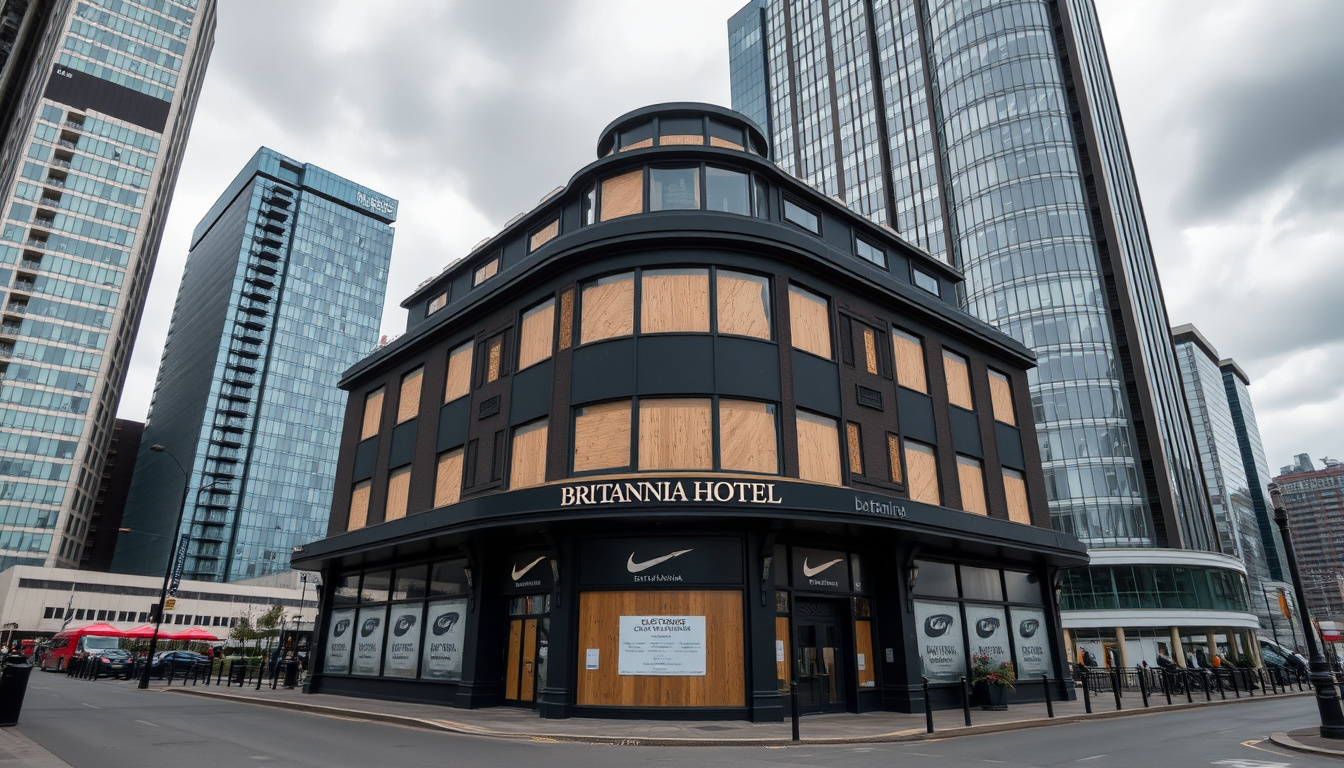
The Britannia International Hotel in Canary Wharf was built to project London’s financial ambition. Now it serves as asylum seeker housing—a change that has sparked protests and raised questions about who profits from the UK’s immigration system.
Location: Canary Wharf, London · Operator: Britannia Hotels · Nearest Station: Canary Wharf Jubilee line, 5 min walk · Key Feature: Water’s edge, modern glass-fronted building · Room Amenities: Private balcony, spa bath, en-suite
Quick snapshot
- Owned by Alex Langsam, octogenarian hotel tycoon (Byline Times)
- Pre-tax profit: £39.3 million for year to March 2023, up 18% from £33.3 million in 2022 (Byline Times)
- Hotel opened 9 June 1992 (Wikipedia)
- Exact current ownership person beyond Langsam
- Precise closure date and reason for Canary Wharf location
- Star rating consensus — rating sources vary
- Actual cost per night to Home Office remains disputed
- 1988: Britannia Hotels began development adjacent to Canary Wharf (Wikipedia)
- 9 June 1992: Hotel officially opened (Wikipedia)
- 2022: Started housing asylum seekers en-masse for Home Office (Byline Times)
- 23 July 2025: Telegraph reported Home Office plans for asylum seekers (The Telegraph)
- Home Office contracts under political scrutiny (UnHerd)
- Ongoing protests at multiple Britannia Hotels locations (UnHerd)
- Freedom of Information requests pending with Tower Hamlets Council (WhatDoTheyKnow)
Britannia Hotels operates more than 60 hotels across the UK, with the Canary Wharf property representing one of its most high-profile locations in the heart of London’s financial district. The chain has carved out a controversial niche: at least 17 of its properties have been block-booked by the Government for asylum seeker accommodation, generating profits that have drawn scrutiny from investigators and politicians alike.
| Attribute | Details |
|---|---|
| Operator | Britannia Hotels |
| Location | Canary Wharf, London |
| Building Style | Modern glass-fronted |
| Transport | 5 min walk to Canary Wharf station |
| Known For | Asylum seeker housing |
Who owns the Britannia Hotel Canary Wharf now?
Britannia Hotels is owned by octogenarian hotel tycoon Alex Langsam, an 80-something businessman who has accumulated a portfolio spanning more than 60 properties across the UK. The company logged £107,000 a day in profit during 2022-2023, according to financial filings reviewed by Byline Times investigation — a rate of return that has drawn sharp criticism given the conditions documented at some locations.
Alex Langsam connection
Langsam built Britannia Hotels over decades, purchasing and developing the International Hotel adjacent to Canary Wharf in 1988. The company has never been a stranger to controversy: it has been voted the UK’s worst hotel chain for 11 consecutive years in Which? polling, earning an ‘abysmal’ overall customer satisfaction rating in 2023.
Britannia Hotels collects government money regardless of whether London’s financial districts thrive or struggle.
Britannia Hotels ownership structure
Britannia Hotels registered pre-tax profits of £39.3 million for the year to March 2023, up 18% from £33.3 million in 2022 — a trajectory that coincides precisely with when the company began housing asylum seekers en masse for the Home Office. The profit surge has prompted questions about whether public funds meant to support vulnerable people are instead flowing into private hands.
The implication: public money intended for asylum support appears to be padding private profits.
Why is the Britannia Hotel in Canary Wharf closed?
Reports indicate the Britannia International Hotel Canary Wharf is closed, though the precise closure date and official reason remain unclear from public records. What is documented is that hundreds of protestors gathered in Canary Wharf to protest the reported use of the Britannia International Hotel to house asylum seekers — a demonstration that drew police reinforcements before nightfall.
Closure timeline
While the hotel opened on 9 June 1992 with considerable fanfare as a commercial property in London’s emerging financial hub, its current status appears uncertain. Booking sites still list the property, but multiple reports suggest it has ceased normal hotel operations.
Asylum housing role
The Home Office has used Britannia properties for asylum seeker accommodation before: rooms were temporarily rented in two Bournemouth locations and one in Folkestone due to overcrowding at detention centres. The agency has also rented Britannia rooms for new refugees waiting for long-term housing. A Freedom of Information request was made to Tower Hamlets Borough Council regarding asylum seeker numbers and capacity at the Britannia International Hotel, though the response details have not been publicly disclosed.
The shift from commercial hotel to asylum housing highlights how London’s financial districts are being repurposed — triggering protests and political condemnation from figures like Conservative Assembly member Susan Hall.
How many stars is Britannia Hotel Canary Wharf?
There is no established consensus on the official star rating for the Britannia International Hotel Canary Wharf. Rating sources vary, and the property’s unusual situation — caught between commercial hospitality and government housing contracts — complicates any straightforward classification.
Rating sources
Tripadvisor and HotelsCombined list the property, but reviews paint a picture at odds with the building’s premium glass-fronted appearance. Byline Times documented videos showing badly leaking ceilings, uncleared food, and clothes littering corridors in Britannia Hotels — footage that undermines any claims to upscale service.
Comparison to luxury hotels
For context, Canary Wharf’s legacy as a symbol of London’s financial ambition — a district that grew under Margaret Thatcher’s era of high finance — makes the Britannia property’s current state particularly stark. The Telegraph reported that high-end office demand in Canary Wharf has slumped as working from home became prevalent post-lockdown, contributing to broader economic pressures on the district.
What this means: even luxury positioning cannot mask the reputational damage from documented conditions.
What happened at the Britannia Hotel?
The Britannia International Hotel in Canary Wharf has been at the centre of multiple controversies, ranging from public protests to specific incidents that have drawn news coverage and political attention.
Affray incident
A woman was found guilty of affray at the hotel in connection with events involving asylum seekers housed there, according to BBC reporting. The incident highlights the tensions that can arise when vulnerable populations are concentrated in properties that may lack adequate support infrastructure.
Immigration news
In December 2018, a separate Britannia property — the Britannia Royal at Kingston upon Hull — cancelled a charity reservation for rough sleepers on Christmas Eve and Christmas Day without explanation. The incident drew widespread criticism and led the company to temporarily remove its presence from social media. While this occurred at a different location, it illustrates a pattern of conduct that has coloured public perception of the chain.
Online claims alleged the government was paying £500 per night to house asylum seekers at the Britannia Hotel, but the Home Office disputed these figures via YouTube verification. The actual nightly cost remains undisclosed, leaving taxpayers without clarity on how their money is being spent.
The pattern: incidents at multiple Britannia properties reveal systemic tensions between government housing contracts and community standards.
What are Britannia Hotel Canary Wharf reviews like?
Guest reviews for the Britannia International Hotel Canary Wharf reflect the broader reputation of the Britannia Hotels chain — one that has consistently ranked at the bottom of consumer satisfaction surveys. The Which? verdict of “worst hotel chain” for 11 consecutive years applies across the portfolio, not just to individual properties.
Tripadvisor feedback
Visitors posting on review platforms have reported issues consistent with the conditions documented by Byline Times: maintenance problems, cleanliness issues, and service levels that fall well short of what guests paying premium Canary Wharf prices would expect.
Parking and amenities
The property offers private balconies, spa baths, and en-suite facilities — amenities that position it as a premium offering on paper. However, the gap between listed features and actual guest experience appears significant, based on available reviews.
The catch: premium amenities listed on paper contrast sharply with documented guest experiences.
| Feature | Britannia International Hotel | Luxury Canary Wharf alternatives |
|---|---|---|
| Customer satisfaction | Abysmal (Which? 2023) | High (industry average) |
| Which? ranking | Worst chain, 11 consecutive years | Varies by property |
| Asylum housing role | Confirmed (17+ properties) | Not applicable |
| Daily profit rate | £107,000 (2022-2023) | Varies |
| Protest activity | Yes (Canary Wharf and others) | None documented |
The comparison table reveals stark differences between Britannia and competing properties on satisfaction, ranking, and controversy metrics.
Upsides
- Waterfront location in prime Canary Wharf district
- Modern glass-fronted building architecture
- Private balcony and spa bath rooms available
- Close to Jubilee line (5-minute walk)
- Government contracts ensure revenue stability
Downsides
- Voted worst UK hotel chain 11 consecutive years
- Documented maintenance and cleanliness failures
- Asylum housing controversies and protests
- Home Office cost disputed — actual figures hidden
- Canary Wharf exodus of wealthy residents
- Slumping office demand post-lockdown
Britannia Hotel Canary Wharf: A Timeline
The Britannia International Hotel’s trajectory tracks not just the rise and fall of a single property, but the shifting economics of London’s financial district and the UK’s approach to asylum housing.
- 1988: Britannia Hotels purchased and began development of the International Hotel adjacent to Canary Wharf
- 9 June 1992: Hotel officially opened as a commercial property in London’s financial heart
- December 2018: Separate Britannia Royal property in Kingston upon Hull cancelled charity rough sleeper reservation, drawing criticism
- 2022: Britannia Hotels began housing asylum seekers en masse for the Home Office
- March 2022: Company reported pre-tax profit of £39.3 million, up 18% from previous year
- 2024: Byline Times documented poor conditions across Britannia properties; profit trajectory linked to asylum housing contracts
- 23 July 2025: The Telegraph reported Home Office plans to place asylum seekers at the Britannia International Hotel Canary Wharf
- Ongoing: Protests, political controversy, and Freedom of Information requests continue
Confirmed Facts vs. Unverified Rumours
Separating what is documented from what is claimed requires examining the evidence trail around the Britannia International Hotel Canary Wharf.
- Confirmed: Operated by Britannia Hotels per official site
- Confirmed: Location in Canary Wharf, 5-minute walk from Jubilee line
- Confirmed: Owned by Alex Langsam (octogenarian hotel tycoon)
- Confirmed: 18% profit increase coinciding with asylum housing contracts
- Confirmed: Protests held in Canary Wharf over migrant hotel plans
- Unclear: Exact current ownership person beyond Langsam
- Unclear: Precise closure date and official reason
- Unclear: Star rating consensus across rating platforms
- Unclear: Actual cost per night to Home Office (disputed £500 claim)
- Unclear: Freedom of Information request response from Tower Hamlets Council
What People Are Saying
“The fact migrants are now being housed in one of the wealthiest and most important parts of London is a sad sign of the city’s decline under Sadiq Khan and Labour. Tax raids have driven out investors and business people. Canary Wharf should be the financial heart of London, not a dumping ground for Labour’s immigration failures.”
— Susan Hall, Conservative Assembly member and former London mayoral candidate (The Telegraph)
“No, the government is not paying £500 a night to house asylum seekers in this hotel despite these claims going viral online.”
— Home Office (via YouTube verification)
“The hotel was being prepared to accept asylum seekers.”
— Police commander, as reported by Reform UK MP Lee Anderson (UnHerd)
The Bigger Picture
The Britannia International Hotel Canary Wharf is not merely a story about one building. It reflects the intersection of three forces that have reshaped parts of London: the retreat of high finance from office towers as remote work becomes permanent, the explosion of government spending on asylum accommodation, and the concentration of both trends in properties owned by a single family enterprise.
Canary Wharf was built to symbolise London’s capacity for reinvention — a district transformed from derelict docks into a global financial centre. That legacy now sits in tension with a new reality: half-empty office towers, departing wealthy residents, and a hotel that some see as a refuge while others see a symbol of policy failure.
The profit numbers are stark. Britannia Hotels made £39.3 million in the year to March 2023, up 18% from the previous year, logging £107,000 a day in profit. That windfall arrived precisely as the company expanded its asylum housing operations — a coincidence that critics say is not coincidence at all.
The question is not whether the UK needs accommodation for asylum seekers. The question is whether the contracts being awarded are delivering value for taxpayers, dignity for residents, and transparency for the communities where these properties operate.
Britannia Hotels profits from asylum housing contracts while communities face protests and taxpayers lack cost transparency.
Related reading
- Byline Times investigation into Britannia Hotels profits
- UnHerd coverage of Canary Wharf protests
- The Telegraph report on asylum seeker plans
- Britannia Hotels on Wikipedia
Related reading: Olympic Lagoon Resort Paphos · Mirabello Bay Luxury Resort
Frequently asked questions
Is the Britannia Hotel Canary Wharf currently open for bookings?
Reports suggest the property has closed or ceased normal hotel operations, though booking sites may still list availability. The precise closure date and official status remain unclear from public records.
What amenities does Britannia Hotel Canary Wharf offer?
Listed amenities include private balconies, spa baths, and en-suite facilities. However, guest reviews and documented conditions suggest a significant gap between listed features and actual quality.
How to get to Britannia Hotel Canary Wharf by public transport?
The property is a 5-minute walk from Canary Wharf Jubilee line station, making it accessible from central London and beyond.
Is Alex Langsam the direct owner of Britannia Hotel Canary Wharf?
Alex Langsam is confirmed as the owner of Britannia Hotels, the parent company that operates the Canary Wharf property. The precise ownership structure for individual properties within the chain is less transparent.
What is the connection between Britannia Hotel Canary Wharf and immigration?
The Home Office reportedly planned to house asylum seekers at the Britannia International Hotel, triggering protests in Canary Wharf. At least 17 Britannia Hotels properties have been block-booked by the Government for asylum seeker accommodation.
Does Britannia Hotel Canary Wharf have parking facilities?
Parking information varies by listing. Visitors should check directly with the property for current availability, given the uncertain operational status.
Are there luxury alternatives to Britannia Hotel Canary Wharf?
Canary Wharf offers several alternative accommodations, though none have been confirmed as direct replacements. The district’s hotel market reflects broader economic pressures including slumping office demand and an exodus of wealthy residents.
What is the star rating of Britannia Hotel Canary Wharf?
There is no established consensus on an official star rating for this property. Rating sources vary, and the property’s unusual situation complicates straightforward classification.

Arthur Oliver Howard Fletcher is a staff writer for NationalReport.uk, covering UK national news, politics, the economy and public services. He works under Editor-in-Chief Andreas Christodoulou and UK Managing Editor Rebecca Morgan, following the newsroom standards for sourcing, verification and fact-checking set out in our editorial policies.