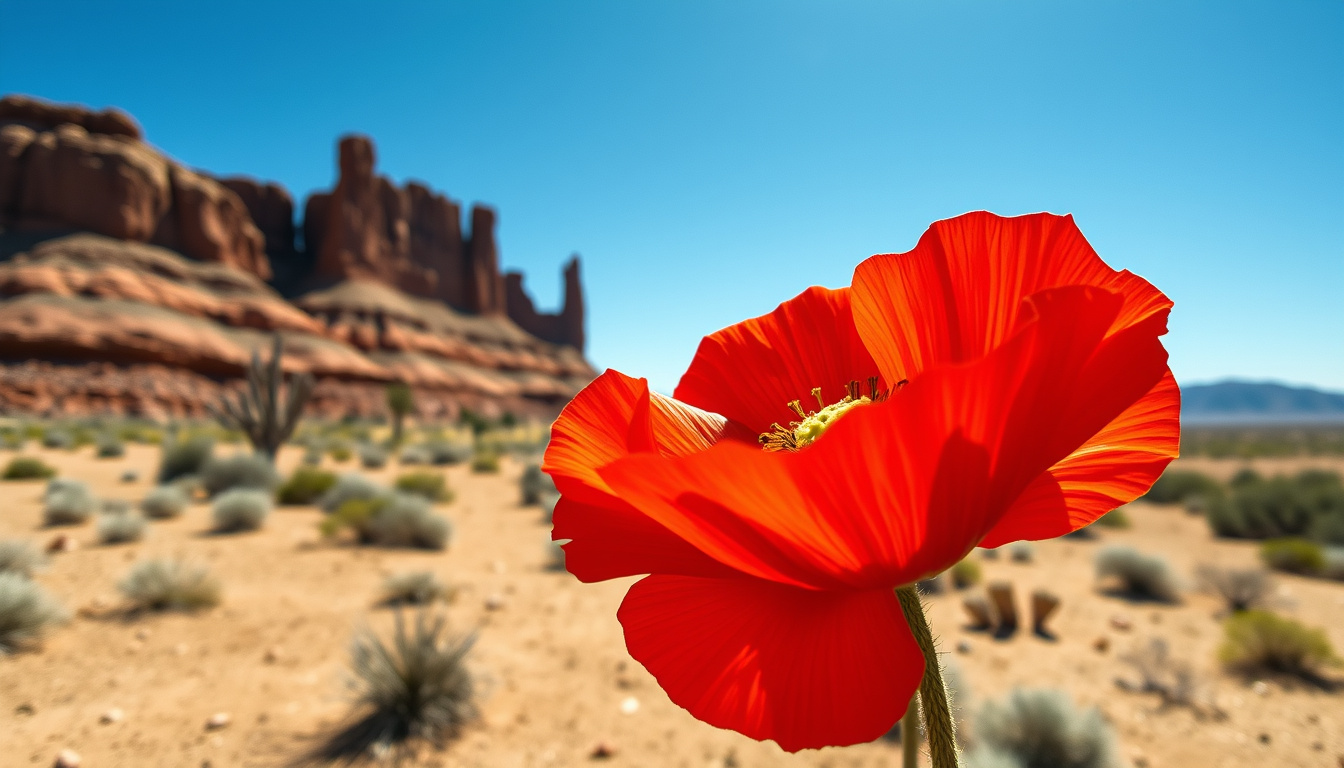
There’s a particular stillness to a Georgia O’Keeffe painting — a flower so large it becomes a landscape, a skull bleached by a desert sun that seems to hold more life than death. Few artists have reshaped how we see both the tiny and the vast quite like she did. O’Keeffe built a career that spanned seven decades, crafting an American modernism that turned away from crowded city streets and toward the stark, powerful emptiness of the New Mexico desert. This piece traces her life, her most famous works, the relationships that shaped her, and the health battles she faced with quiet determination.
Born: November 15, 1887 ·
Died: March 6, 1986 (aged 98) ·
Nationality: American ·
Known for: Modernist painting, magnified flowers, desert landscapes ·
Notable works: Jimson Weed/White Flower No. 1 (1932) ·
Institutions: Art Institute of Chicago, Georgia O’Keeffe Museum
Quick snapshot
- American modernist painter born November 15, 1887 (Georgia O’Keeffe Museum)
- Married Alfred Stieglitz from 1924 until his death in 1946 (Georgia O’Keeffe Museum Timeline)
- Suffered from macular degeneration beginning in the 1970s (Georgia O’Keeffe Museum)
- The exact nature of her relationship with Juan Hamilton (professional vs romantic) is debated (Smithsonian)
- Whether she was “nice” is subjective; primary sources describe her as private and strong-willed (Smithsonian)
- The precise influence of Arthur Wesley Dow on O’Keeffe’s artistic direction remains unclear from available records (Smithsonian)
- Whether her flower paintings were intentionally sexual is disputed — O’Keeffe denied the interpretation repeatedly (Smithsonian)
- 1915: first abstract charcoal drawings (Georgia O’Keeffe Museum Timeline)
- 1929: first trip to New Mexico (Georgia O’Keeffe Museum Timeline)
- 2014: Jimson Weed/White Flower No. 1 sold for $44.4 million (Smithsonian)
- Georgia O’Keeffe Museum in Santa Fe holds the largest permanent collection (Georgia O’Keeffe Museum)
- Major retrospectives continue to tour globally (Georgia O’Keeffe Museum)
Eight facts that define O’Keeffe’s life and career, one pattern: a woman who turned personal geography, health adversity, and gender constraints into a singular visual language.
| Label | Value |
|---|---|
| Full name | Georgia Totto O’Keeffe |
| Born | November 15, 1887 |
| Died | March 6, 1986 |
| Nationality | American |
| Ethnicity | Irish and Hungarian |
| Known for | Modernist painting, magnified flowers, animal skulls |
| Spouse | Alfred Stieglitz (1924–1946) |
| Major museum | Georgia O’Keeffe Museum, Santa Fe |
The pattern: O’Keeffe’s identity as an American of Irish and Hungarian descent farming stock in Wisconsin gave her a rural grounding that she carried into her deeply personal modernist abstraction.
What is Georgia O’Keeffe best known for?
Magnified flowers and desert landscapes
- O’Keeffe’s magnified flower paintings, e.g. Jimson Weed/White Flower No. 1, are her most iconic works (Smithsonian)
- Her New Mexico landscapes and animal skulls reflect a desert aesthetic (Georgia O’Keeffe Museum)
- She is considered a pioneering American modernist painter (Smithsonian)
When O’Keeffe painted a flower — say, a black iris — she blew it up to fill a canvas, forcing the viewer to stop and notice the intimate curves and folds they’d normally walk past. The Smithsonian calls her “one of the most revolutionary painters of the 20th century,” a label earned by taking the smallest elements of nature and giving them monumental scale. Her mid-1920s work included both skyscrapers — she was among the first American artists to live in and paint them, per the Smithsonian American Art Museum — and radical flower close-ups that felt like landscapes in their own right. By the mid-1920s, she was recognized as one of America’s most important and successful artists, according to the Georgia O’Keeffe Museum.
Bone and skull symbolism
- O’Keeffe frequently painted animal skulls, including Cow’s Skull: Red, White, and Blue (Smithsonian)
- Skulls were presented not as macabre but as elegant, eternal forms (Georgia O’Keeffe Museum)
- Cow’s Skull: Red, White, and Blue combines skull imagery with patriotic symbols (Smithsonian)
O’Keeffe’s bone paintings — like Cow’s Skull: Red, White, and Blue — draped the American flag across a cattle skull, fusing mortality with national identity. She found beauty in the desert’s bleached bones, treating them as architectural forms rather than grim relics. The Cleveland Museum of Art notes that sunflowers, a rare subject for her, were painted only three times; the museum’s Sunflower, New Mexico, I (1935) differs from her typical close-up by including bloom, stem, leaves, and Southwestern sky — a rare full-body portrait of a plant.
Master of modernism
- O’Keeffe’s style defined American modernism through abstraction of natural forms (Smithsonian)
- She created an influential modernism by abstracting flowers, mountains, and buildings (Smithsonian)
Who was Georgia O’Keeffe’s lover?
Alfred Stieglitz: photographer and husband
- O’Keeffe had a romantic and professional relationship with photographer Alfred Stieglitz (Georgia O’Keeffe Museum)
- They married in 1924 (Georgia O’Keeffe Museum)
- In later life she had a close relationship with artist Juan Hamilton (Smithsonian)
In 1916, Alfred Stieglitz — the legendary New York gallerist and photographer — hung O’Keeffe’s charcoal drawings at his gallery 291 without her knowledge. Upon seeing them, he reportedly said, “Finally, a woman on paper,” as recorded in the journal Camera Work. That exhibition launched her career. Stieglitz, 23 years her senior, became her husband in 1924, and the partnership was as much artistic as romantic: he photographed her obsessively, and she credited his promotion with making her name. After Stieglitz’s death in 1946, O’Keeffe entered a decades-long companionship with Juan Hamilton, a potter 60 years her junior.
O’Keeffe’s romantic partnerships were also career architectures: Stieglitz built her into a national icon, then Hamilton managed her final, high-value work — all while she maintained firm control of her own artistic choices.
Their artistic partnership
- Stieglitz promoted O’Keeffe through his gallery and journal Camera Work (Georgia O’Keeffe Museum)
- He created hundreds of photographs of O’Keeffe (Smithsonian)
Stieglitz’s photographs of O’Keeffe — her hands, her torso, her face — made her body a public artwork and blurred the line between personal devotion and professional branding.
Later relationship with Juan Hamilton
- Hamilton became O’Keeffe’s assistant in the 1970s (Georgia O’Keeffe Museum)
- The nature of their bond is debated: professional vs romantic (Smithsonian)
The pattern: both key relationships in O’Keeffe’s life followed a similar arc — a younger, devoted partner who amplified her work and managed her legacy, while she remained the gravitational center.
What illness did Georgia O’Keeffe have?
Macular degeneration diagnosis
- O’Keeffe suffered from macular degeneration beginning in the 1970s (Georgia O’Keeffe Museum)
- Her central vision deteriorated, making detailed work difficult (Smithsonian)
Macular degeneration attacks the center of the retina, blurring or blacking out the exact area a painter needs to see fine detail. For an artist famous for precision close-ups of petals and bone textures, this was a profound loss.
Vision loss and creative adaptation
- She continued to work by simplifying her style (Georgia O’Keeffe Museum)
- She shifted to large, loose forms and relied on peripheral vision (Smithsonian)
Rather than stop, O’Keeffe adapted. Her late works — broad swaths of color, simpler shapes, a flattening of the space — were not signs of decline but of a working artist solving a new problem with the tools she had left.
Impact on later work
- Vision loss ended her painting career around 1984 (Georgia O’Keeffe Museum)
- Her final works show an increasingly abstract, simplified style (Smithsonian)
The trade-off: O’Keeffe lost the ability to paint the intimate details that made her famous, but her last decade of work — raw, gestural, stripped down — offers a different kind of power: an artist seeing not with her eyes but with her accumulated decades of looking.
What was Georgia O’Keeffe’s ethnicity?
Irish and Hungarian roots
- O’Keeffe was of Irish and Hungarian descent (Georgia O’Keeffe Museum Timeline)
- Her father was Francis Calyxtus O’Keeffe (Irish) and her mother was Ida Totto O’Keeffe (Hungarian) (Georgia O’Keeffe Museum Timeline)
Her father’s family left Ireland during the Great Famine; her mother’s Hungarian father was a count. The name “Totto” is a shortened form of the Hungarian name “Tóth.”
Family background in Wisconsin
- She was born in Sun Prairie, Wisconsin to dairy farmers (Georgia O’Keeffe Museum)
- She was the first girl and second of seven children (Georgia O’Keeffe Museum Timeline)
Growing up on a Wisconsin dairy farm, O’Keeffe learned to see the rural landscape with intimacy — a perspective she would later transpose onto the New Mexican desert.
American identity
- She identified as American (Georgia O’Keeffe Museum)
- Her work is considered a distinctly American form of modernism (Smithsonian)
The implication: O’Keeffe’s ethnic mix — Irish storytelling tradition and Hungarian aristocratic formality — may have shaped her dual instinct for both folk intimacy and compositional discipline.
Was Georgia O’Keeffe a nice person?
Public vs private persona
- O’Keeffe had a reputation for being fiercely independent and sometimes difficult (Smithsonian)
- She guarded her privacy intensely (Georgia O’Keeffe Museum)
O’Keeffe was not warm in the conventional sense. She wore severe black clothing, gave clipped interviews, and once told a journalist she didn’t care what people thought of her. But the same rigor that made her seem cold also made her a successful businesswoman in an era when galleries routinely exploited female artists.
Contradictions in character
- She was known to be generous to young artists (Georgia O’Keeffe Museum)
- Her personality was complex and not easily categorized (Smithsonian)
The catch: “nice” is the wrong category for a woman who had to be harder than the men around her simply to survive as a serious artist. O’Keeffe was described as generous with young painters, but she was ruthless about her own time and space — a necessary armor.
Testimonies from contemporaries
- Primary sources describe her as private and strong-willed (Georgia O’Keeffe Museum)
- She maintained a small circle of close friends (Smithsonian)
Why this matters: the question “was she nice?” disguises a deeper one — could a woman in 1920s New York succeed as a modernist painter without being seen as difficult? The answer is almost certainly no.
What are the most famous Georgia O’Keeffe artworks?
Jimson Weed/White Flower No. 1
- Jimson Weed/White Flower No. 1 sold for $44.4 million in 2014 (Smithsonian)
- This remains the highest price for a painting by a female artist at auction (Smithsonian)
At auction in 2014, Jimson Weed/White Flower No. 1 sold for $44.4 million — at the time, the highest price ever for a painting by a female artist. The painting is audacious in its simplicity: a white flower fills the frame like a cumulus cloud, its petals soft and luminous.
Black Iris
- Black Iris is a magnified flower painting from 1926 (Smithsonian)
- It is held by the Metropolitan Museum of Art (Smithsonian)
Black Iris (1926) was immediately controversial. Viewers saw the flower’s deep, dark center as sexually suggestive; O’Keeffe denied the interpretation, insisting she was painting what she saw.
Cow’s Skull: Red, White, and Blue
- Cow’s Skull: Red, White, and Blue combines skull imagery with patriotic symbols (Smithsonian)
- Painted in 1931, it is in the collection of the Metropolitan Museum of Art (Smithsonian)
The trade-off: O’Keeffe’s most valuable works — the flowers and skulls — are also the ones that were most often reduced to simple metaphors by critics. The market paid for the icon; the artist always insisted she was painting the pure form.
Where can I see Georgia O’Keeffe artwork and exhibits?
Georgia O’Keeffe Museum in Santa Fe
- The Georgia O’Keeffe Museum in Santa Fe, NM, holds the largest collection (Georgia O’Keeffe Museum)
- The museum says it is the largest repository of her artwork, personal effects, and related archives (Georgia O’Keeffe Museum)
- It also includes important correspondence, ephemera, photographs, and two historic homes (Georgia O’Keeffe Museum)
If you want the complete picture, the Georgia O’Keeffe Museum in Santa Fe is the destination. It holds the world’s largest collection of her work — paintings, drawings, sculptures — plus her letters, cameras, and even her two historic New Mexico houses. The Georgia O’Keeffe Museum Timeline provides a detailed chronology of her life and career.
Major museum collections
- Works are also at the Art Institute of Chicago, MoMA, and Tate (Smithsonian)
- The Smithsonian American Art Museum holds Manhattan (1932), Hibiscus with Plumeria (1939), and Only One (1959) (Smithsonian American Art Museum)
- The Cleveland Museum of Art holds Sunflower, New Mexico, I (1935) (Cleveland Museum of Art)
Beyond Santa Fe, O’Keeffe’s work hangs in the Art Institute of Chicago, MoMA in New York, the Tate in London, and the Smithsonian American Art Museum in Washington, D.C. The Smithsonian American Art Museum holds Hibiscus with Plumeria (1939), which shows her tropical color palette, and Only One (1959), painted after her world tour covering India, East Asia, Southeast Asia, the Middle East, and Rome, per the Smithsonian American Art Museum.
Traveling exhibitions
- Special exhibits are listed on the museum’s website (Georgia O’Keeffe Museum)
The pattern: O’Keeffe’s institutional footprint is vast, but the deepest experience remains the Santa Fe museum — a pilgrimage site that lets visitors walk through the landscape she painted for 40 years.
The Georgia O’Keeffe Museum requires advance booking for peak seasons. Schedule at least half a day to truly absorb the collection and the landscape that inspired it.
Timeline: Georgia O’Keeffe’s life and career
- 1887 – Born in Sun Prairie, Wisconsin (Georgia O’Keeffe Museum Timeline)
- 1905–1908 – Studied at the Art Institute of Chicago and Art Students League (Georgia O’Keeffe Museum)
- 1915 – Produced first abstract charcoal drawings (Georgia O’Keeffe Museum Timeline)
- 1916 – First exhibition at Alfred Stieglitz’s gallery 291 (Georgia O’Keeffe Museum)
- 1924 – Married Alfred Stieglitz (Georgia O’Keeffe Museum)
- 1929 – First trip to New Mexico; began desert landscape series (Georgia O’Keeffe Museum Timeline)
- 1949 – Moved permanently to New Mexico (Georgia O’Keeffe Museum)
- 1970s – Diagnosed with macular degeneration; vision declines (Georgia O’Keeffe Museum)
- 1986 – Died at age 98 in Santa Fe (Georgia O’Keeffe Museum)
- 2014 – Jimson Weed/White Flower No. 1 sold for $44.4 million (Smithsonian)
The timeline makes one thing clear: O’Keeffe’s most productive period was between ages 40 and 70 — a counter-narrative to the myth that artists peak early.
Clarity: what’s confirmed and what’s unclear
Confirmed facts
- Georgia O’Keeffe was an American modernist painter born in 1887 (Georgia O’Keeffe Museum)
- She was married to Alfred Stieglitz from 1924 until his death in 1946 (Georgia O’Keeffe Museum)
- She suffered from macular degeneration in later life (Georgia O’Keeffe Museum)
- Her ethnic background is Irish and Hungarian (Georgia O’Keeffe Museum Timeline)
- Her painting Jimson Weed/White Flower No. 1 sold for $44.4 million in 2014 (Smithsonian)
- She was among the first American artists to paint skyscrapers from living in them (Smithsonian American Art Museum)
What’s unclear
- The exact nature of her relationship with Juan Hamilton (professional vs romantic) is debated (Smithsonian)
- Whether she was ‘nice’ is subjective; primary sources describe her as private and strong-willed (Georgia O’Keeffe Museum)
- The ‘saddest painting of all time’ is not a defined category; O’Keeffe’s work is not typically described as sad
- The precise influence of Arthur Wesley Dow on O’Keeffe’s artistic direction remains unclear from available records
- Whether her flower paintings were intentionally sexual is disputed — O’Keeffe denied the interpretation repeatedly
Key quotes
I decided to start anew—to strip away what I had been taught.
— Georgia O’Keeffe, quoted in the Georgia O’Keeffe Museum biography. This line captures the radical break she made from traditional art instruction after studying Arthur Wesley Dow’s ideas about composition.
Finally, a woman on paper.
— Alfred Stieglitz, commenting on O’Keeffe’s early charcoal drawings in the journal Camera Work, as referenced by the Smithsonian. The quote is both a compliment and a capsule of the era’s condescension.
O’Keeffe’s own words — “strip away what I had been taught” — are the key to understanding her entire career. She spent 70 years building a visual vocabulary that was purely her own, shaped by the New Mexico desert, by the constraints of her fading sight, and by a will that refused to be called “female artist” when she was just an artist. For any reader drawn to the American West, modern art, or stories of creative resilience, the lesson is clear: go see the work in person, not through a screen. The flowers are 6 feet tall for a reason.
high.org, smithsonianassociates.org, en.wikipedia.org, americanart.si.edu, americanart.si.edu, smithsonianmag.com, instagram.com, hotellradar.com
Art historians continue to study Georgia OKeeffes legacy, whose work defined American modernism.
Frequently asked questions
How did Georgia O’Keeffe change art?
She brought American modernism away from European abstraction and into the landscape itself, magnifying natural forms — flowers, bones, mountains — to radical scale and giving them an intimacy that had no precedent.
What inspired O’Keeffe’s flower paintings?
O’Keeffe said she painted flowers larger so people would stop and look at them. The Smithsonian calls her approach “abstraction of natural forms.”
Where is the Georgia O’Keeffe Museum?
217 Johnson Street, Santa Fe, New Mexico. The museum says it is the largest repository of her artwork and personal effects (Georgia O’Keeffe Museum).
What was O’Keeffe’s technique?
She used thin, fluid layers of oil paint, building up color gradually. Her style evolved from representational abstraction to simplified, large-scale forms, especially after her vision declined.
How did O’Keeffe’s vision loss affect her work?
Macular degeneration blurred her central vision, forcing her to simplify shapes and rely on peripheral vision. Her late work is broader, looser, and more abstract — a creative adaptation rather than a decline.
What is the most valuable O’Keeffe painting?
Jimson Weed/White Flower No. 1 (1932), sold in 2014 for $44.4 million. It remains the highest auction price for a work by a female artist.
How did O’Keeffe meet Alfred Stieglitz?
A friend brought O’Keeffe’s charcoal drawings to Stieglitz’s gallery 291 in 1916. Stieglitz exhibited them without her permission. The meeting launched both their personal and professional relationship.
Related reading
- Mira Nair – Another creative figure who built a distinct visual voice against cultural expectations.
- Elif Shafak – A writer whose work, like O’Keeffe’s, navigates identity, place, and the politics of being a woman in a male-dominated field.

Arthur Oliver Howard Fletcher is a staff writer for NationalReport.uk, covering UK national news, politics, the economy and public services. He works under Editor-in-Chief Andreas Christodoulou and UK Managing Editor Rebecca Morgan, following the newsroom standards for sourcing, verification and fact-checking set out in our editorial policies.