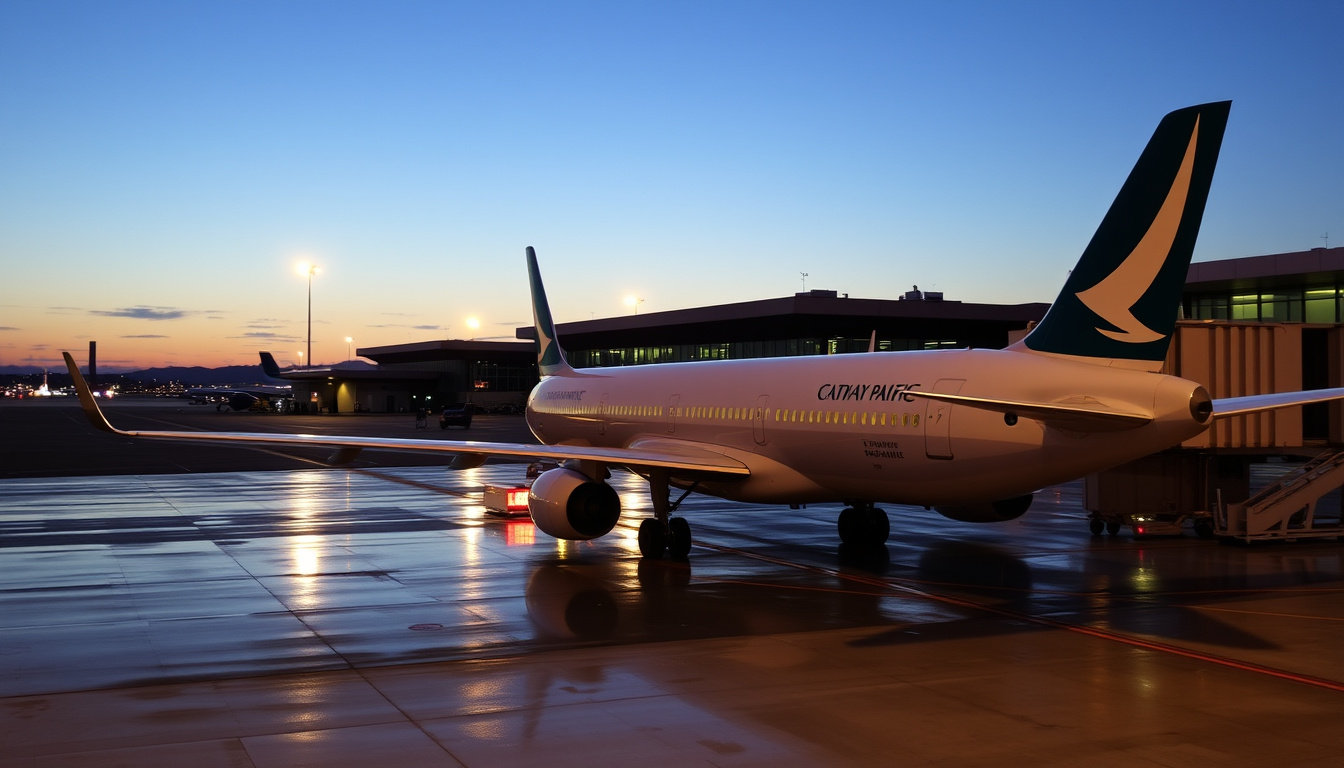
Cathay Pacific started with one DC-3 in 1946 and now moves millions across the world’s most competitive aviation markets. Yet for all its reach, the airline often leaves travelers with more questions than answers: Who actually controls the board? Is the service worth the premium? And how does it really compare to the Gulf carriers like Emirates? This breakdown delivers the facts you need to decide.
Founded: 1946 · Headquarters: Hong Kong · Fleet size: 179 aircraft (2025) · Destinations: over 200 · Alliance: oneworld · Parent: Swire Pacific / Air China
Quick snapshot
- Flag carrier of Hong Kong (Wikipedia (aviation encyclopaedia))
- Major shareholders: Swire Pacific (~45%), Air China (~27%) (Aviation Outlook (industry analysis))
- Fleet includes A350 and 777-300ER (Cathay Pacific official site)
- Exact ownership mix after full bailout repayment
- Whether fleet will return to pre-pandemic size of ~230 aircraft
- 1946: Founded by Roy Farrell and Sydney de Kantzow (Wikipedia (aviation encyclopaedia))
- 2006: Air China acquires a 29.9% stake (Wikipedia (aviation encyclopaedia))
- 2020: HK$27.3 billion government bailout (Aviation Outlook (industry analysis))
- 80th anniversary campaign “80 Years Together” in 2026 (Aviation Outlook (industry analysis))
- Continued fleet renewal with A321neo deliveries (Aviation Outlook (industry analysis))
| Attribute | Details |
|---|---|
| IATA code | CX |
| Year founded | 1946 |
| Headquarters city | Hong Kong |
| Fleet size (2025) | 179 |
| Destinations | 200+ |
| Alliance | oneworld |
| Parent company | Swire Pacific / Air China joint control |
| Skytrax rating | 3–5 stars (route-specific) |
Cathay Pacific is Hong Kong’s flag carrier, yet its two largest shareholders are British (Swire) and Chinese (Air China), making it a geopolitical bellwether as much as an airline.
What country owns Cathay Pacific?
The short answer is that Cathay Pacific is the flag carrier of Hong Kong, but its ownership structure tells a more intricate story. The airline is publicly listed on the Stock Exchange of Hong Kong (SEHK: 293) and controlled by a mix of powerful institutional shareholders.
Who is the current owner?
- Swire Pacific is the largest shareholder, holding approximately 45.12% of the airline (Aviation Outlook (industry analysis)).
- Air China holds around 27.11% after trimming its stake by selling roughly 1.61% for HK$1.32 billion in January 2026 (Aviation Outlook (industry analysis)).
- Qatar Airways holds approximately 9.99% of the carrier (Aviation Outlook (industry analysis)).
- The HKSAR Government holds approximately 6.08%, a stake acquired during the 2020 bailout (Aviation Outlook (industry analysis)).
The pattern: no single shareholder has absolute control, but Swire Pacific effectively manages the airline while Air China holds significant board influence.
Is Cathay Pacific owned by China or Hong Kong?
Technically, it is a Hong Kong–incorporated company with its main hub at Hong Kong International Airport (Wikipedia (aviation encyclopaedia)). However, following the 2020 bailout, the Hong Kong government is a permanent shareholder. Meanwhile, Air China’s 27% stake gives Beijing a substantial indirect voice. This means the airline operates as a Hong Kong brand but within China’s regulatory orbit.
The implication: Cathay Pacific must serve the commercial interests of its global shareholders while aligning with Beijing’s aviation strategy.
Is Cathay Pacific a good airline?
Consistency is Cathay Pacific’s strongest asset. In an industry where service quality varies wildly between routes, the airline maintains a uniform standard that few competitors match.
Upsides
- Strong in-flight service and seat comfort across all cabins (Skytrax (global airline rating agency))
- Modern, fuel-efficient fleet with A350 and 777-300ER
- Extensive Asian network via oneworld alliance
Downsides
- Premium pricing outside of seasonal sales
- Smaller home market (Hong Kong) vs Dubai or Sydney
- Complex ownership can slow strategic decision-making
What are Cathay Pacific’s strengths and weaknesses?
The airline holds a Skytrax 5-star rating on select routes, placing it in an elite group alongside Singapore Airlines and ANA (Skytrax (global airline rating agency)). Its fleet modernization — particularly the introduction of the A350 and the refurbishment of its 777-300ERs — has kept the passenger experience competitive with the Gulf carriers. The trade-off is that its premium product comes with premium price tags outside of regular sales.
How does Cathay Pacific rank among global airlines?
In most industry rankings, Cathay Pacific sits just outside the top 3. It consistently beats European legacy carriers but trails Singapore Airlines and Emirates in overall brand perception. Where it wins is route density across Asia-Pacific and North America, served by a fleet of 179 aircraft (Aviation Outlook (industry analysis)).
“Cathay Pacific continues to deliver a very strong product in business class, with seat comfort and service consistency ranking among the industry’s best.”
Skytrax Rating Report, 2024
While rivals chase gimmicks — onboard lounges, shower spas, open suites — Cathay Pacific wins by simply getting the basics right more often than anyone else on long-haul routes.
Which is better, Emirates or Cathay Pacific?
This is the question every Asia-Pacific traveler wrestles with. Both airlines are full-service carriers with outstanding business class products, but they operate from different hubs and with different fleet strategies.
Three airlines, three strategies. Here’s how they stack up on the metrics that matter for long-haul travelers.
| Metric | Cathay Pacific | Emirates | Qantas |
|---|---|---|---|
| Hub | Hong Kong (HKG) | Dubai (DXB) | Sydney (SYD) |
| Fleet size (approx.) | 179 (Aviation Outlook (industry analysis)) | 260 (Emirates official site) | 130 (Qantas official site) |
| Destinations | 200+ | 150+ | 100+ |
| Alliance | oneworld (oneworld alliance site) | None | oneworld |
| Business Class seat | 1-2-1 config (A350) | 1-2-1 config (A380) | 1-2-1 config (787) |
| Skytrax rating | 5-star (route-specific) | 5-star | 4-star |
| Key owner | Swire Pacific / Air China | Government of Dubai | Publicly listed (ASX: QAN) |
Cathay Pacific vs Emirates: business class showdown
Emirates offers more award seats and larger economy seats on its A380 fleet, making it a strong choice for leisure travelers. However, Cathay Pacific often rates higher for seat comfort and service consistency, particularly in business class (Skytrax (global airline rating agency)). The catch: Emirates’ Dubai hub offers one-stop connectivity to Europe and Africa, while Cathay Pacific’s Hong Kong hub is better positioned for North America and Northeast Asia.
Which airline offers better value for long-haul flights?
For business travelers flying transpacific routes, Cathay Pacific’s schedule from Hong Kong to Los Angeles, San Francisco, and Vancouver is hard to beat. For European travelers heading to Asia or Australia, the choice depends on whether you prioritize the in-flight product (Emirates) or the alliance ecosystem (Cathay Pacific / Qantas).
The trade-off: Emirates gives you more physical space; Cathay Pacific gives you better operational reliability and award availability within oneworld.
Why is Cathay Pacific so cheap?
The perception that Cathay Pacific is “cheap” stems from aggressive seasonal sales that undercut its usual premium positioning. This is a deliberate strategy to fill seats on highly competitive routes.
Seasonal pricing strategies
- Budget sales are common during off-peak seasons (Feb–May, Sep–Nov).
- Economy fares on transpacific routes can drop to as low as $550 round-trip from the US West Coast.
- These sales are limited and often sell out within 48 hours.
Competition on transpacific routes
Route competition with Chinese carriers like China Southern and China Eastern drives discounting. Additionally, Singapore Airlines and EVA Air compete aggressively on connecting traffic through their hubs. Cathay Pacific’s pricing does not reflect typical full-service carrier rates year-round — it dips sharply during sales and climbs back to premium levels near departure.
The implication: if you see a cheap Cathay Pacific fare, book it quickly. It’s a tactical move, not a permanent price shift.
Cathay Pacific timeline
- 1946: Founding of Cathay Pacific by Roy Farrell and Sydney de Kantzow in Shanghai (moved to Hong Kong shortly after) (Wikipedia (aviation encyclopaedia)).
- 1980s: Expansion to long-haul routes, including London and Vancouver.
- 2006: Air China acquires a 29.9% minority stake, establishing a strategic cross-shareholding.
- 2020: Received a government bailout (HK$27.3 billion) to survive the pandemic (Aviation Outlook (industry analysis)).
- 2026: 80th anniversary celebrated under the campaign “80 Years Together”.
What this means: Cathay Pacific’s trajectory reflects Hong Kong’s own evolution — from a colonial trading post to a global aviation hub under Chinese sovereignty.
What’s confirmed and what’s still unclear
Confirmed facts
- Cathay Pacific is the flag carrier of Hong Kong (Wikipedia (aviation encyclopaedia)).
- Swire Pacific holds 45.12% and Air China holds 27.11% (Aviation Outlook (industry analysis)).
- Fleet includes Airbus A350 and Boeing 777-300ER (Cathay Pacific official site).
What remains unclear
- Exact breakdown of future ownership after full bailout repayments.
- Whether Cathay Pacific will return to pre-pandemic fleet size of ~230 aircraft.
“Our investment in the A350 and 777-300ER reflects a long-term commitment to elevating the passenger experience across all cabins.”
Ronald Lam, CEO, Cathay Pacific (2024 Fleet Renewal Interview)
The pattern: what’s confirmed is grounded in public filings and official statements; what’s unclear hinges on decisions yet to be made by a board with divided loyalties.
Summary
Cathay Pacific remains a top-tier choice for long-haul travel, but its premium product comes with premium price tags outside of sales. The airline’s dual identity — a Hong Kong brand with strong Chinese and British shareholder influence — creates both stability and strategic friction. For the Asia-Pacific traveler, the verdict is simple: Cathay Pacific delivers exactly what it promises, but its future hinges on how deftly it navigates the competing interests of its powerful shareholders.
Related reading: **American Airlines Guide** · **Smiths Group Share Price Analysis**
yunise.com, tripadvisor.com, facebook.com, youtube.com, qantas.com, columbusga.gov, trendportal.dk
For travelers considering the airline, Cathay Pacifics London to Hong Kong flights offer a direct connection that showcases the carrier’s service quality on one of its flagship routes.
Frequently asked questions
Is Cathay Pacific a safe airline?
Yes. Cathay Pacific holds an IATA Operational Safety Audit (IOSA) certification and maintains a modern fleet with an excellent safety record.
Can I book a Cathay Pacific flight online?
Yes. You can book directly through the official Cathay Pacific website or via its mobile app. Online check-in opens 48 hours before departure.
Does Cathay Pacific fly to Europe?
Yes, Cathay Pacific operates direct flights from Hong Kong to London (LHR), Paris (CDG), Amsterdam (AMS), Zurich (ZRH), and several other European cities, many with daily frequencies.
What is the Cathay Pacific baggage allowance?
Standard baggage allowance varies by route and cabin. Typically, Economy allows 30 kg (1 piece), Premium Economy 40 kg (2 pieces), and Business/First 50 kg (2 pieces) on transpacific and European routes.
How do I earn Asia Miles on Cathay Pacific?
You earn Asia Miles by flying Cathay Pacific or its oneworld partners. You can also earn miles by using co-branded credit cards or shopping through the Asia Miles online mall.

Arthur Oliver Howard Fletcher is a staff writer for NationalReport.uk, covering UK national news, politics, the economy and public services. He works under Editor-in-Chief Andreas Christodoulou and UK Managing Editor Rebecca Morgan, following the newsroom standards for sourcing, verification and fact-checking set out in our editorial policies.