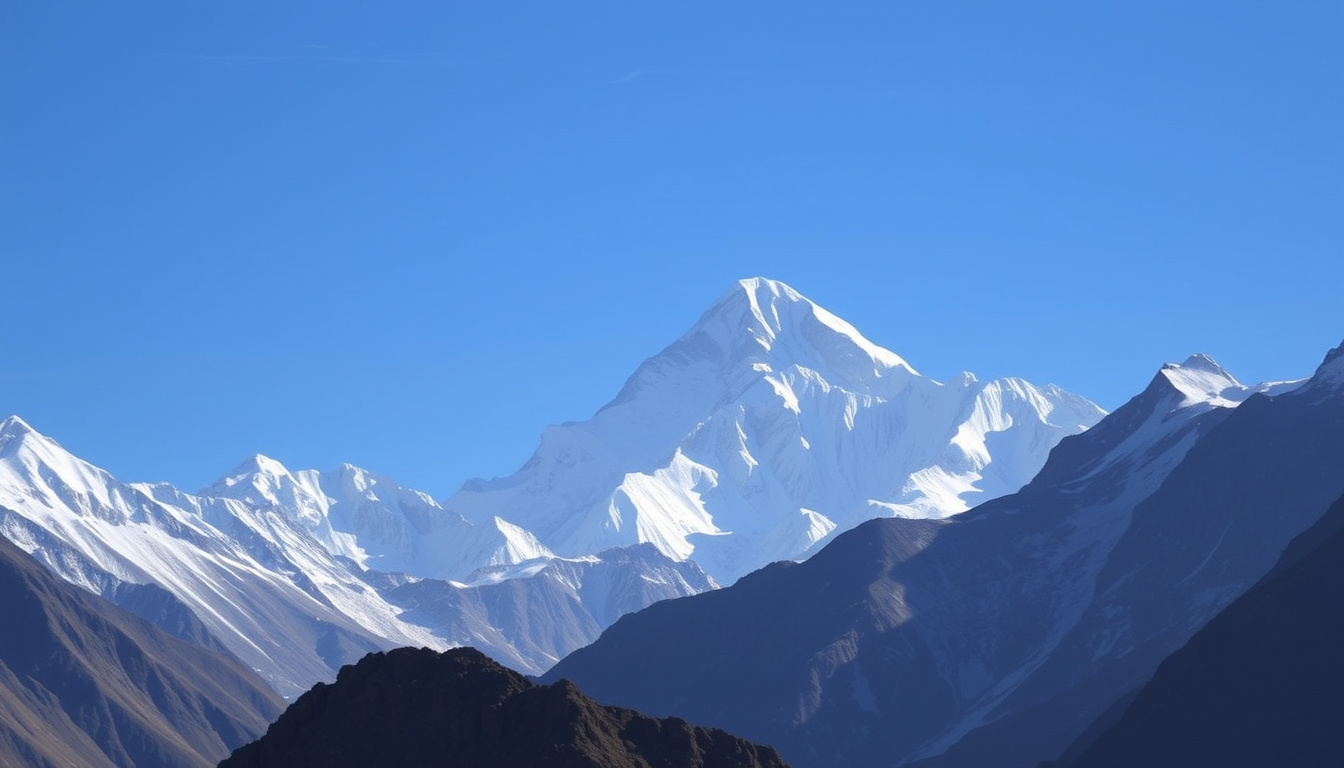
You’ve seen the postcard peak — but Mount Everest is also a border marker, a graveyard, and a $50,000 bucket-list item wrapped in one. This guide answers the most common questions about the world’s tallest mountain: where it sits, why climbing costs a fortune, how many have died, and why pilots give it a wide berth.
Height: 8,848.86 m (29,031.7 ft) ·
Location: Nepal / Tibet (China) border ·
First ascent: 1953 by Hillary and Norgay ·
Total deaths (as of 2024): Over 300 ·
Average climbing cost: ~$45,000
Quick snapshot
- Location: Nepal/China border (Britannica)
- Height: 8,848.86 m (Britannica)
- Continent: Asia (Britannica)
- Over 300 deaths (Big Think)
- Death zone hazards above 8,000 m (Eco Holidays Nepal)
- 2 PM rule limits summit attempts (Britannica)
- Cost: $35,000–$100,000 (Climbing)
- Permit required ($11,000 Nepal) (Britannica)
- Best season: spring (Britannica)
- First ascent 1953 (Britannica)
- George Mallory’s body found 1999 (Climbing Kilimanjaro)
- 1996 disaster killed 8 (Britannica)
Of the 13,737 recorded summits on Everest, the split between the two sides reveals a stark pattern in risk and reward.
| Metric | Nepal (South Side) | Tibet (North Side) |
|---|---|---|
| Total summits (through 2026) | 9,887 | 3,850 |
| Deaths recorded | 229 | 110 |
| Death rate | 2.3% | 2.9% |
| Standard route | South Col / Southeast Ridge | North Col / Northeast Ridge |
| Death zone start | ~7,950 m (above Camp IV) | ~8,300 m (above Camp III) |
Source: Alan Arnette (expedition statistics compiler); Eco Holidays Nepal (death zone guide)
The implication: the North Side kills at a slightly higher rate per summit, a trade-off climbers face when choosing their route.
In which country is Mount Everest in?
Mount Everest sits on the border between Nepal and the Tibet Autonomous Region of China. The peak itself straddles the two countries: the southern slope lies in Nepal, the northern slope in Tibet. Its exact coordinates are 27°59′N 86°55′E, placing it within the Himalayas, the continent-spanning mountain range that separates the Indian subcontinent from the Tibetan Plateau.
Both sides manage access and permits independently. Nepal issues permits from Kathmandu; China requires a separate Tibet travel permit for the North Side approach.
What continent is Mount Everest in?
Everest lies entirely within Asia, specifically in the Himalayan range that runs through Nepal, India, Bhutan, and China.
What is the exact geographical location?
The summit sits at 27°59′17″N 86°55′31″E, about 160 km northeast of Kathmandu and 380 km southwest of Lhasa.
The two-faced geography means climbers effectively choose a country before they choose a route, and that choice determines everything from permit cost to rescue availability.
How many climbers died on Everest?
As of 2024, more than 330 people are known to have died on Mount Everest since the first recorded attempts. An estimated 200 bodies remain on the mountain today, many unrecovered due to the extreme altitude and terrain.
The Himalayan Database, which tracks expeditions, records at least 322 deaths since 1922. But because not all fatalities are formally reported (especially on the Tibet side), the true number is likely higher.
What is the death rate on Everest?
Based on 13,737 recorded summits through 2026, the overall death rate is about 2.5% — roughly one death per 40 summiters. But the rate varies sharply by route: 2.3% on the Nepal side, 2.9% on the Tibet side.
What are the main causes of death?
Most deaths occur in the Death Zone, the area above 8,000 meters where oxygen pressure is so low that the human body begins to die. Common causes: altitude sickness, falls, avalanches, frostbite, and exhaustion. In recent years, overcrowding has amplified risks, especially during summit windows.
The pattern: cheaper operators on the Nepal side have been linked to a disproportionate share of recent fatalities, suggesting lower budgets can mean lower safety.
Why does it cost $40,000 to climb Mount Everest?
A full guided expedition to Everest typically costs between $35,000 and $60,000, with some premium operators charging $100,000 or more. The Nepal climbing permit alone is $11,000 per person in peak season (though travel agencies often quote $15,000 to include logistics). On the Tibet side, the permit is cheaper but requires a Chinese guide and additional travel paperwork.
How much does it cost to climb Mount Everest in 2026?
A 2026 pricing analysis by ExpedReview reports an average cost of $61,267 and a median of $54,995 for the Nepal South Side. Budget operators may offer packages near $35,000; luxury expeditions can exceed $100,000.
What factors influence the cost?
- Permit fee — $11,000 on the Nepal side; about CNY 50 for the Tibet travel permit (plus guide fees).
- Guides and Sherpa support — a personal high-altitude guide adds $5,000–$15,000.
- Logistics — food, oxygen, tents, porters, and base camp services.
- Travel and insurance — flights, evacuation insurance (often $500–$1,000).
- Operator margin — established companies with proven safety records charge a premium.
What are 5 facts about Mount Everest?
Beyond the height and location, Everest is rich with curiosities and grim landmarks.
What is the height of Mount Everest?
The official height, jointly agreed by Nepal and China in 2020, is 8,848.86 meters (29,031.7 feet).
Who was the famous body found on Everest?
The body of George Mallory, who died in 1924 trying to reach the summit, was discovered on the North Face in 1999 by an expedition searching for clues. It remains at around 8,155 meters.
What is the oldest body still on Mount Everest?
The oldest known body is likely that of Andrew Irvine, Mallory’s climbing partner, whose remains have never been recovered. His ice axe was found in 1933, but no body. Other bodies from the 1920s and 1930s may still lie in the Death Zone.
Who climbed Everest first?
The first successful ascent was made on May 29, 1953 by Sir Edmund Hillary (New Zealand) and Tenzing Norgay (Nepal).
What is the Rainbow Valley?
A climber’s nickname for a section of the North Side route where brightly colored down suits mark the location of bodies that have been exposed for years. It’s a sobering reminder of the mountain’s toll.
The trade-off: Everest’s fame draws thousands, but the same fame that fills permit quotas also fills the Death Zone with bodies that become landmarks.
Why do planes not fly over Everest?
Commercial airliners do fly near the Himalayas — some routes pass within 100 km of Everest — but they cannot fly directly over the peak for two reasons: insufficient engine performance at high altitude and lack of engine-out escape routes. If an engine fails over the Himalayas, a plane cannot glide to a safe landing altitude (the mountains are too high). Additionally, turbulence and extreme weather are common above the range.
What is the 2 PM rule on Everest?
The “2 PM rule” is a widely adopted safety guideline: climbers must turn back and head down from the summit by 2:00 PM regardless of how close they are. After that hour, the risk of nightfall, incoming storms, and oxygen exhaustion becomes lethal. The rule is credited with saving lives but is not enforced by law — some guides ignore it to increase summit rates.
Are there any flights that cross Everest?
Small sightseeing aircraft and helicopters operate scenic flights that come close, but they do not cross the peak. Some helicopter tours from Kathmandu offer a close-up view, landing at Everest Base Camp (but not on the summit).
The catch: Everest’s height creates an aerodynamic trap for large jets. Flying over would demand engine-out drift-down procedures that are impossible given the mountain’s elevation.
Timeline of key Everest events
- 1856 – First recorded survey; Peak XV identified as highest (Britannica).
- 1924 – Mallory and Irvine last seen; bodies lost (Climbing Kilimanjaro).
- 1953 – First successful summit by Hillary and Norgay (Britannica).
- 1975 – First woman reaches summit (Junko Tabei) (Alan Arnette).
- 1996 – May disaster kills 8 climbers; later book/film (Britannica).
- 1999 – Mallory’s body found at 8,155 m (Climbing Kilimanjaro).
- 2019 – Nepal permit fee set at $11,000 (Britannica).
- 2023 – Record number of permits issued (478) (Alan Arnette).
Confirmed facts vs. what remains unclear
Confirmed facts
- Height: 8,848.86 m (2020 agreement) (Britannica)
- Location: border of Nepal and Tibet (China) (Britannica)
- First ascent: 1953 by Hillary and Norgay (Britannica)
- Current permit cost: $11,000 (Britannica)
What’s unclear
- Exact number of deaths (different datasets vary) (Big Think)
- Identity of some bodies on the mountain (Climbing Kilimanjaro)
- Whether Mallory and Irvine reached summit before death (Britannica)
- Exact count of bodies remaining on the mountain (Climbing Kilimanjaro)
“We knocked the bastard off.”
— Sir Edmund Hillary, reflecting on the first ascent in 1953
“Because it’s there.”
— George Mallory, when asked why he wanted to climb Everest
“It’s a place where the human body is literally dying.”
— David Breashears, filmmaker and Everest veteran, describing the Death Zone
For the aspiring climber in 2026, the choice is clear: invest in a reputable operator on the Nepal side, respect the 2 PM rule, and accept that Everest is as much a gamble on logistics as it is on human endurance. Or stay at sea level — the photos look just as good from here.
Related reading: Barstools Bar: Difference, Styles, Comfort & Cost Guide
namastenepaltrekking.com, swotahtravel.com, tibettravel.org, gototibet.com, ebctrekguide.com, facebook.com, abendanalyse.de
For detailed statistics on climbing expenses and fatalities, check out Mount Everests location and costs.
Frequently asked questions
What is the best season to climb Mount Everest?
The primary climbing window is April–May (pre-monsoon spring). A shorter window in September–October is possible but less reliable.
How long does it take to climb Mount Everest?
A full expedition typically lasts 6–9 weeks, including acclimatization rotations and weather waiting.
Is climbing Mount Everest dangerous?
Yes. The death rate of about 2.5% makes it one of the most dangerous civilian activities. Most deaths occur in the Death Zone.
What is the death zone on Everest?
The area above 8,000 meters (26,247 ft) where oxygen pressure is too low for sustained human survival without supplemental oxygen.
How do climbers prepare for Everest?
Preparation includes months of high-altitude training, gear acquisition (windproof suits, oxygen systems, ice axes), and often a previous 8,000 m peak climb.
What equipment is needed to climb Everest?
Essential gear includes a high-altitude down suit, double boots, crampons, ice axe, oxygen mask/tank system, sleeping bag rated to -40°C, and a satellite phone.

Arthur Oliver Howard Fletcher is a staff writer for NationalReport.uk, covering UK national news, politics, the economy and public services. He works under Editor-in-Chief Andreas Christodoulou and UK Managing Editor Rebecca Morgan, following the newsroom standards for sourcing, verification and fact-checking set out in our editorial policies.