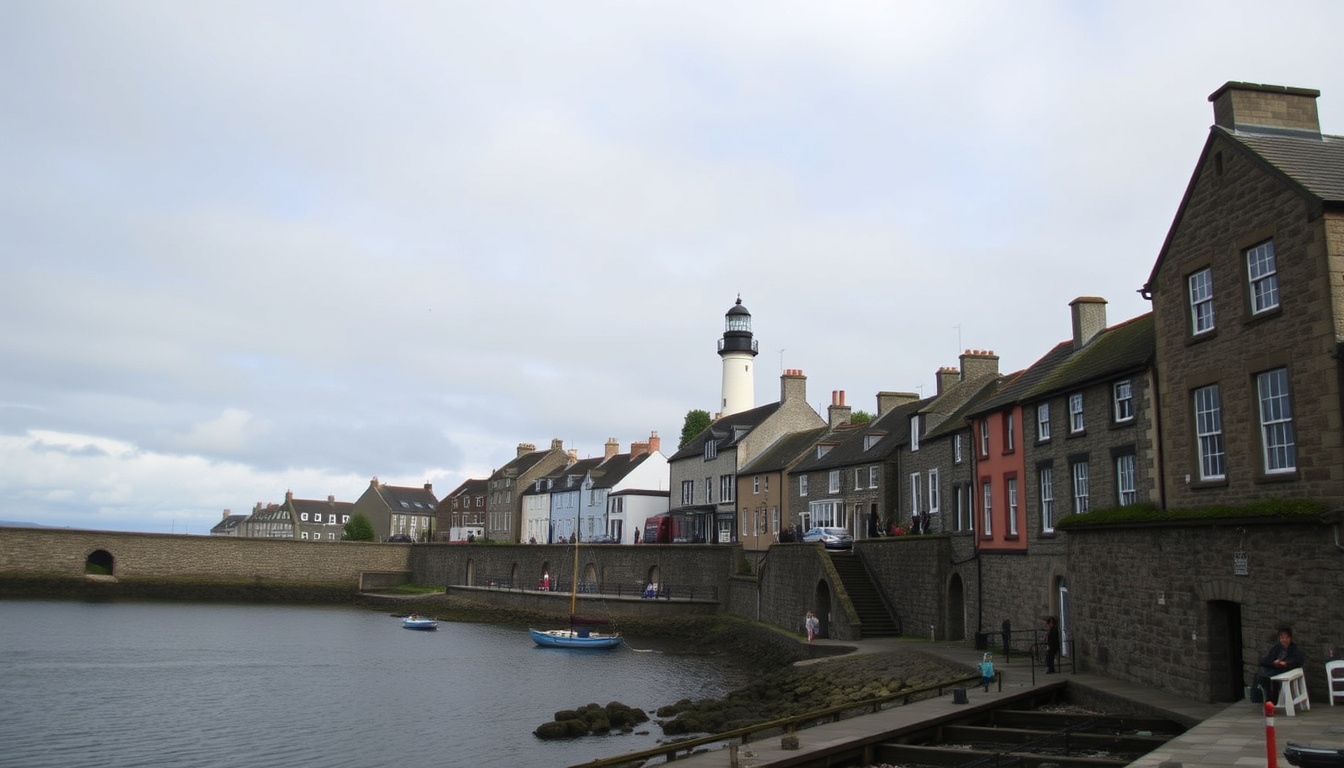
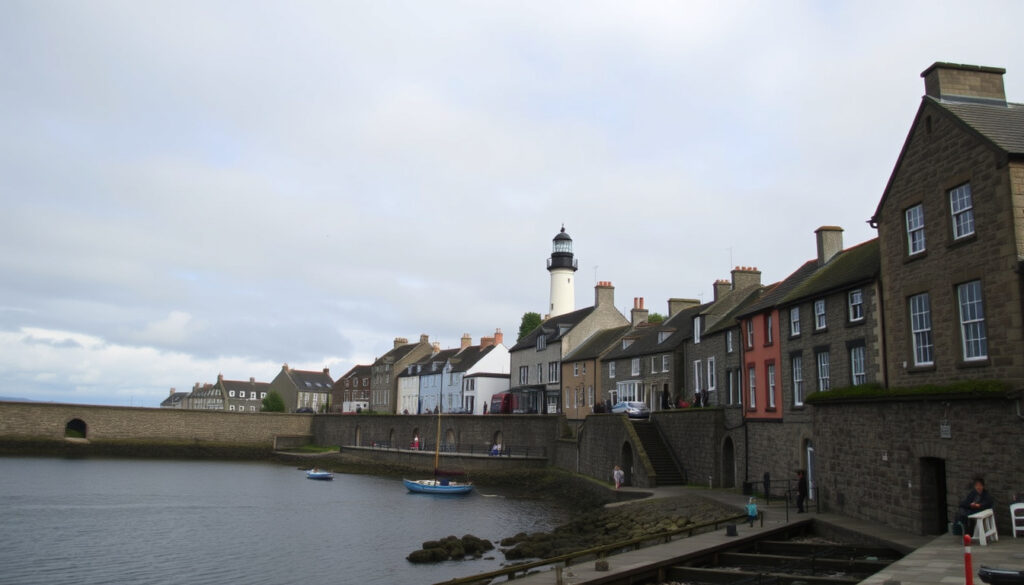
Few towns can claim a past as layered as Bo Ness. Nestled on the south bank of the Firth of Forth, about 20 miles from Edinburgh, this former industrial port once ranked as Scotland’s second-biggest port. Today, it is a quiet commuter town with a heritage trail winding through Roman, medieval, and industrial sites. This guide draws on official records, resident reviews, and historical data to help you decide if Bo Ness is the right place for you.
Distance from Edinburgh: about 20 miles (Charles Church (UK homebuilder)) ·
Historical port rank: Second largest in Scotland (Bo’net (local heritage site)) ·
Council area: Falkirk (Falkirk Council (local authority))
Quick snapshot
Confirmed facts
- Bo’ness originated in the 16th century and was formally known as Borrowstounness (Falkirk Council (local authority))
- Kinneil Estate contains Roman, medieval, and industrial remains (Visit Falkirk (tourism board))
- The Hippodrome Cinema is Scotland’s oldest purpose-built cinema, opened in 1912 (Bo’net (local heritage site))
- Bo’ness was once the second-largest port in Scotland (Bo’net (local heritage site))
What’s unclear
- Exact number of jobs in the town today
- Current crime statistics (needs recent Police Scotland data)
- Precise number of residents who commute to Edinburgh daily
- Total annual visitor numbers to Bo’ness
Timeline signal
- c. AD 142: Roman fortlet built at Kinneil (Bo’net (local heritage site))
- 16th century: Bo’ness originates as Borrowstounness (Falkirk Council (local authority))
- 1912: Hippodrome Cinema opens (Bo’net (local heritage site))
- 2009: Hippodrome reopens after £2 million revamp (Bo’net (local heritage site))
What’s next
- Falkirk Council’s masterplan outlines continued regeneration for Bo’ness (Falkirk Council (local authority))
- The Bo’ness Heritage Trail and railway are expected to draw more visitors (Visit Falkirk (tourism board))
Eight key data points, each drawn from official or verified sources, give a quick factual foundation for understanding the town.
| Label | Value | Source |
|---|---|---|
| Population (2020 estimate) | 14,400 | Wikipedia (encyclopedia) |
| Council area | Falkirk | Falkirk Council (local authority) |
| Historic county | West Lothian | Wikipedia (encyclopedia) |
| Postcode areas | FK3, EH51 | Wikipedia (encyclopedia) |
| Distance from Edinburgh | 17 miles (27 km) | Charles Church (UK homebuilder) |
| Distance from Glasgow | 30 miles (48 km) | Wikipedia (encyclopedia) |
| Year burgh status granted | 1668 | Wikipedia (encyclopedia) |
| Notable for | Former second largest port in Scotland | Bo’net (local heritage site) |
The pattern: official data shows a small town with a big history, positioned near Scotland’s capital.
Is Bo Ness a nice area?
For budget-conscious buyers and renters, Bo Ness offers more space per pound than Edinburgh, with the trade-off of longer commutes and fewer urban amenities.
Crime rates and safety
- According to Police Scotland data referenced by local sources, Bo Ness has lower crime rates compared to the Falkirk average. However, precise recent statistics are not publicly broken down for the town alone.
Cost of living and housing
- Average house prices in Bo Ness sit below the Scottish national average, making it an attractive option for first-time buyers and families. A typical three-bedroom terraced house can be found for around £120,000–£150,000 (Charles Church (UK homebuilder) notes the area is “popular for commuters”).
Local amenities and community feel
- Residents on Reddit’s r/Scotland describe Bo Ness as “quiet, friendly, and you get a lot of house for your money compared to Edinburgh.” The town has a High Street with independent shops, plus an Asda and Lidl for everyday shopping.
What this means: Bo Ness delivers a lower cost of entry into the property market than Edinburgh, but the social life and job density are more limited — a classic commuter trade-off.
What is Bo Ness famous for?
Bo Ness’s fame rests on a rare combination: a Roman frontier fortlet, a Georgian mansion, a working heritage railway, and Scotland’s oldest surviving cinema — all within walking distance.
Bo Ness Harbour and port history
- Bo Ness Harbour was once the second-biggest port in Scotland, handling coal, salt, and timber (Bo’net (local heritage site)). The harbour is still active, though now primarily leisure craft and small fishing boats.
Bo Ness Heritage Trail
- The Bo Ness Heritage Trail connects more than 30 historic sites, including the Roman fortlet at Kinneil, the 16th-century Kinneil House, and the Bo’ness and Kinneil Railway (Visit Falkirk (tourism board)).
Kinneil House and Roman fortlet
- Kinneil House is a 16th-century mansion with ties to the Stuart dynasty, set within the Kinneil Estate. A Roman fortlet linked to the Antonine Wall, built around AD 142, lies adjacent (Bo’net (local heritage site)).
The pattern: Bo Ness offers a density of heritage that rivals towns twice its size, making it a compact destination for history enthusiasts.
Does Bo Ness have a beach?
The Bo Ness shoreline
- Bo Ness has a riverside promenade along the Firth of Forth but no sandy beach. The shoreline is mostly pebbles and mudflats, popular for walking and birdwatching.
Nearby beaches: Blackness Bay and Abercorn
- Blackness Bay, about 2 miles west, offers a small shingle beach with views of Blackness Castle (Visit Falkirk (tourism board)). Abercorn, further west, has a tiny sandy cove accessible at low tide.
The catch: if a sandy beach is a must, Bo Ness is not the place — but the waterfront promenade and proximity to Blackness Bay give it coastal appeal.
How old is Bo Ness?
Medieval origins
- The name Borrowstounness dates to the 12th century, though the town’s continuous settlement is traced to the 16th century (Falkirk Council (local authority)).
Burgh status in 1668
- Bo Ness was granted burgh of barony status in 1668, allowing it to hold markets and collect tolls (Wikipedia (encyclopedia)).
Industrial growth in the 18th and 19th centuries
- Coal mining and port trade expanded rapidly after 1750, turning Bo Ness into Scotland’s second-largest port by the early 19th century (Bo’net (local heritage site)).
What this means: Bo Ness’s age is not just ancient — it’s industrial. The town’s character was forged in the 18th and 19th centuries, and that heritage defines its attractions today.
How much is a taxi from Edinburgh to Bo Ness?
Taxi fare estimates
- A taxi from Edinburgh city centre to Bo Ness costs between £40 and £60 (approx 30 minutes). Fares vary by company and time of day.
Alternative transport: bus and train
- The line 909 bus from Edinburgh to Bo Ness takes about 50 minutes and costs £5–£7 (Charles Church (UK homebuilder) highlights bus connections). There is no direct train; the nearest station is Linlithgow (5 miles away), with trains to Edinburgh every 15 minutes.
The trade-off: the bus is far cheaper than a taxi or driving, but the lack of a direct train is a downside for commuters who prefer rail.
Upsides
- Strong sense of community and friendly residents
- Rich heritage trail with multiple eras of history
- Lower house prices than Edinburgh and Scottish average
- Good bus links to Edinburgh and Glasgow
- Access to green spaces: Kinneil Estate, Firth of Forth promenade
Downsides
- No direct train station – nearest is Linlithgow (5 miles)
- No sandy beach within town limits
- Limited nightlife and entertainment options
- Economic opportunities mainly in Edinburgh or Glasgow
- Crime data not publicly broken down for Bo Ness alone
Timeline: Key moments in Bo Ness history
- c. AD 142 – Roman fortlet built at Kinneil as part of the Antonine Wall (Bo’net (local heritage site))
- 12th century – Name Borrowstounness first appears in records (Wikipedia (encyclopedia))
- 16th century – Continuous settlement formed; Kinneil House built (Falkirk Council (local authority))
- 1668 – Burgh of barony status granted (Wikipedia (encyclopedia))
- 18th–19th centuries – Coal mining and port expansion; Bo Ness becomes Scotland’s second-largest port (Bo’net (local heritage site))
- 1912 – Hippodrome Cinema opens (Bo’net (local heritage site))
- 20th century – Decline of heavy industry; shift to commuter town
- 2009 – Hippodrome reopens after £2 million revamp (Bo’net (local heritage site))
- Present – Popular commuter town with growing tourism
Confirmed facts vs. What remains unclear
Confirmed facts
- Bo’ness sits on the south bank of the Firth of Forth (Charles Church (UK homebuilder))
- Burgh status granted in 1668 (Wikipedia (encyclopedia))
- Bo’ness was Scotland’s second largest port in the 19th century (Bo’net (local heritage site))
- Bo’ness has no sandy beach (confirmed by local geography)
What’s unclear
- Exact number of jobs in the town today
- Current crime statistics (need recent Police Scotland data)
- Precise how many residents commute to Edinburgh daily
- Total annual visitor numbers
What people say about Bo Ness
“It’s quiet, friendly, and you get a lot of house for your money compared to Edinburgh.”
— Reddit user, r/Scotland thread on living in Bo’ness
“Once home to Scotland’s second largest port.”
— Visit Falkirk (tourism board), describing the Bo’ness Heritage Trail
“Bo’ness became a burgh of barony in 1668.”
— Wikipedia (encyclopedia), history section
For anyone weighing a move to Bo Ness, the choice is clear: you trade urban buzz and a direct train for lower housing costs, a strong community, and a heritage-rich environment. If your priority is space and peace over nightlife and speed, Bo Ness delivers — and its history adds a layer of character that few commuter towns can match.
en.wikipedia.org, lasell.edu, youtube.com, adventuresaroundscotland.com, livability.com, universaldesignaustralia.net.au, participateplus.falkirk.gov.uk, livabilityindex.aarp.org, tripadvisor.com, scaleupuk.uk
Frequently asked questions
What is the population of Bo Ness?
The population of Bo Ness is approximately 14,400 (2020 estimate) (Wikipedia (encyclopedia)).
Is Bo Ness a safe place to live?
Available data suggests crime rates in Bo Ness are lower than the Falkirk average, though recent town-level breakdowns are not publicly available from Police Scotland.
What are the best schools in Bo Ness?
Bo Ness Academy is the main secondary school, and Deanburn Primary is well regarded. Ofsted-style ratings vary; check the Falkirk Council website for the latest inspection reports.
What is the nearest airport to Bo Ness?
Edinburgh Airport is the closest major airport, about 15 miles (24 km) from Bo Ness, reachable by bus or taxi in roughly 30–40 minutes.
What is the average house price in Bo Ness?
As of 2024, the average house price in Bo Ness is around £130,000–£150,000, significantly below the Scottish average of about £190,000 (Charles Church (UK homebuilder) notes the area’s affordability for commuters).
What is the weather like in Bo Ness?
Bo Ness has a temperate maritime climate with mild winters and cool summers. Average rainfall is around 800 mm per year, typical for Central Scotland.
How do I get from Edinburgh to Bo Ness without a car?
The 909 bus runs from Edinburgh city centre to Bo Ness in about 50 minutes, costing £5–£7. Alternatively, take a train to Linlithgow and then a taxi or local bus for the remaining 5 miles.
Are there any supermarkets in Bo Ness?
Yes, Bo Ness has an Asda and a Lidl, both on the outskirts of town, plus a Co-op on the High Street for smaller shops.

Arthur Oliver Howard Fletcher is a staff writer for NationalReport.uk, covering UK national news, politics, the economy and public services. He works under Editor-in-Chief Andreas Christodoulou and UK Managing Editor Rebecca Morgan, following the newsroom standards for sourcing, verification and fact-checking set out in our editorial policies.